What Is Grade A Antler? The Classification System That Changes What You Buy

Quick Answer: Grade A antler for dogs is a structural classification based on four measurable criteria: cortex integrity (no cracks, pitting, or chalking), density (15-25% heavier per linear inch than Grade B), marrow quality (fragrant, intact, actively engaging to the dog), and moisture content (resilient without being damp enough to mold). Every piece Heartland Antlers ships clears all four. "Premium" and "natural" are unverified marketing labels, Grade A is a sorting standard with defined criteria. For power chewers, grade is the single most important factor in both safety and longevity.

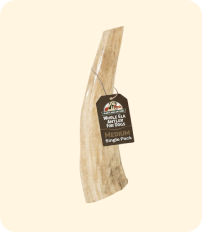
Whole Elk Antler Chew - Large (45-65 lbs)
Recommended for Most Dogs (45-65 lbs)
Whole Elk Antler Chew - Large (45-65 lbs)
Grade A whole elk antlers are the highest quality cut for safe, long-lasting chewing.
Shop Whole Elk Antler Chew

Grade A elk antler runs 15-25% heavier per linear inch than Grade B from the same species and shed, and that weight difference is structural density, not luck. For a power chewer, that margin is what separates a chew that holds 3-8 weeks from one that develops sharp edges in under two.

Walk into any pet store or scroll through any online shop and you will see the same words on every bag of antler chews: premium, natural, high-quality. Every brand uses them. None of them define what those words mean.

Grade A antler is not a label. It is a sorting standard built on four measurable factors: cortex integrity, density, marrow quality, and moisture content. Every piece we ship clears all four. Grade A pieces weigh 15-25% more per linear inch than Grade B material of the same species and cut, because the structural density is genuinely different. That is the whole system.

This guide covers what each factor means, why Grade B fails under pressure, how to spot the difference at home, and which dogs the grade matters for most. After reading it, you will know exactly what to look for before any antler goes to your dog.

How We Apply the Grade A Standard at Heartland

We hand-sort every piece before it ships. The four-criteria check takes under two minutes per piece and is a pass-fail gate, not a scoring range. A piece that fails any one criterion does not move forward. Grade A pieces weigh 15-25% more per linear inch than Grade B material from the same elk shed. That weight difference is measurable by hand. It is the clearest single indicator of whether a piece will hold up for a power chewer or fracture under load. In sorting Grade A material across thousands of pieces, we've found density and cortex integrity travel together, a piece that passes the weight-per-inch check almost always passes the surface inspection too.

Why Most Antler Has No Real Grade

The antler chew market runs almost entirely on unverified claims. Most brands buy from a supplier, apply their own label, and call the contents premium. A few use A/B/C designations, but the criteria behind those letters vary from one supplier to the next and are rarely disclosed to the buyer.

The result is inconsistency at scale. One bag is excellent. The next is dry, chalky, and brittle. The customer does not know why. They assume antler is antler.

For a moderate chewer, that inconsistency is a disappointment. The dog loses interest in a dry, odorless piece and walks away. For a power chewer, it is a different problem. Power chewers apply sustained, directed pressure until they find a weak point. In ungraded antler, that weak point is often a cortex micro-fracture: a small imperfection in the outer shell that was never caught before the piece shipped.

Cortex failure is how antler splinters. Not because antler is inherently dangerous. Because that specific piece was not sorted for structural integrity before it was sold.

This is the problem Grade A exists to solve.

On "Grade A+" and Other Marketing Escalations

Some brands have begun using "Grade A+" or "Grade A Plus" to differentiate their product. The implication is that there is a structural standard above Grade A.

Grade A is a structural classification with specific criteria. If the cortex is intact, density is confirmed, marrow is active, and moisture is balanced, the piece meets Grade A. There is no independent structural basis for a category above this because Grade A already requires all four criteria to pass at a defined level.

"Grade A+" is a marketing label without a published structural definition. No third-party grading body oversees antler chew classification. No industry standard exists that defines Grade A+ as distinct from Grade A with disclosed criteria. The label does marketing work, not quality assurance work.

What matters is what the sorting process actually checks. Ask any brand: what specifically does your grading process verify? If the answer includes cortex integrity, density per unit, marrow activity, and moisture balance, you are looking at a real grade system regardless of what letters they attach to it. If the answer is "top 5% of sheds" or a superlative with no disclosed criteria, the number is performing on a product page, not in a sorting room.

Our four-factor standard is documented below. You can run the home check yourself when your order arrives and verify it independently.

The Four Factors That Determine Antler Grade

Antler quality is not subjective. It comes down to four structural attributes, each of which can be evaluated by hand before a piece ships. Here is what each one means.

Outer Cortex Integrity Determines Whether the Piece Splinters

The cortex is the hard outer shell of the antler. It is the load-bearing layer that holds the piece together under chew pressure. Grade A cortex is smooth, continuous, and free of cracks, pitting, or surface chalking.

Any compromise in the cortex is a stress concentration point. When a dog applies pressure at that point, the fracture propagates inward. That is how you get a shard. Cortex integrity is the single most important factor in chew safety.

A Grade A piece shows no surface cracking, chalking, or pitting when examined under direct light. A Grade B piece has at least one of these conditions visible before the dog ever touches it.

Density Determines How Long the Piece Lasts

Dense antler absorbs pressure and returns to shape. Low-density antler deflects pressure at weak points. The density of an antler is determined by the health and diet of the animal and the point in the growth cycle at which the antler was shed.

Shed antler collected in early to mid-season tends to be denser than late-season drops. Grade A pieces are heavier for their size. Pick one up and it should feel more solid than you expect.

Marrow Quality Determines Whether the Dog Comes Back to It

The marrow channel runs through the center of the antler. In Grade A pieces, it is intact, fragrant, and actively engaging to the dog. The scent and flavor of the marrow is what keeps a dog working a chew across multiple sessions.

Low-grade marrow is dry and odorless. The dog works the chew for a few minutes, finds nothing, and leaves it. Dry marrow is not a safety problem. It is a value problem. You pay for a chew that does not hold your dog's attention.

Moisture Content Determines Whether the Structure Stays Resilient

Antler needs to hold a specific moisture range. Too dry and the structure becomes brittle, which creates fracture risk. Too wet and it becomes a mold vector.

Grade A antler sits at the balance point. It has enough moisture to remain resilient under pressure and palatable to the dog, without crossing into the range where storage becomes a concern. This balance is a function of how the antler was dried and stored after collection.

What Grade B and Grade C Look Like

Knowing what lower grades look like is useful whether you are buying from us or buying from anyone else. Here is how to spot them.

Grade B shows surface irregularities: pitting, minor cracking, small areas of cortex compromise. The marrow is less fragrant. The piece is lighter for its size, indicating lower density. Grade B is still usable for low-intensity, light chewers who apply minimal jaw pressure. It is not appropriate for power chewers or working breeds.

Grade C is a piece that should not be sold as a dog chew. Significant surface compromise. Chalky texture when you run a fingernail across it. Visibly low density on cut ends. Dry, odorless marrow. Grade C antler is fragile under any meaningful pressure. A power chewer will splinter it.

The problem is that Grade B and Grade C antler often looks fine in a product photo. The pitting is subtle. The chalkiness does not photograph. You cannot sort by looking at a listing. You sort by inspection, by weight, and by smell.

Why Grade A Matters More for Power Chewers Than Other Dogs

Not every dog tests antler the same way. Chewing style varies significantly by breed and individual temperament, and that variance changes the stakes.

A soft-jawed moderate chewer, a Labrador working a piece at medium pressure over long sessions, will get less value from a Grade B piece. It will bore them sooner. The dry marrow provides no ongoing reward. It is a disappointment but not a hazard.

A power chewer is a different calculation. Pit Bulls, American Bullies, Cane Corsos, Belgian Malinois, working Rottweilers: these dogs apply high, directed jaw pressure and they find the weakest point in a piece faster than you would expect. They are not gentle about it. For these dogs, any cortex compromise is a structural failure waiting to happen under load.

German Shepherds and other high-drive working breeds approach chewing methodically, often returning to the same pressure point repeatedly. Low-density antler will fail under that kind of sustained, focused pressure. See the German Shepherd antler guide for breed-specific fit recommendations.

For dogs that chew with the most intensity, the grade of the antler is not a nice-to-have. It is the specification that makes the chew safe. Read the antlers for aggressive chewers guide for the full breakdown.

How We Sort at Heartland Antlers

Every piece in a Heartland Antlers box has been through a hand inspection. Here is what actually happens.

Each piece is turned by hand and the cortex surface is checked for continuity. We are looking for cracks, surface pitting, and chalking. Anything that shows cortex compromise is pulled.

The cut ends are examined for density. A dense cross-section looks tightly packed, with fine internal structure and minimal visible porosity. A low-density cross-section looks open, loose, or chalky at the center. Pieces that fail the visual density check are also evaluated by weight relative to size. Anything that feels too light for its dimensions comes out.

Marrow is checked for scent. Grade A marrow is detectable, natural, and distinct. Odorless pieces indicate dry, low-grade marrow. They do not ship.

The result is that every piece in every box clears all four criteria: cortex intact, density confirmed, marrow active, moisture in range. No bleaching. No flavor coating. Grade A elk. Hand-sorted.

What to Look For When You Buy Anywhere

If you are evaluating antler chews from any source, here is a short checklist you can run before buying or before giving a piece to your dog.

Cortex description. Does the brand describe cortex integrity as a sorting criterion? If the listing says "natural antler" with no structural language, there is no grading system in use.

Weight claims. Grade A antler is consistently heavier for its size than lower grades. Some brands that sort well will note this. Most do not.

Marrow disclosure. Does the listing mention marrow scent or marrow quality as a factor? If the brand has sorted for marrow, they will say so. If there is no mention, the marrow is likely incidental.

Bleaching or coating. Bleached antler has been chemically treated, which compromises surface density and creates micro-cracks. Flavor-coated antler is masking the quality of the piece underneath. Neither should be in a Grade A chew.

Return policy language. A brand confident in its grading will stand behind it. Brands that sell ungraded antler often hedge heavily in their return policies or don't publish one.

A brand confident enough to teach you how to evaluate antler anywhere is a brand that knows its antler holds up to that evaluation.

Grade A Test for Antler: What to Check Before Giving It to Your Dog

When your antler arrives, run this four-point check before it goes to your dog.

1. Surface feel. Run a finger along the outer cortex. It should be smooth and continuous. No grit, no pitting, no rough patches. If you can feel surface irregularities, the cortex has been compromised somewhere in the piece.

2. Weight check. Pick it up. Grade A antler should feel heavier than it looks for its size. Dense antler has mass. If a piece feels surprisingly light, the interior density is low.

3. Smell the ends. Grade A marrow has a distinct, natural scent. Hold a cut end close and you will smell it. No scent at all means the marrow is dry, low-grade, or old stock.

4. Inspect the cross-section. The cut ends of the antler should show dense, tightly packed internal structure. Compact, fine-grained appearance. If the cross-section looks chalky, open, or loosely packed, the piece is low density. For a power chewer, do not use it.

Four checks. Under two minutes. You will know immediately whether the piece you received is what you paid for.

Grade A vs. Grade B: What the Difference Looks Like

Attribute Grade A Grade B Grade C
Cortex surface Smooth, continuous, no cracks or pitting Minor pitting or surface irregularities present Visible cracking, chalking, significant surface compromise
Density 15-25% heavier per linear inch than Grade B Baseline; lower structural mass Low; visibly open cross-section
Marrow Fragrant, active, engaging to dog Less fragrant; reduced reward signal Dry, odorless; no engagement reward
Moisture Balanced; resilient under jaw pressure May be drier; brittleness risk under sustained load Often over-dry; fracture risk at moderate pressure
Appropriate for All chew profiles, including power chewers Light-pressure dogs only Not appropriate for dog chews
Typical duration (adult GSD) 3-8 weeks daily sessions Under 2 weeks Fails in first or second session

Find the Right Fit

Grade A matters most when you match it to the right dog. The antler has to be the right size, the right cut, and the right density for your dog's jaw and chew drive.

For sizing by weight, breed, and jaw type, read the What Size Antler for Your Dog guide. For more on what makes antler safe versus risky, read the are antlers safe for dogs guide. For a species comparison by jaw type, read Elk vs. Deer Antler for Dogs.

For breed-specific Grade A fit configurations, see the guides for Pit Bulls, Rottweilers, Belgian Malinois, and Cane Corsos. To understand how Grade A performs against other chew categories, read Antler vs. Nylabone and Antler vs. Rawhide.

Browse the full collection and find the right fit for your dog at Heartland Antlers. One ingredient. One chew. It lasts.

Frequently Asked Questions

What does Grade A antler mean?

Grade A antler meets four structural standards: the outer cortex is intact and free of cracks or pitting, the interior density is high (15-25% heavier per linear inch than Grade B), the marrow channel is fragrant and engaging, and the moisture content is balanced for safety and palatability. At Heartland Antlers, every piece is hand-inspected against all four criteria before it ships.

How do I know if my dog's antler is Grade A?

Run the four-point home test: check the surface for smoothness, pick it up and assess the weight relative to its size, smell the cut ends for marrow scent, and examine the cross-section for dense, tightly packed structure. If any of those checks fail, the piece is below Grade A.

Is Grade A antler safer for dogs?

Yes, in one specific way. Cortex integrity is the primary safety factor in antler chews. A Grade A piece has a continuous, crack-free outer shell that holds together under chew pressure. Lower-grade pieces with cortex compromise have structural weak points that can fracture under load and produce shards. Grade A is not a guarantee against every possible chewing incident, but it removes the most preventable risk factor.

What is the difference between Grade A and Grade B antler?

Grade B antler has surface irregularities: minor cortex pitting or cracking, less fragrant marrow, and lower density. It is usable for light chewers who do not apply high jaw pressure. For power chewers or working breeds, Grade B is a safety concern because the structural weak points that define it are exactly what high-pressure chewing will find and exploit. Grade A has none of those compromises.

Do all antler brands use the same grading system?

No. There is no industry-wide grading standard for antler chews. A small number of brands use A/B/C designations, but the criteria behind those letters vary from supplier to supplier and are rarely disclosed. Most brands do not grade at all. They apply general quality language with no structural criteria behind it. When evaluating any brand's grade claims, ask specifically what cortex integrity, density, marrow quality, and moisture content mean in their sorting process.

Frequently Asked Questions

What does Grade A antler mean?

Grade A antler meets four structural standards: the outer cortex is intact and free of cracks or pitting, the interior density is high, the marrow channel is fragrant and engaging, and the moisture content is balanced for safety and palatability. At Heartland Antlers, every piece is hand-inspected against all four criteria before it ships.

How do I know if my dog's antler is Grade A?

Run the four-point home test: check the surface for smoothness, pick it up and assess the weight relative to its size, smell the cut ends for marrow scent, and examine the cross-section for dense, tightly packed structure. If any of those checks fail, the piece is below Grade A.

Is Grade A antler safer for dogs?

Yes, in one specific way. Cortex integrity is the primary safety factor in antler chews. A Grade A piece has a continuous, crack-free outer shell that holds together under chew pressure. Lower-grade pieces with cortex compromise have structural weak points that can fracture under load and produce shards. Grade A is not a guarantee against every possible chewing incident, but it removes the most preventable risk factor.

What is the difference between Grade A and Grade B antler?

Grade B antler has surface irregularities: minor cortex pitting or cracking, less fragrant marrow, and lower density. It is usable for light chewers who do not apply high jaw pressure. For power chewers or working breeds, Grade B is a safety concern because the structural weak points that define it are exactly what high-pressure chewing will find and exploit. Grade A has none of those compromises.

Do all antler brands use the same grading system?

No. There is no industry-wide grading standard for antler chews. A small number of brands use A/B/C designations, but the criteria behind those letters vary from supplier to supplier and are rarely disclosed. Most brands do not grade at all. When evaluating any brand's grade claims, ask specifically what cortex integrity, density, marrow quality, and moisture content mean in their sorting process.

Back to blog