
Quick answer: Antler and rawhide have different structures and different product checks. Antler is hard bone material. Rawhide comes from animal hide and may soften and change shape during use. Neither category is safe for every dog, and antler is not a proven safer substitute for a dog that swallows rawhide. Compare the specific product, your dog's mouth and chewing behavior, and the care instructions.
Heartland sells antlers. That should not turn this comparison into a blanket claim that all rawhide is chemically unsafe or that antler only wears to harmless powder. We do not have comparative product testing that supports either claim. Ingredient transparency matters, but so do hardness, loose pieces, manufacturing controls and how the dog uses the chew.
Compare antler and rawhide materials
Antler is mineralized bone. Whole antlers retain a hard outer surface; split elk antlers expose inner material without removing all hardness. An antler can crack, form a sharp edge or become a swallowing hazard as it wears. “Grade A” is a seller's quality description, not a clinical safety certification.
Rawhide is made from animal hide. It is sold in many forms, such as rolls, sheets and shaped chews. Recipes, processing, thickness and additives differ. A pale color does not prove a particular bleaching process, and a brown color does not prove the absence of processing. Ask the maker about the actual product rather than inferring its history from appearance.
| Check | Antler | Rawhide |
|---|---|---|
| Material | Bone material, with a hard surface. | Animal hide; texture and processing vary. |
| Change during use | Can wear, crack or develop loose pieces. | Can soften, unravel or release pieces. |
| Main questions | Hardness, fit, cracks, edges and remaining size. | Exact product, fit, softening, loose pieces and swallowing behavior. |
| Label claim limits | Natural, single ingredient or Grade A does not establish safety. | Natural, digestible or dental wording does not establish suitability for every dog. |
A naturally shed antler and a hide-based product also have different supply chains. If this matters to you, ask for documented collection or source information. Avoid assuming that a short ingredient list proves a fully traced supply chain or a smaller environmental impact.

Understand the different risks
Cornell advises avoiding antlers because of tooth and fragment risks, while noting that some rawhides may be suitable with supervision. This does not make every rawhide product appropriate. It does mean that a fair comparison cannot rank all antlers above all rawhide on safety.
With either category, a piece that fits into the mouth and can be swallowed is a concern. Rawhide that softens or separates needs close observation. Do not offer small strips as a universal way to reduce risk. Antler's hardness is a separate issue: it can damage teeth even when the piece is too large to swallow.
A dog that crushes, snaps or gulps objects does not automatically need the hardest chew on the shelf. Stop and review the plan with your veterinarian. Dogs with dental pain or recent dental work need an individual recommendation; softened rawhide is not a home treatment for sore teeth.
For a dental goal, check the current Veterinary Oral Health Council accepted-product list and the exact listed claim and directions. Some specific rawhide products are listed. Acceptance belongs to that product and claim, not to all rawhide or all chews. Chewing does not replace an appropriate tooth-brushing and veterinary dental care plan.

Use a product-specific label check
Keep the packaging and ask clear questions before purchase:
- Material: What animal source and ingredients are declared? Is there a coating or flavoring?
- Processing: What does the maker say it does, and can it explain a claim without vague terms such as “chemical free”?
- Traceability: Is there a business contact and a lot or batch identifier?
- Use: What size, supervision, storage and retirement instructions apply?
- Diet: If the product is eaten, what feeding or calorie information is available?
An unfamiliar ingredient name is not evidence that a substance is dangerous. Conversely, a one-line ingredient list does not establish that a product cannot carry germs or damage teeth. For allergies or a prescribed diet, ask the veterinarian before adding any chew; do not assume an antler is a universal allergy-safe alternative.
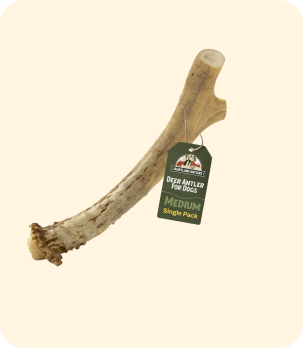
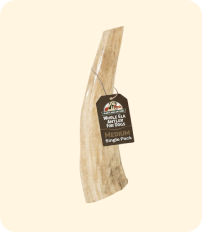
For Heartland antlers, ask about the species, cut, dimensions and current condition. Our range includes whole deer, whole elk and split elk. The Grade A guide can explain product grading, but grading should not be read as a dental guarantee. The size guide is a fit aid, not proof of safety.

Make a supervision and retirement plan
Stay close enough to see the chew and the dog's mouth. Follow the applicable manufacturer directions. Inspect before, during and after use. Remove an item if it releases pieces, develops sharp edges, changes to an unsafe shape, becomes small enough to swallow or prompts forceful biting. Do not leave an antler or rawhide as an unattended substitute for supervision.
Use a calm, practiced trade when removing an item; do not create a struggle over it. If a dog guards chews, seek qualified behavior guidance and manage access separately from other dogs. A storage container out of reach helps prevent a used chew becoming an unplanned session.
If you suspect a swallowed piece, contact your veterinarian for advice. Breathing difficulty or choking needs urgent care. Repeated vomiting, appetite loss, marked lethargy or abdominal discomfort also need prompt veterinary assessment. A product label cannot tell you whether a swallowed object will pass.
For cost, record your actual purchase and suitable use. We cannot promise that a particular antler replaces a certain number of rawhide bags or lasts a set number of weeks. Retire an unsuitable item even when much of it remains. Flexible food toys, scent work and training may suit the dog's routine better than either material.

Frequently asked questions
Are antlers safer than rawhide?
There is no blanket answer that favors antler. Hard antlers can damage teeth and produce pieces. Rawhide products differ, and softening or swallowed pieces can create problems. Ask about the specific dog and product.
Is every rawhide chemically bleached?
Do not assume a process from the category or color. Ask the manufacturer. We cannot substantiate a claim about every rawhide seller.
Does antler only wear to harmless powder?
No. An antler can crack, form a sharp edge or release a piece. A visible defect is a reason to stop access.
Is rawhide suitable after dental work?
Follow the treating veterinarian's recovery instructions. Do not substitute a chew based on an assumption that it will soften enough.
What should a dog that gulps chews use instead?
Review the behavior and suitable enrichment with your veterinarian. Moving to a harder material does not solve every swallowing or tooth risk.
For related material comparisons, read antler versus raw bone and antler versus bully stick. For Heartland product details, contact us or see the current catalog.