Best Chew for Aggressive Chewers: Why Grade A Elk Antler Is the Terminal Solution

Quick Answer

The best chew for an aggressive chewer is a correctly sized Grade A whole elk antler. It is dense cortical bone with no seams, glue lines, or manufacturing failure points for a high-pressure jaw to exploit. Sized correctly and used with supervision, it lasts a power chewer 3 to 6 weeks of daily sessions — versus minutes to days for bully sticks, rawhide, or rubber, and with none of the swallowed-chunk risk of nylon. The one honest caveat: any hard chew can fracture a tooth if it is the wrong hardness for that specific dog. We cover exactly how sizing, grade, and supervision manage that risk below.

If you own a dog that treats a "tough" chew like a demolition assignment, you already know the pattern. You buy something marketed as indestructible. It survives one evening. By the weekend it is a pile of fragments on the rug, and you are back to shopping. This article is the end of that loop.

We are going to define what "aggressive chewer" actually means as a mechanical problem, put the real contenders side by side — Grade A elk antler, nylon, horns, and Himalayan cheese — and be honest about the one thing most antler sellers won't tell you: the tooth-fracture question. Then we will size it correctly so it works. This is written by Don Johnson, who has spent years matching antler to jaw for a veteran-owned business that grades every piece before it ships.

What "Aggressive Chewer" Actually Means

"Aggressive chewer" is not a personality trait. It is a mechanical specification. It describes a dog that applies sustained, high-pressure bite force in a grinding pattern rather than gentle gnawing — and keeps at it long enough to find any weakness in the material.

That distinction matters because most chews don't fail from a single big bite. They fail from repetition. A power chewer runs what an engineer would call a fatigue test: hundreds of load cycles on the same spot until the material tires and gives. Whatever the weakest point of the chew is — a seam, a marrow core, a glue line, a molded edge — a serious chewer will locate it and exploit it.

So the question isn't "what's the hardest chew?" The question is "what chew has no exploitable failure point and won't shatter the dog's teeth?" Those two requirements pull in opposite directions, and that tension is the entire game.

"Indestructible" Is the Wrong Specification

Here is the trap. If you chase pure hardness, you will land on nylon or a cow hoof — and a chew that is genuinely harder than a dog's tooth doesn't get destroyed; it destroys the tooth instead. We put the two side by side in antler vs. cow hooves if that is the pair you are weighing. Veterinary dentists have a name for the result: a slab fracture, where the side of a molar shears off under pressure and exposes the pulp (Missoula Veterinary Dentistry).

The correct target is not "indestructible." It is maximum durability that still abrades gradually instead of shattering, at a hardness the individual dog's teeth can tolerate. A chew should wear down slowly under work — giving your dog the satisfying, jaw-tiring resistance they crave — without behaving like an anvil. That is a narrow window. Grade A elk antler sits inside it better than any other option we've tested against a real power chewer. But it is a window, not a guarantee, which is why grade, size, and supervision are non-negotiable rather than marketing garnish.

The Contenders, Side by Side

Below is the honest comparison for a genuine aggressive chewer. "Durability" is how long it survives; "primary risk" is the failure mode that actually sends dogs to the vet. We've included the honest downsides of our own product — a chew is a tool, and a tool with no stated limits is a sales pitch, not information.

Chew Type Durability (Aggressive Chewer) Primary Risk Verdict
Grade A Whole Elk Antler 3–6 weeks, daily Tooth fracture if oversized-hard for a small dog; managed by grade + correct sizing + supervision Winner. No seams to exploit; abrades gradually; longest safe lifespan
Nylon Chew Days to weeks Non-digestible chunks → GI obstruction; very hard on enamel Avoid. Sheared shards don't break down in the gut
Cow / Buffalo Horns 1–3 weeks Hollow core cracks into sharp splinters; can trap the lower jaw Risky. Sharp longitudinal split is the common failure
Himalayan Cheese (Yak) Chew Hours to a few days Hard end-piece is a choking/swallow hazard once worn down A treat, not a durability chew. Consumed too fast for power jaws

The pattern is clear. Nylon and horns can match antler on lifespan, but they fail dangerously — non-digestible shards and sharp splinters. Himalayan chews fail fast — a power chewer treats one as an appetizer. Grade A elk antler is the only option that combines a multi-week lifespan with a gradual, abrasive wear pattern instead of a shatter. For the deeper nylon breakdown, see our head-to-head on antler vs. Nylabone.

Why Grade A Elk Antler Wins

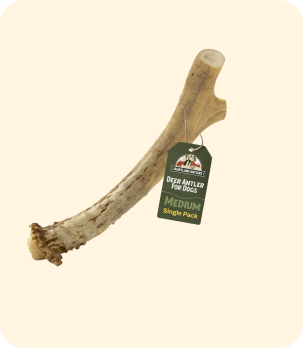
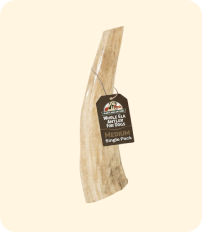
Elk antler is dense cortical bone. Grade A means the outer cortex is fully intact — no cracks, no chalky spots, no fracture points introduced by weathering or careless processing. That intact cortex is the whole story for a power chewer, because it means there is no pre-existing weak point for the jaw to find.

Species matters too. Grade A elk antler carries roughly 30–40% greater cortical density than comparable deer antler, which is why elk outlasts deer at every equivalent grade. And whole (unsplit) elk keeps the marrow core sealed inside the cortex, so there is no soft center for your dog to dig into and blow apart. If you want the full grading breakdown, we wrote a dedicated guide on what Grade A antler actually means.

This is why grade is not optional for this dog type. Grade B antler carries micro-fractures a high-pressure jaw will locate and split. Give a serious chewer a Grade B piece and you have handed them a chew with a built-in failure line. For the mechanics of how long a properly graded piece lasts, see how long antler chews last.

The Honest Part: The Tooth-Fracture Question

Any article about hard chews that skips this is selling you something. So here it is straight.

In one survey of over 1,000 veterinarians, the large majority did not recommend antler chews, and the reason is consistent: dental fracture risk. The American Kennel Club lists antlers, bones, and hooves among the chews most associated with cracked teeth and warns owners to avoid anything too hard to make a dent in with a fingernail (AKC, "Damaging Chews"). The often-cited home version is the kneecap test: rap the chew against your own kneecap, and if it hurts, it may be too hard for your dog's enamel.

We are not going to wave that away. It is real, and a fractured tooth requiring extraction or a root canal can run $800–$2,000+. What we will do is tell you where that risk actually comes from, because it is not random.

The fracture risk stems from specific, controllable conditions: the wrong hardness for that particular dog, the wrong size, and no supervision. Change those variables and you change the risk profile substantially. That is exactly why many vets who decline to recommend antlers broadly still make an exception for appropriately sized elk antler in the right dog, supervised. Practically, that means:

  • Match hardness to the dog. A dog that has already chipped a tooth, a senior, or an aggressive-but-reckless chewer is a candidate for a softer chew, not a harder one. Antler is for a strong, methodical grinder — not every big dog.
  • Never let them lever it against a back molar. Correct size (below) keeps the chew in the front of the mouth where the work is safer.
  • Supervise, and retire the nub. When a piece wears down small enough to swallow whole, it comes away. The AKC and AVMA both stress supervision and correct sizing for any chew.

We cover the full safety framework — including which dogs should skip antler entirely — in Are antler chews safe for dogs? Read it. It is the honest companion to this page, and it will tell you if your dog is the exception.

Which Breeds Are Aggressive Chewers

Chewing intensity clusters by jaw structure, not by size alone. These are the profiles that consistently need Grade A whole elk:

  • Crusher jaws: Pit Bull, American Bully, Cane Corso, Rottweiler — maximum sustained compression.
  • High-drive working jaws: Belgian Malinois, German Shepherd, Akita — relentless, focused sessions.
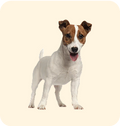
  • Prey-drive terriers: Jack Russell and working terriers — small mouths, disproportionate intensity.
  • Other consistent producers: Rhodesian Ridgeback, Doberman, Alaskan Malamute.

Note the terriers on that list. Chewing drive does not scale with weight, which is the exact trap that leads to undersizing — the single most common mistake owners of these dogs make.

How to Size for an Aggressive Chewer

The failure mode for aggressive chewers is always undersizing, never oversizing. An oversized antler is slightly harder for your dog to work comfortably — but it does not fracture, and it stays too big to swallow. An undersized antler gets treated like a compression test until it either breaks or becomes a swallow hazard. When in doubt, go up.

Dog Weight Chew Length Aggressive-Chewer Adjustment
Small (5–25 lbs) 4–5" Whole, not split
Medium (25–45 lbs) 5–6" Size up one step
Large (45–65 lbs) 6–8" Go to the top of the range
XL (65–85 lbs) 8–10" XL whole elk
Giant (85+ lbs) 9"+ Giant whole elk only

Quick rules by jaw type:

  • Crusher breeds: size up from the chart. If it says Large, buy XL.
  • Scissor-jaw grinders: Large-to-XL whole elk for sustained work.
  • Terriers & small high-drive dogs: whole, never split — a split piece exposes the marrow core they'll target.
  • Puppies under 10 months: split elk, supervised only; adult teeth aren't set.

For the complete method, use our antler sizing guide before you buy — it is the difference between a 6-week chew and a Tuesday-night failure.

Find the Right Fit

Match the chew to the jaw and you solve this permanently:

Frequently Asked Questions

Are antlers too hard — will they break my dog's teeth?

They can, if the hardness is wrong for that specific dog. That's the honest answer, and it's why the AKC flags very hard chews. The risk is controllable: choose Grade A (no fracture-prone weak spots), size up so the chew stays in the front of the mouth, supervise, and skip antler entirely for dogs with prior dental damage or reckless chewing styles. A strong, methodical grinder on a correctly sized whole elk antler is a very different risk profile than a reckless dog gnawing a too-small hard chew on a back molar.

How long does a Grade A elk antler last?

A correctly sized Grade A whole elk antler typically lasts an aggressive chewer 3 to 6 weeks with regular daily sessions — because it abrades gradually rather than breaking apart. See our full lifespan breakdown.

Can an aggressive chewer actually break a Grade A antler?

A power chewer can break lower-grade or undersized antler — that's a grade-and-size failure, not an antler failure. A correctly sized Grade A whole elk piece is chosen specifically to withstand sustained aggressive chewing without fracturing. Retire any piece once it wears small enough to swallow.

What is the strongest antler for a dog?

Grade A whole elk antler. It's the densest, most structurally sound option, and elk outperforms deer at every comparable grade because of species density — roughly 30–40% more cortical density than deer.

Heartland Antlers is a veteran-owned business. Free shipping on U.S. orders over $50. This article is educational and not a substitute for veterinary advice — supervise every chew session and consult your vet about your dog's dental history before choosing a hard chew.

Ready to shop?

Back to blog