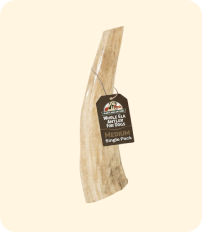

Quick answer: There is no proven antler specification for every German Shepherd. Body weight, working status and a Grade A label cannot establish dental safety. If your dog works the same surface repeatedly, inspect that area closely and stop for damage or forceful biting. Whole deer, whole elk and split elk all retain hard material, so a different size or cut does not remove that concern.
Heartland can explain its product cuts and dimensions. We cannot promise that a large whole elk antler will last a German Shepherd three to eight weeks, that a lower grade will fail within two weeks, or that quality selection removes all microscopic weak points. A useful plan starts with the individual dog's mouth and behavior.
Watch the dog instead of assuming a breed pattern
Some German Shepherds work an object slowly; others bite forcefully, tear pieces away or lose interest. Behavior can also change with excitement, competition or a different product. “Patient grinder” is a description of something you observe, not a rule that applies to every member of the breed.
If your dog returns to one contact area, inspect that surface, both ends and the whole piece. Gradual wear can be easy to miss when the item is put away between sessions. A before-and-after condition note may help you notice a change, but a photo record is not a test that proves the object is safe.
Stop when there is a crack, loose material, sharp edge or a change to crushing bites. Do not assume damage means only that you bought the wrong grade. It may mean the activity or material is unsuitable. Replacing it with a denser or larger hard object should not be the automatic next step.
Record what your dog did, the product and cut, the location of damage, and whether a piece might have been swallowed. These observations can inform a discussion with the veterinarian. Do not continue a session to confirm a pattern or reach a target duration.

Keep size, grade and dental suitability separate
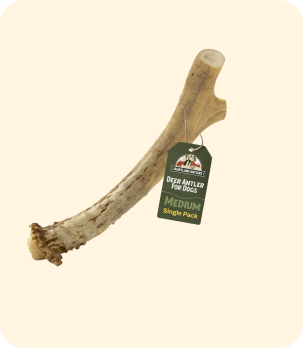
Size is about the actual mouth and item: length, thickness, shape and how far it can enter the mouth. A weight range can help describe a product, but does not replace an individual fit check. Being a working dog or exceeding a certain weight does not create a proven requirement for XL whole elk.
UC Davis cautions that very hard chewing objects can cause tooth fractures. An intact antler can still be too hard for teeth. Supervision helps you intervene but does not remove the physical risk. Grade A is a seller's selection description, not a veterinary guarantee.
| Product fact | Useful meaning | Limit |
|---|---|---|
| Whole deer or whole elk | Retains an outer antler surface. | Both are hard materials; neither is universally suitable by breed. |
| Split elk | Exposes the interior along a cut face. | Hard material remains; not a universal puppy or senior option. |
| Size label | Helps compare catalog choices. | Does not certify mouth fit or tooth strength. |
| Grade A | Describes the seller's quality selection. | Does not guarantee absence of all defects or prevent tooth damage. |
We have no basis here for fixed elk-versus-deer density percentages or grade weight-per-inch percentages. Natural pieces vary. Heartland does not sell split deer antlers, so that product should not appear as a puppy recommendation.

Give an active Shepherd a varied routine
The American Kennel Club describes German Shepherds as active dogs that need physical and mental activity. A chew can only be one possible part of that routine. It cannot replace exercise, learning, interaction or rest, and a hard antler is not required to give a dog a task.
Choose activities that match health and training: a walk with time to investigate scents, short reward-based skills, a suitable food puzzle and quiet recovery. A working or sport dog may need a plan with its veterinarian and trainer. Do not use persistent chewing as a substitute for rest or as a way to exhaust the jaw.
Introduce any new toy where you can observe it. A food puzzle is useful only if the dog uses it as intended rather than breaking off parts. Count food used in training and puzzles within the daily food plan. For a prescribed diet, use only the permitted ingredients and items.
If a dog sniffs a chew and leaves it, respect that choice. It does not prove the interior reward is too difficult to reach. A new loss of interest combined with mouth discomfort or changed eating needs veterinary assessment. Do not treat split antler as a remedy for a painful mouth.

Use condition-based checks and clear stopping rules
If an antler remains in your dog's individual plan, stay close enough to see the mouth and item throughout use. Inspect before, during and after each session. Stop for cracks, sharp edges, loose pieces, unsafe remaining size, forceful biting or signs of discomfort. No fixed twenty-minute session or weekly schedule can replace those checks.
Store the item out of reach between sessions. In a multi-dog household, prevent another dog taking an item selected for someone else. Practice a calm trade, and seek qualified behavior help if guarding develops. Pulling an object away by force can change the situation and make future removal harder.
If you see tooth damage or a change in eating, arrange veterinary assessment. If you suspect a swallowed piece, contact the veterinarian with the product details. Breathing trouble, collapse or suspected choking needs urgent care. Do not assume that antler fragments are harmless because the material is natural.
For value, note the purchase cost and actual suitable use. Early retirement is still the correct end of use when the item changes. There is no reliable breed-specific lifespan or saving against a fixed number of bully sticks. Do not keep a damaged object to meet a promised number of weeks.

Frequently asked questions
What size antler should a German Shepherd use?
No breed-only size establishes safety. Discuss dental suitability, then compare the actual dimensions and behavior rather than selecting by weight alone.
Is elk always the right material for an adult Shepherd?
No universal rule is supported. Whole and split antlers remain hard, and the individual dog and piece matter.
Does Grade A remove all weak points?
No. It is not a guarantee against cracks, fragments or tooth damage.
Should a working Shepherd get a larger antler?
Working status is not a clinical sizing rule. Review the mouth, behavior and enrichment plan with the professionals who know the dog.
Can puppies or senior dogs use split antler?
Do not assume it is gentle enough. Developing, worn or treated teeth need individual veterinary guidance.
Read the antler safety guide, Grade A guide and size guide. For Heartland product facts, contact us or view the current catalog. Related breed guides cover the Rottweiler and Belgian Malinois.