
A Belgian Malinois can put substantial effort into an activity. That is a reason to observe material choice and behavior carefully, not a reason to buy the hardest chew. A working dog's teeth can still be injured by a hard object.
The AKC describes the Malinois as an active working partner. Build the daily plan around suitable movement, learning, interaction and rest. An antler is not a replacement for that plan.
Plan for the dog's response, not a drive label
“High drive” is too broad to choose an antler size or predict how a dog will use it. Watch this dog's behavior in this setting. Does it bite forcefully, repeatedly focus on one area, try to swallow pieces or become difficult to interrupt?
Record those observations alongside the activity that came before. A dog may use an item differently after an exciting event than during a quiet period. That record is more useful than assuming every Malinois has the same chewing pattern.
Do not hand over a hard object as a way to exhaust a dog after training. Choose a suitable transition to rest and ask a qualified professional for help if the dog cannot settle. Increasing hardness is not a behavior treatment.
Keep the household plan consistent. Define which objects are available, when people supervise and how activities end. For separation-related distress, use a specific care plan rather than unattended chewing.

Protect the teeth used for daily work
AAHA warns that antlers can fracture teeth. Body size, training history and a strong bite do not prove that teeth can tolerate the material.
Include dental history in the choice. Tell the veterinarian about previous fractures, wear, treatment and changes in eating or handling toys. Do not wait for complete refusal of food before reporting a concern.
Cornell's fractured-tooth guidance explains why visible damage needs assessment. Stop the hard item if a tooth problem is suspected. A split cut is not treatment for worn teeth and should not replace restrictions after dental work.
Ask which materials and activities fit the dog's current mouth. Follow the exact directions for any replacement toy, and remove one the dog tears into swallowable parts. Durability and dental suitability are separate questions.

Do not use density or size as a guarantee
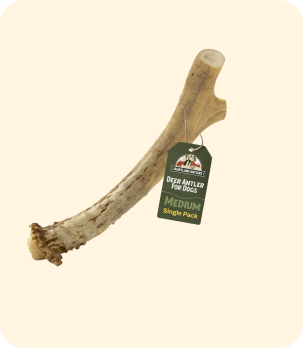
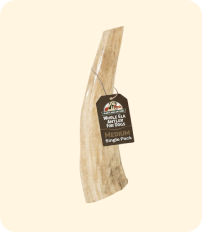
The antler forms in Heartland's range are whole deer, whole elk and split elk. A split exposes the interior; hard material remains. The catalog describes products, not a clinically tested Malinois configuration.
This guide does not have validated evidence for a fixed elk-versus-deer density percentage, a Grade A lifespan multiplier or a three-to-eight-week working-dog lifespan. We do not use those claims to choose a product.
Use current weight and the exact label as starting information, then review the actual piece and behavior. Do not automatically move up one size after damage. Deep gouges, a crack, loose material or a sharp area can be a reason to stop that material, not simply buy more of it.
For the same reason, a working title or participation in a sport does not create a need for XL whole elk. Consult the current catalog for facts, then discuss suitability with the veterinarian.

Build a clear stop and recovery routine
Stay present for any chew session, inspect the item and keep it out of reach afterward. Remove damaged or swallowable pieces. Do not use a fixed two-inch or molar-width cutoff for every dog, and do not put a piece into the mouth as a test.
Plan how the activity will end before starting it. If the dog stiffens, guards or growls, do not force removal or reach toward the mouth. Keep others away and seek qualified help with a safe collection plan. Our multi-dog guide also covers separation around valued items.
Offer a range of suitable tasks. A brief skill session, controlled search or measured-food puzzle can use attention without requiring antler chewing. Choose difficulty that the dog can handle and leave room for rest. More effort is not always a better outcome.
Contact a veterinarian promptly after a suspected swallowed piece or tooth injury. Give the time, item description and signs you observed. Breathing trouble, collapse or severe distress needs emergency care.

Frequently asked questions
Does a Malinois need the hardest antler?
No. Strong chewing can increase concern about a hard material. It does not establish a need for it.
Is Grade A whole elk guaranteed to hold up?
No grade or cut guarantees a particular lifespan or prevents dental injury. Check the item and the individual response.
Should I size up after a piece cracks?
Stop using the cracked piece. Reassess the material and the dog's behavior; a larger replacement is not an automatic solution.
Can a split antler help after dental work?
Follow the clinic's restrictions. A split antler retains hard material and is not a recovery treatment.
Use our veterinary question list and condition guide. Ask Heartland for exact product details.