My Dog Broke a Tooth on an Antler: What to Do Now (and Why It Happened)

If your dog broke a tooth on an antler, call your vet today. A fractured tooth exposes nerve, hurts, and invites infection, and it will not heal on its own. Book an exam. Treatment is usually a root canal or an extraction. The honest cause is almost always fit, not proof that antlers are evil: an undersized or low-grade antler let a back molar clamp and lever until the tooth sheared off. Correct size and grade removes most of that risk.

That is the short version. Below is the full triage, then the plain mechanics of why it happened, so you can make a better call next time without swearing off chews for good.

What to do right now

Move in order. Do not wait to see if it settles down. A broken tooth is not a bruise. It stays painful and it gets worse.

  1. Take the antler away. Session is over. Do not let your dog keep working the same piece that just cost a tooth.
  2. Look, gently. If your dog will let you lift a lip, check the big upper cheek teeth. You are looking for a flat sheared face, a pink or dark dot in the middle (exposed pulp), or blood. Do not pry the mouth open or poke the tooth. It hurts.
  3. Call your vet and book an exam. Say the words "fractured tooth, possible pulp exposure." That moves you up the schedule. Same-week is the goal, not next month.
  4. Soften the food. Wet the kibble or switch to canned for a few days so eating does not grind the injured side.
  5. Skip the human painkillers. No ibuprofen, no acetaminophen, no aspirin. Several are toxic to dogs. Let the vet dose pain.

According to VCA Animal Hospitals, a "watch and wait" approach to a fractured tooth is never a good idea, because broken teeth are painful and the exposed pulp is an open door for bacteria. Dogs hide dental pain well. Quiet does not mean fine.

How do I know my dog actually cracked a tooth?

Sometimes the break is obvious. Often it is a hairline you will miss. Watch the behavior instead of only the tooth.

  • Chewing on one side, or suddenly refusing the antler he loved yesterday
  • Drooling more than normal, sometimes tinged pink
  • Dropping food, or eating slower and more carefully
  • Pawing at the mouth or rubbing the face on the floor
  • Bad breath that shows up fast, or facial swelling under the eye
  • Flinching when you touch that side of the muzzle

Any two of those together earn a vet visit. The tooth that breaks most often is the fourth upper premolar, the large carnassial tooth near the back. It sits where a dog generates the most force, so a crack there is easy to overlook and slow to show.

What will the vet do about a broken tooth?

The exam usually starts awake, but the real decision needs dental X-rays and a look under anesthesia. A fracture that exposes the pulp has two honest fixes.

  • Root canal. Saves the tooth. The vet removes the damaged pulp, seals it, and your dog keeps the crown. Good for a working tooth like the carnassial.
  • Extraction. Removes the tooth entirely. Simpler in some cases, and the right call when the tooth is too damaged to save.

For fresh breaks in young dogs, vital pulp therapy is sometimes an option. Veterinary dentists generally reserve it for dogs under about 18 months with a very recent fracture, because the pulp still has a chance to wall itself off. That window is short, which is another reason speed matters.

Cost runs into the hundreds of dollars, and a root canal on a large carnassial runs higher. It is not a small bill. It is also not optional, because an untreated fracture can turn into a root abscess. For the longer view on keeping teeth intact, we wrote a separate piece on antler chews and dog dental health.

Why it happened: the slab fracture, in plain terms

Here is the part the fear pages skip and the seller pages dodge. We will just tell you.

The injury has a name: a slab fracture. The side of a back tooth shears off like a flake of slate. It happens on the carnassial because that tooth is a wedge, and a wedge under enough sideways force splits along its face.

Three things stack up to cause it, and none of them is "antlers are poison":

  • Leverage. The break is rarely from chewing the tip. It comes when a dog gets a whole molar around a piece and clamps down with the jaw acting as a lever. Full-molar contact plus bite force is the fracture recipe.
  • Size. An undersized antler is the main way a big dog gets that full-molar grip. Too small, and the piece slides to the back where the force lives. A correctly sized antler keeps your dog gnawing the end, not vise-gripping the middle.
  • Grade. A brittle, dried-out, low-grade antler chips and cracks under load in ways a dense, sound piece does not. Cortex integrity is not a marketing word. It is the difference between a piece that grinds down and one that shatters. That is the whole reason we sort by our Grade A standard.

Fix the leverage and you fix most of the risk. That is a fit problem, and fit is solvable. A German Shepherd or a Cane Corso on a hand-sized whole antler is chewing the tip. The same dog on a too-small piece is one bad angle from a slab fracture. If your dog is a serious grinder, read how to size an antler to your dog before the next one goes down.

The fingernail rule, honestly

You have probably heard the vet test: if you cannot dent a chew with your thumbnail, it is too hard for your dog. It is a good, blunt rule, and we are not going to pretend an antler passes it. A whole antler does not dent under a fingernail. Neither does a bone, a hoof, or a hard nylon chew.

So take the rule for what it is really flagging: hardness that lets a tooth take the full load instead of the chew giving way first. The rule is right that hardness matters. It is just too crude to tell a well-fitted whole antler apart from a jagged, undersized one, because both fail the thumbnail.

Here is the honest version of the rule. Hardness is one factor. Leverage is the other, and it is the one the thumbnail test cannot see. You manage hardness two ways: match the size so your dog gnaws instead of clamps, and choose a split antler for mouths that should not meet a hard face at all. A split piece exposes the softer marrow channel, so the surface gives under the tooth. That is the closest an antler gets to passing the spirit of the fingernail rule.

How to prevent a tooth fracture from an antler chew

You do not have to quit chews to protect the tooth. You have to change three things.

Match the size to the dog

The piece should be long and thick enough that your dog cannot fit a full molar around it. A power chewer works the tip of a big antler. He clamps a small one. When in doubt, size up. This is the single highest-leverage fix.

Split it for at-risk mouths

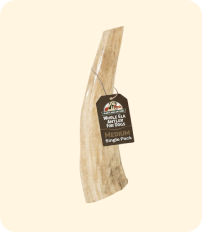
Whole antlers are for experienced adult grinders. Choose split for puppies past about ten months, for seniors with worn enamel, for first-timers, and for dogs with an undershot or misaligned bite. The exposed marrow channel is softer and forgiving. If your dog is older, our guide to antlers for senior dogs walks through why the whole-versus-split call changes with age.

Buy grade, not just price

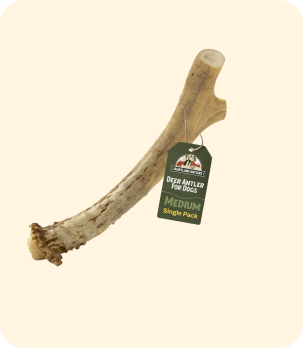
A cheap multipack antler is often dried out and brittle, which is exactly the piece that chips and shears. A dense, sound, Grade A elk antler grinds down instead of cracking apart. One ingredient, sorted for cortex, density, and moisture. That is not a slogan. It is the physical property that keeps the piece intact under a hard bite.

Manage the session and the retirement point

  • Keep early sessions short, in the range of 15 to 30 minutes, and supervise. Most fractures happen during long, unwatched, over-enthusiastic chews.
  • Retire the antler when it wears down to a hard nub small enough to swallow or wedge behind the molars. That short, hard stub is a fracture and a choke risk. Toss it.
  • Never hand a hard chew to a dog with a known dental problem without asking your vet first.

None of that requires a graveyard of failed chews or a lifetime of guessing. Match the dog, buy the grade, watch the session. Antlers are not the villain here, and neither are you. Fit is. For the fuller safety picture, we lay it all out in are antler chews safe for dogs.

Frequently Asked Questions

Should I stop giving my dog antlers after a broken tooth?

Not necessarily, but change what you give. A fracture is almost always a size or grade problem, not proof antlers are unsafe. Move to a correctly sized, Grade A piece, and choose a split antler if your dog is young, senior, or hard on his mouth. If your dog already has dental disease, ask your vet before offering any hard chew.

Can a cracked tooth from an antler heal on its own?

No. Enamel and pulp do not regrow. A fracture that reaches the pulp stays painful and can abscess. The tooth needs a root canal or an extraction. The only thing waiting does is let bacteria get further in.

How much does it cost to fix a dog's broken tooth?

Plan on several hundred dollars for the exam, dental X-rays, and anesthesia, and more for a root canal on a large carnassial tooth. Extraction is often less than a root canal but still not cheap. Your vet can quote after imaging shows how deep the fracture goes.

Is it my fault my dog broke a tooth?

Do not carry that. Most owners were handed an undersized or low-grade antler with no fit guidance, which is a sourcing failure, not a parenting one. Now you know the mechanism: leverage on a back molar. Size up, choose grade, split for at-risk mouths, and the odds change fast.

Are split antlers safer than whole antlers?

For the wrong mouth, yes. A split antler exposes the softer marrow channel, so the surface gives under the tooth instead of forcing the tooth to give. That makes it the safer pick for puppies, seniors, first-timers, and misaligned bites. Experienced adult grinders can handle a correctly sized whole antler.

Ready to fix the fit instead of quitting chews? Start with a correctly sized, Grade A piece and split it if your dog needs a softer face. Shop Grade A elk antlers and find the right fit for your dog.

Back to blog