
Quick answer: Compare an antler with a specific Nylabone product, not the brand name alone. Nylabone sells several chew types and edible products. This guide focuses on its non-edible Power Chew toys. Antler is hard bone material; those toys use manufactured materials that vary by product. Neither natural origin nor a power-chewer label proves that a hard chew is suitable for your dog.
Heartland sells antlers. We do not have controlled tests that show an antler outlasts a Nylabone by a fixed multiple, costs less per month or has a better safety profile. The useful comparison is the material, fit, condition, instructions and your dog's behavior. A dog that breaks one hard object should not automatically receive a harder one.
Identify the exact product
The manufacturer's use guide distinguishes Power Chew, Strong Chew, Flexi Chew and puppy ranges. Its non-edible products are not intended to be eaten. Check the actual product page and package for material, size and directions. Instructions for one range should not be applied to another, or to an edible Nylabone treat.
Power Chew is a line marketed for powerful chewing. It would be inaccurate to say that the line is intended only for light or moderate chewers. The marketing category still does not establish suitability for an individual mouth. A dog can meet a weight range and still bite too forcefully for a hard object.
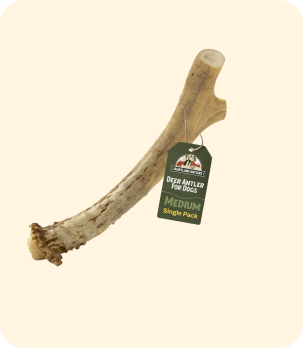
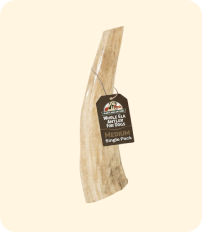
Heartland's antlers are a different material. Whole deer and whole elk retain a hard outer surface. Split elk exposes the inner structure but still has hard material. “Grade A” describes a seller's quality selection; it is not a veterinary certification or a standardized tooth-protection score. Heartland does not offer split deer antlers.
| Question | Antler | Non-edible Power Chew toy |
|---|---|---|
| What are you comparing? | The actual species, cut and dimensions. | The exact model, material and size. |
| Can the dog eat pieces? | Do not offer loose fragments as food. | The maker says the product is not intended to be eaten. |
| What needs inspection? | Cracks, edges, loose pieces and remaining size. | Damage, worn ends and remaining size, using the maker's directions. |
| Does its shape establish the material? | No; verify it is an actual antler. | No; an antler-shaped toy can still be a manufactured toy. |

Separate hardness from durability
Durability describes resistance to wear or damage. It does not mean an object is gentle on teeth. Cornell links very hard objects to fractured teeth and advises against antlers. Consider that guidance before using any hard chew as the solution to rapid toy destruction.
Watch for crushing bites, attempts to snap the object, and swallowing behavior. If those occur, stop and review the plan. Selecting a large piece can reduce some fit concerns but cannot eliminate dental risk. Supervision helps you notice a change; it does not make a tooth unable to break.
Do not use breed, age or a “power” label as a substitute for an individual assessment. A puppy with developing teeth, an older dog with dental wear or a dog recovering from treatment needs a plan from its veterinarian. Split antler is not a universal gentle option for these dogs.
Non-edible does not mean a toy needs to supply nutrition. A suitable enrichment object can have value without being food. Conversely, an antler's mineral composition is not a reason to use it as a supplement. Do not judge safety by whether the material sounds natural or synthetic.

Inspect wear and follow care directions
Nylabone's current guide calls for supervision, frequent inspection and replacement when a chew is damaged, its ends are worn down or it becomes too small. It also directs owners to contact a veterinarian if a large piece is swallowed. Use that product's current package directions for cleaning and handling.
Antler also needs inspection before, during and after use. Stop access for cracks, sharp edges, loose pieces, unsafe remaining size or a change to forceful biting. Do not assume it will only wear into powder. Do not pass a damaged remainder to a smaller dog to extend its use.
Keep chews out of reach between supervised sessions. Use a calm trade to remove an item. In a multi-dog home, manage access so one dog cannot take an item chosen for another. If guarding changes the dog's behavior, get qualified help rather than repeatedly forcing the item away.
A damaged tooth, reluctance to eat or persistent mouth discomfort warrants veterinary assessment. Breathing trouble or suspected choking needs urgent help. If you suspect a swallowed piece, keep the product and packaging details available when you call.

Compare cost and engagement with records
We cannot substantiate fixed claims such as five days of toy use versus eight weeks of antler use. Actual results depend on the item and dog, and use must stop before a calendar target if condition demands it. Current prices also vary by size, seller and promotion.
Record the purchase cost, appropriate supervised sessions, condition changes and reason for retirement. That produces a useful cost-per-session comparison for your own household. Do not count sessions that continued after a piece became unsuitable. A low cost per hour is not a benefit if the activity exposes teeth to an unacceptable risk.
Interest also varies. We cannot promise that dogs prefer antler in a side-by-side test or that a manufactured toy loses all flavor after a set number of days. If a dog is not engaged, consider a suitable food puzzle, a scent game or training rather than adding flavor or forcing longer use.
We have no evidence here to accuse Nylabone products of containing harmful PFAS, undisclosed toxins or accumulating material in a dog's body. Questions about a specific product should go to its maker. A fair material comparison should not use unknowns as proof of harm.

Frequently asked questions
Is antler safer than Nylabone?
No universal claim is supported. Evaluate the specific product and dog. Hard antlers carry dental and fragment risks, and non-edible toys require the maker's use and replacement checks.
Is every Nylabone made of the same material?
No. Identify the range and exact product. This comparison concerns non-edible Power Chew toys, not every toy or edible treat sold by the brand.
Should I switch if my dog breaks a chew?
Stop use and review the behavior and alternatives with your veterinarian. A stronger or harder object is not automatically the right next step.
Can the dog eat an antler fragment?
Do not offer fragments as food. Remove loose pieces and contact your veterinarian if you suspect a substantial piece was swallowed.
What about an antler-shaped toy?
Shape is not material. Read the maker's description and use instructions; do not apply care advice for a natural antler to a manufactured toy.
Read our antler safety guide and size guide. For Heartland material and dimension details, contact us or see the current catalog.