Elk vs. Deer Antler for Dogs: How to Pick the Right One for Your Dog's Jaw

Quick Answer: For dogs over 45 lb with moderate to strong chew drive, elk antler is the correct choice. Elk has approximately 30-40% greater cortical density than deer at equivalent piece size and outlasts deer by 2-4x under sustained grinding pressure. For dogs under 35 lb, puppies, seniors, or first-time antler dogs, deer antler is the better fit, it offers more marrow access and appropriate resistance without demanding full bite force. The cut matters as much as the species: split exposes marrow immediately, whole delivers a longer-lasting session. Heartland Antlers supplies both species in Grade A.

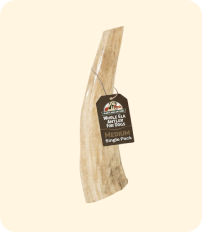
Whole Elk Antler Chew - Large (45-65 lbs)
Recommended for Heavier Chewers
Whole Elk Antler Chew - Large (45-65 lbs)
Whole elk antlers are denser than deer and last longer for sustained chew sessions.
Shop Whole Elk Antler Chew

Every week someone asks: "Should I get elk or deer?" Almost every guide answers it the same way. Elk is harder. Deer is softer. Pick accordingly.

That answer is incomplete. It treats hardness as the whole story when hardness is one variable in a larger fit problem. The real question is not which species is better. It is which species matches your dog's jaw style, chew intensity, and what you need the antler to do over time.

Elk antler has approximately 30-40% greater cortical density than deer antler at equivalent piece size. That density means elk outlasts deer by 2-4x under sustained grinding pressure from working-breed dogs, and also means it is the wrong choice for a puppy, a senior, or a first-time antler dog who has not learned how to work the purchase point yet.

This guide covers when elk is right, when deer is right, and how split vs. whole changes the outcome for both.

What We See When Dogs Get the Wrong Species

After working with hundreds of breed-specific antler customers, the two failure modes we see most are: elk given to a first-timer (the dog ignores it) and deer given to a power chewer (the antler fails faster than expected). Both are species mismatch problems, not antler problems. We've found that getting the species right the first time reduces returns and reorders more than any other single variable.

The Real Difference Between Elk and Deer Antler

Both elk and deer antler are shed naturally and contain no additives. Both provide the same basic categories of value: mental engagement, jaw work, and marrow nutrition. The structural differences are what matter when you are matching antler to dog.

Elk antler has a denser, more compact cortex. The outer bone layer is harder and holds up under sustained, heavy pressure. The marrow channel running through the center is proportionally smaller relative to the total antler size. More of the antler is solid bone.

Deer antler has a lower overall density. The cortex is softer and more accessible. The marrow channel is proportionally larger relative to the antler's size, meaning more of the antler's reward is reachable sooner. A dog working a deer antler finds the marrow with less effort.

The density difference is not trivial. It is the reason a Pit Bull can go through a deer antler in a session and still be hunting for more, while that same dog works an elk antler across multiple sessions. It is also the reason a senior dog with worn teeth might abandon an elk antler entirely while doing fine with deer.

Neither species is universally better. They serve different jaw profiles.

A note on conflicting information in this comparison: Some guides describe deer antler as harder or denser than elk. Both claims have a partial basis, and they are measuring different things.

Deer antler tines have a cortex that is proportionally thick relative to the piece's overall diameter. Because deer are smaller animals, their antler tines are narrower. A higher percentage of each cross-section is solid cortex. If you measure hardness at a specific surface contact point, deer can register harder per unit of area.

Elk antler is larger in every dimension. The cortex is thick in absolute terms, even if it represents a somewhat smaller percentage of the total cross-section in the widest pieces. A large Grade A elk whole has more total cortical mass and structural volume than any deer antler equivalent.

What matters for chewing dogs is total load capacity, not surface hardness at a single point. Elk handles more total jaw force before showing wear because there is more structural material to give. That is why elk outlasts deer by 2-4x under sustained grinding pressure from working-breed dogs. Elk is not necessarily harder at every contact point. It has more structural volume across the life of the chew.

When Elk Is the Right Call

Elk antler is built for dogs that work hard and work consistently.

Power chewers and crusher-jaw breeds are the primary use case. Pit Bulls, American Bullies, Cane Corsos, Rottweilers, and other breeds with strong, sustained bite pressure will defeat deer antler faster than the chew is cost-effective. Elk's denser cortex holds up to that pressure. It gives them something to actually work against.

Working breeds and high-drive dogs are a close second. Belgian Malinois, German Shepherds, and similar dogs do not just chew, they focus on the chew with intensity. They need something that holds up to that sustained attention. An elk antler gives a Malinois multiple meaningful sessions. A deer antler in the same situation often does not.

Dogs that have already defeated deer antler belong on elk. If your dog has gone through deer antlers faster than expected, that is not a failure of antlers as a category. It is a signal about jaw strength. Move to elk whole and size up appropriately.

Episodic chewers who go hard in bursts also benefit from elk. A Husky may ignore the antler for days and then work it for an hour straight. You want something durable enough to survive that pattern and still be meaningful when they return to it.

When Deer Is the Right Call

Deer antler works best where accessibility matters more than durability.

First-time antler dogs are the clearest case. A dog encountering antler for the first time needs to find the reward signal quickly enough to stay engaged. If they cannot locate the marrow, they lose interest and move on. Deer's proportionally larger marrow channel and softer surface make the reward more accessible early. The dog learns the behavior, builds the habit, and can graduate to elk once they have figured out how to work an antler.

Softer-jawed adults, including most toy and small breeds and many medium breeds, do not generate the bite pressure needed to make elk's density work in their favor. They are not going to crack the cortex. They will work the marrow channel and the ends, which is where deer's structure gives them more to access.

Seniors are a consistent deer antler candidate. As dogs age, enamel wears and teeth become more susceptible to fracture under hard impact. A whole elk antler puts significant pressure on worn teeth. Deer split, sized correctly, gives the senior dog the engagement and marrow nutrition without the fracture risk. The antler for senior dogs guide covers the full senior configuration.

Puppies under 10 months should stay on deer split, supervised. Puppy teeth are not built for elk density. The work required to access elk's denser marrow channel can put too much stress on developing dentition. Deer split gives them appropriate engagement at lower pressure.

Dogs with undershot jaws, like Boxers, often struggle with the purchase point on harder antlers. Their jaw geometry makes it difficult to get proper grip on a dense elk surface. Deer split, or elk split, solves this by exposing the marrow directly and giving a wider, softer working surface to engage.

Split vs. Whole: The Other Half of the Decision

Species and cut are two separate variables. Both elk and deer come in split and whole. Choosing the species correctly and then choosing the wrong cut still gets you the wrong outcome.

Whole antler keeps the cortex intact. The dog has to earn marrow access by working the ends and the natural surface over time. Whole is harder to get into, lasts longer, and is better suited to experienced chewers who know how to work an antler and stay engaged with it.

Split antler exposes the marrow channel directly. The reward signal is immediate. The working surface is softer because the cortex has been cut through. Split is the right starting point for first-timers, undershot jaws, puppies, and seniors. It is also useful for dogs who have plenty of chewing ability but need a lower-resistance option for dental health reasons.

Split is not automatically easier in a bad way. It is the appropriate cut for the right context. A power chewer on a split antler will consume it faster than they would whole, which matters for cost-per-session calculations. A first-timer on whole antler may not engage at all.

The practical rule: when in doubt on experience level, start split. Once the dog knows how to work an antler, transition to whole.

Elk vs. Deer Antler Comparison Table

Feature Elk Antler Deer Antler
Ingredient Shed elk antler, one ingredient Shed deer antler, one ingredient
Lasts (power chewer) 4-8 weeks of daily sessions 1-3 weeks (2-4x faster consumption under heavy pressure)
Grade available Grade A (cortex-sorted, density-verified) Grade A (cortex-sorted, density-verified)
Cost per session Under $1/day for working breeds Higher cost-per-session under heavy chewing
Cortical density 30-40% denser than deer at equivalent size Baseline density, appropriate for lighter jaw force
Marrow channel Proportionally smaller; harder to access Proportionally larger; more accessible marrow
Best for Power chewers, working breeds, crusher jaws, 45 lb+ First-timers, seniors, puppies, small breeds, soft jaws, under 35 lb

The Fit-First Decision Table

Use this as a quick reference. Species and cut recommendations assume correct sizing. See the size guide for weight-based sizing.

Dog Type Species Cut
Power chewer / crusher jaw (Pit, Bully, Corso) Elk Whole
High-drive working breed (Malinois, GSD) Elk Whole
Episodic hard chewer (Husky) Elk Whole
Moderate adult chewer, healthy teeth Elk or Deer Whole
First-time antler dog Deer (preferred) or Elk Split
Soft-jawed adult or small breed Deer Split or Whole
Undershot jaw (Boxer) Deer or Elk Split
Puppy under 10 months Deer Split, supervised
Senior dog Deer (preferred) Split, sized down
Dog that has defeated deer antler Elk Whole

When two columns say "or," default to the softer option if you are uncertain, then adjust based on what you observe.

What Happens When You Get It Wrong

Mismatches are not catastrophic, but they waste money and erode trust in the product.

Elk on a first-timer. The dog approaches it, sniffs it, maybe mouths it a few times, and walks away. They have not learned the purchase point yet and the dense cortex gives them no immediate reward signal. You interpret this as "my dog does not like antlers." The actual problem was giving an advanced chew to a dog who has not learned the skill yet.

Deer on a power chewer. The antler fails faster than expected. Lower density under high pressure means the cortex breaks down sooner. With a crusher jaw and sustained pressure, there is also a higher risk of splintering from the weaker structure. Deer is not designed for that workload.

Too small, either species. A piece that fits entirely in the back teeth creates a fracture point under pressure. It also presents a swallowing risk as the dog gets close to finishing it. Size is not cosmetic. An undersized antler is a hazard regardless of species.

Too large, either species. A dog that cannot get proper grip loses interest. The antler becomes an obstacle rather than a chew. Size the antler to the dog's jaw span, not their body weight alone.

A Note on Grade

Getting the species right matters less than you would think if you get the grade wrong at the same time.

Grade A elk is a specific standard. Antlers graded A are denser, more recently shed, and structurally superior to B-grade material. A B-grade elk antler may perform closer to a deer antler in terms of how quickly it breaks down, which defeats the purpose of choosing elk for a power chewer.

The same logic applies to deer. Grade matters across both species.

If you have chosen elk for a power chewer and it is failing faster than expected, check the grade before blaming the species. Species gets you in the right category. Grade determines performance within that category. Read more about what Grade A means in the Grade A antler guide.

For German Shepherds specifically, the German Shepherd antler guide covers exactly how to configure both species for that breed's jaw style. For Labradors, read the Labrador antler guide.

Find the Right Fit

Match the species to the jaw. Match the cut to the experience level. Match the size to the dog. Get all three right and an antler chew works the way it is supposed to: long-lasting, engaging, and appropriate for the dog working it.

Browse the full selection at Heartland Antlers. If you are not sure where your dog lands, start with the size guide and come back to this page for the species and cut call.

For safety considerations by species, read Are Antlers Safe for Dogs?. For the grade system that determines performance within each species, read What Is Grade A Antler. Breed-specific species and cut calls are covered in guides for the Pit Bull, Rottweiler, Cane Corso, and Belgian Malinois. For dogs at the other end of the jaw spectrum, see the antler for senior dogs guide and the antler for puppies guide.

Frequently Asked Questions

Is elk or deer antler better for dogs?

Neither is universally better. Elk is denser and lasts longer under heavy pressure, making it the right choice for power chewers, working breeds, and dogs that have gone through deer antler quickly. Elk antler outperforms deer by 2-4x under sustained grinding pressure from working-breed dogs. Deer is more accessible and has a proportionally larger marrow channel, making it better for first-timers, seniors, puppies, and soft-jawed dogs. The right answer depends on your dog's jaw strength, experience with antler, age, and chew intensity.

Is elk antler too hard for my dog?

For most adult dogs with healthy teeth and some antler experience, elk whole at the right size is appropriate. It becomes too hard in specific situations: puppies under 10 months, seniors with significantly worn teeth, first-time antler dogs who have not learned the purchase point, and soft-jawed small breeds that cannot generate enough pressure to work the surface. If any of those describe your dog, start with deer or elk split before moving to elk whole.

What size elk antler should I get?

The antler should be large enough that it cannot fit fully into the back of the dog's mouth but small enough that the dog can grip and work it. An antler that is too small creates fracture risk and swallowing risk as the dog gets close to finishing it. An antler that is too large prevents proper grip and the dog loses interest. Use the size guide for weight-based recommendations.

Can puppies have elk antler?

Puppies under 10 months should not have elk whole. Puppy teeth are not developed enough to handle elk's density safely. The recommended option for puppies is deer split, supervised, sized to their jaw. Once the dog passes 10 months with healthy adult teeth coming in, you can assess whether to move toward elk based on their jaw strength and chew style.

What is the difference between split and whole antler?

Whole antler keeps the outer cortex intact. The dog works the ends and surface to earn marrow access over time. It lasts longer and suits experienced chewers. Split antler has been cut lengthwise, exposing the marrow channel directly. The reward signal is immediate and the working surface is softer. Split is appropriate for first-timers, puppies, seniors, and dogs with undershot jaws. Both elk and deer come in whole and split. The cut is a separate decision from the species.

Why does elk antler cost more than deer antler?

Three factors. Elk sheds are larger and range over more terrain during shedding season, which means lower collection density per field mile for shed hunters. Second, the Grade A selection rate for elk is lower because larger pieces have more exposure to field and transport handling before collection, and the cortex inspection rejects more material. Third, processing cost per unit is higher for larger material. You are paying for greater structural volume, Grade A density verification, and the collection labor that produces it.

Frequently Asked Questions

Is elk or deer antler better for dogs?

Neither is universally better. Elk is denser and lasts longer under heavy pressure, making it the right choice for power chewers, working breeds, and dogs that have gone through deer antler quickly. Elk antler outperforms deer by 2-4x under sustained grinding pressure from working-breed dogs. Deer is more accessible and has a proportionally larger marrow channel, making it better for first-timers, seniors, puppies, and soft-jawed dogs.

Is elk antler too hard for my dog?

For most adult dogs with healthy teeth and some antler experience, elk whole at the right size is appropriate. It becomes too hard in specific situations: puppies under 10 months, seniors with significantly worn teeth, first-time antler dogs who have not learned the purchase point, and soft-jawed small breeds. If any of those describe your dog, start with deer or elk split before moving to elk whole.

What size elk antler should I get?

The antler should be large enough that it cannot fit fully into the back of the dog's mouth but small enough that the dog can grip and work it. An antler that is too small creates fracture risk and swallowing risk. An antler that is too large prevents proper grip and the dog loses interest. Use a size guide based on the dog's weight for specific recommendations.

Can puppies have elk antler?

Puppies under 10 months should not have elk whole. Puppy teeth are not developed enough to handle elk's density safely. The recommended option for puppies is deer split, supervised, sized to their jaw. Once the dog passes 10 months with healthy adult teeth coming in, you can assess whether to move toward elk based on their jaw strength and chew style.

What is the difference between split and whole antler?

Whole antler keeps the outer cortex intact. The dog works the ends and surface to earn marrow access over time. It lasts longer and suits experienced chewers. Split antler has been cut lengthwise, exposing the marrow channel directly. The reward signal is immediate and the working surface is softer. Split is appropriate for first-timers, puppies, seniors, and dogs with undershot jaws. Both elk and deer come in whole and split.

Back to blog