You've probably heard two things about antler chews. One: dogs love them and they last forever. Two: vets hate them and they break teeth.
Both are true. That tension is real. And most of the content out there either dismisses the vet concerns or leans so hard into fear that it gives you no useful answer.
This post gives you the actual answer - which is not "antlers are safe" or "antlers are dangerous." It's this: the right antler, in the right size, for the right dog is safe. The wrong one isn't. Here's how to tell the difference.
The Vet Concern Is Real - Here's Exactly What the Risk Is
Let's get the uncomfortable part out of the way first.
In a survey of over 1,000 veterinarians, 93% did not recommend antler chews for dogs. Veterinary dental specialists are even more emphatic. The American Veterinary Dental College lists antlers alongside bones and hooves as chews to avoid.
That's not nothing. Those are real professionals with real clinical experience.
The specific injury they're worried about is a slab fracture. That's when the side of a tooth - usually the upper fourth premolar, the big carnassial tooth in the back of the mouth - shears off under pressure. It exposes the pulp cavity, the nerves, and the blood vessels inside. It's painful. It can lead to infection and abscess. It usually requires surgical extraction.
One study found that one in four dogs presented for a routine dental cleaning already had a traumatic dental injury. Half of those were fractured or broken teeth.
That's the risk. Named, specific, real. Not dismissed.
But here's what most of those vet articles don't explain: not all antlers create the same risk. The slab fracture risk isn't from "antlers" as a category. It's from specific conditions - wrong hardness level for that dog, wrong size, wrong supervision. Change those variables and you change the risk profile significantly.
What Actually Causes Tooth Fractures
Slab fractures happen in one of three ways.
Wrong hardness for the dog. Whole deer antlers are extremely dense. They're the hardest option in the antler category. A dog who hasn't built up to that hardness, or who is a lighter chewer being given a deer antler because it was on sale, is being set up for a problem. The antler doesn't give. The tooth does.
Wrong size. This one is underappreciated. When an antler is too small, a dog can fit it sideways in their back molars and generate full crushing pressure. That's when the carnassial tooth is most at risk. The antler needs to be large enough that the dog can only work on it from the end - not clamp down on it crossways. Size up when in doubt.
A worn-down chew, unsupervised. An antler that started out the right size becomes the wrong size as it gets chewed down. When it's small enough to fit fully in the mouth, the risk profile changes. This is when most fractures happen - not at the start of a chew session, but when the chew has been reduced over days or weeks and nobody noticed it had gotten too small.
None of these risks are inherent to antlers as a material. They're failures of matching and supervision. Fix the match, fix the supervision, and you've addressed the mechanism behind most injuries.
How to Choose Safely: Grade-A Quality, Correct Size, Right Antler Type
Three variables determine whether your dog's antler chew is safe or not.
1. Quality: Grade-A Only
Not all antlers are the same quality. Antlers that are old, dried out, or improperly stored become more brittle and more likely to splinter. Grade-A antlers are selected for density, moisture content, and structural integrity - they wear down through sustained chewing rather than cracking or fracturing under pressure.
At Heartland Antlers, every chew is Grade-A only. We don't sell antlers that don't meet that standard because the difference between Grade-A and lower-grade is the difference between a chew that wears smooth and one that shatters. Naturally shed, ethically sourced, no chemicals - and selected to a quality standard that makes the safety math work.
2. Size: Match to Your Dog's Weight
Here's the rule of thumb: the antler should not be able to fit fully crossways in your dog's mouth.
Use this as your starting guide:
| Dog Weight | Antler Size |
|---|---|
| Under 15 lbs | Small |
| 15 - 35 lbs | Medium |
| 35 - 70 lbs | Large |
| 70 - 100 lbs | XL |
| 100+ lbs | Giant |
When in doubt, size up. A slightly large antler is always safer than one that's too small. Our size guide gives breed-specific recommendations if you want to get more precise.
3. Antler Type: Match to Your Dog's Chewing Intensity
This is the variable most people get wrong - and it's where the vet concerns mostly apply.
| Antler Type | Hardness | Best For |
|---|---|---|
| Whole deer antler | Extra hard | Confirmed power chewers, large breeds, experienced antler dogs |
| Whole elk antler | Hard | Strong chewers, most medium-large breeds |
| Split elk antler | Medium-hard (marrow exposed) | First-timers, moderate chewers, sensitive teeth, older dogs |
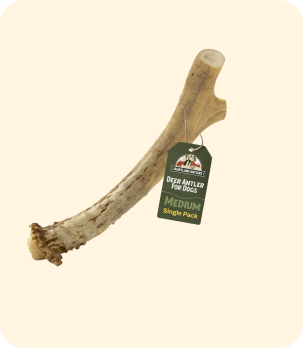
Whole deer antlers are the hardest. They're built for German Shepherds, Pit Bulls, and Labs who destroy everything else. They're not a good starting point for a dog who's never had an antler before, regardless of size.
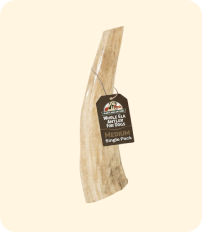
Split elk antlers are the safer starting point for most dogs. The split exposes the inner marrow channel, which is softer than the outer cortex. Dogs tend to lick and scrape rather than bear down with full jaw force. Many vets who won't recommend whole antlers are more comfortable with split elk specifically because the chewing behavior is different - less force, more surface licking.
Split Elk Antlers - The Safer Starting Point for Most Dogs
If you're new to antler chews, or your dog has never had one, start with a split elk antler in the right size. This is not a compromise. It's the right choice.
Here's why split elk antlers carry lower fracture risk:
The inner marrow is the reward. Dogs go for it immediately. They lick, scrape, and nibble - not bite hard. The chewing behavior that causes slab fractures (aggressive bearing-down with back molars) rarely happens with split elk because the marrow satisfies the dog without requiring that kind of force.
Split elk antlers also provide calcium and phosphorus for healthy teeth and bones from the marrow itself, which means your dog gets nutritional benefit while chewing rather than just mechanical stimulation.
The outer shell of a split elk antler is still elk antler - still durable, still long-lasting, still outlasting every bully stick and rawhide on the market. It's not a soft chew. It'll keep a moderate chewer busy for weeks. But the risk profile is substantially lower than whole deer antler.
Once your dog has done well with split elk - shown that they chew methodically rather than trying to crunch through it - you can consider graduating to whole elk antler. For true power chewers, whole deer antler is built for that level of intensity.
For aggressive chewers who are ready for whole deer antler: that extra hardness is the point. A 90-lb German Shepherd who destroys nylons in an afternoon needs something that provides real resistance. That's exactly what deer antler is for - matched to the dog, matched to the size, supervised until you know the pattern.
No splintering. No chemicals. Mess-free, odor-free. That's the experience across both antler types when the fit is right.
When to Supervise and When to Replace
Even the right antler needs the right supervision protocol.
Always supervise the first few sessions. Watch how your dog chews. Are they working methodically at one end? Good. Are they trying to fit the whole thing in their mouth and crunch down? That's the behavior that causes fractures - either the size is wrong, or they need a different hardness level.
Replace the chew when it gets small. When the antler is worn down to the size of your dog's molar span - roughly, when they can fit it crossways in the back of the mouth - take it away. Don't wait until it disappears. The end of a chew session is when most injuries happen.
Check it when you give it back. If an antler has been sitting between sessions, run your thumb along the edges. Sharp edges or cracks mean it's time for a new one.
For split elk specifically: once the marrow is gone, remove the remaining hull. The outer shell without marrow is denser, there's no flavor incentive, and some dogs try to snap through it out of frustration.
The practical rule: any time the chew is small enough to fit fully in your dog's mouth, it's done.
Who Should NOT Give Their Dog Antler Chews
Antler chews are not right for every dog. Here's who should skip them entirely:
Puppies under 6 months. Their adult teeth are still coming in and the roots aren't fully set. Even soft split elk is too much for developing dentition. After 6 months, split elk in the right size can be introduced with close supervision. Hold off on whole elk or deer antler until 12 months minimum.
Dogs with existing dental disease. If your dog already has cracked teeth, advanced periodontal disease, or has had recent dental surgery - no antler chews. The added stress on already-compromised teeth is not worth it. Ask your vet before reintroducing any hard chew after a dental procedure.
Dogs with a history of resource guarding. This is a management issue, not a safety issue with the antler itself - but an unsupervised resource-guarding dog and a high-value chew is a risk worth flagging. Know your dog.
Very small dogs (under 10 lbs). The size guide helps here, but tiny breeds often have fragile dentition regardless of antler size. If your dog is under 10 lbs, talk to your vet before introducing antler chews.
Frequently Asked Questions
Can antler chews break dog teeth?
Yes - the wrong antler can. The risk is highest with whole deer antlers given to dogs who are too small for that hardness level, or when an antler has worn down to a small piece that the dog can clamp down on with full molar pressure. Slab fractures happen when a dog bites down on something that doesn't give.
Grade-A elk antlers in the right size, and especially split elk antlers, carry significantly lower fracture risk. The marrow channel in split elk reduces the overall density and changes the chewing behavior - less force, more licking and scraping.
What do vets say about antler chews?
In a survey of over 1,000 veterinarians, 93% did not recommend antler chews. Their primary concern is slab fractures - where the side of a back tooth shears off under pressure, exposing the pulp and creating infection risk.
That said, their concern applies most directly to whole, hard antlers given without proper size matching. Many vets who decline to recommend antlers broadly will make exceptions for split elk antlers in appropriately sized dogs, supervised. The vet consensus is a real signal - but it's about conditions of use, not about antlers as an inherently unsafe material.
Are split elk antlers safer than whole deer antlers?
Yes, meaningfully so. Split elk antlers expose the inner marrow, which is softer than the dense outer cortex. Dogs lick and scrape rather than bite hard. The force that causes slab fractures - full molar pressure on something rigid - rarely happens with split elk the way it can with whole deer antler.
If you're new to antler chews, or your dog has never had one, start with split elk. You can always move to whole elk or deer antler once you see how your dog chews.
What size antler does my dog need?
The antler should be large enough that your dog can't fit it crossways in their mouth. General guide: under 15 lbs, choose Small; 15 - 35 lbs, Medium; 35 - 70 lbs, Large; 70 - 100 lbs, XL; over 100 lbs, Giant. Size up when between sizes. See our full size guide for breed-specific recommendations.
When should I take an antler chew away?
Replace the chew when it's worn down small enough to fit fully in your dog's mouth. That's when choking risk goes up and when the dog can generate full molar pressure. For split elk antlers, once the marrow is gone, remove the remaining hull - it's denser and some dogs try to snap it. Any time the chew has sharp edges or is cracking, it's done.
Can puppies have antler chews?
Not under 6 months. Puppy teeth - including their adult teeth coming in - aren't set firmly enough to handle antler hardness safely. After 6 months, a split elk antler in the correct small size can be introduced with close supervision. Hold off on whole elk or deer antler until 12 months.
The Bottom Line
Antler chews have real risks. The vet concerns are legitimate, and if you give your dog the wrong antler in the wrong size without supervision, you are taking on real risk of a painful dental injury.
But the solution is not to avoid antlers. The solution is precision.
Grade-A quality means the antler wears instead of shatters. Right size means the dog can't get full molar pressure on it. Split elk as a starting point means the chewing behavior is safer by default. Supervision means you catch the problems before they happen.
That's not a workaround. That's just doing it right.
For dogs who are new to antler chews, split elk antlers are the place to start. They're long-lasting, naturally shed, mess-free and odor-free - and the marrow keeps your dog engaged without the hardness profile that worries vets.
Already know your dog's a power chewer? Deer antler is built for that. See all antler chews →
Free shipping on orders over $50. 30-day returns. Veteran-owned.
Internal links: Antler size guide | Split elk antler chews | Deer antler chews for aggressive chewers