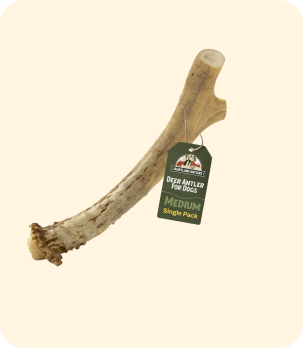
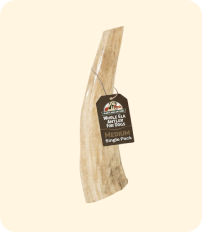
Both are natural. Both are marketed as long-lasting. Both get recommended in the same forums and pet store aisles. So what actually separates an antler chew from a buffalo horn chew - and which one is right for your dog?

Quick answer: for most power chewers, Grade A antler edges out buffalo horn on three specific factors - no splintering risk, cleaner sourcing, and better cost-per-week math for heavy chewers. For moderate chewers who want the enrichment of a hollow center, buffalo horn makes a real case. Here's the full breakdown.
What Is a Buffalo Horn Dog Chew?
Buffalo horn chews are made from the horns of cattle or water buffalo. Unlike shed antlers, horns are a by-product of slaughter - the animals are not raised for their horns. That's worth acknowledging honestly: if sourcing matters to you, this is the key distinction.
The product itself is the hollowed outer wall of the horn - a hard keratin shell with a naturally open cavity inside. That hollow center is one of buffalo horn's genuine selling points: it creates a concave chewing surface that some dogs find stimulating, and it can be stuffed with peanut butter, cheese, or marrow for added enrichment. Think of it as a natural Kong alternative for moderate chewers.
Buffalo horns come in a range of sizes, from small curved tips to large full-horn sections. Hardness varies more than it does with antlers - a thick-walled, wide-diameter horn from a mature animal will be substantially harder than a thin-walled tip. Most buffalo horn chews are imported, primarily from South America or Southeast Asia, though some US-sourced options exist.
Price-per-unit is typically comparable to antler chews, or slightly cheaper - but as we'll get into, unit price isn't the same as cost-per-week for a power chewer.
Antler Chew vs. Buffalo Horn: Key Differences
Here's how the two chews stack up across the criteria that matter most for dog owners:
| Criterion | Antler Chew | Buffalo Horn |
|---|---|---|
| Sourcing | Naturally shed - no animals harmed | Slaughter by-product |
| Splinter risk | No - Grade A density = powder, not shards | Yes - can splinter under extreme bite force |
| Odor / mess | Odor-free, mess-free | Some products have a noticeable odor |
| Hardness | Deer > whole elk > split elk (range) | Medium-hard (relatively consistent) |
| Durability (power chewers) | Weeks to months | Days to weeks for extreme chewers |
| Enrichment potential | Split elk: exposed marrow | Natural hollow center |
| USA sourced | Yes (Heartland Antlers) | Varies; often imported |
The two rows that tend to decide the question for most power chewer owners: splinter risk and durability. We'll go deeper on both below.
Which Is Safer for Dogs - Antlers or Buffalo Horns?
This is the most important question, and it deserves a straight answer.
Buffalo horns can splinter. This is not a fringe opinion or a marketing claim - it is documented repeatedly in power-chewer owner communities, breed-specific groups for pit bulls, Rottweilers, Cane Corsos, and Belgian Malinois. The failure pattern is consistent: once a heavy chewer reaches the hollow interior or begins applying sustained lateral crushing force to the outer wall, the horn material can crack into sharp, curved shards rather than wearing down evenly. Not every dog, not every horn - but the risk exists and it is meaningfully higher than with antlers.
Grade A antlers behave differently under extreme bite force. The dense cortex structure of a naturally shed deer or elk antler does not produce sharp shards. Under sustained power-chewer pressure, Grade A antler fractures as fine powder - essentially the same calcium-phosphate mineral matrix, just ground down. There is no hollow wall to crack, no curved horn geometry to produce a shard. This is why the safety profile of Grade A antlers holds up where buffalo horn does not.
For any dog classified as a power chewer or aggressive chewer - dogs that routinely destroy bully sticks in under 30 minutes, rubber toys in a week, or rawhide in one sitting - the splintering risk of buffalo horn is worth taking seriously. For moderate chewers who work a chew slowly and steadily, the risk is lower.
If you are unsure where your dog falls, see our guide to the best dog chews for aggressive chewers for a straightforward chewer-intensity framework.
Which Lasts Longer for Power Chewers?
For power chewers, the solid cortex of a deer antler or whole elk antler almost always outlasts a buffalo horn - and the math compounds quickly.
The reason is structural. An antler is solid bone-like material throughout. There is no hollow center to reach, no thinning wall to break through. A power chewer works through the outer surface layer by layer, which takes weeks to months depending on antler type and the dog's size. A deer antler for a 70-lb power chewer will typically last two to six weeks.
A buffalo horn, once the initial hard outer surface is worn down and the hollow interior is exposed, is consumed dramatically faster. The walls thin, the structure weakens, and the remaining material goes quickly - or cracks. For an extreme chewer, a buffalo horn that cost $12 - 18 may be gone (or unsafe) within a few days.
Here's what the cost math looks like for a 70-lb power chewer over four weeks:
| Chew Type | Avg. Unit Cost | Lifespan (power chewer) | Cost / Week |
|---|---|---|---|
| Buffalo horn (imported) | $12 - 18 | 3 - 10 days | $8 - 42 |
| Whole elk antler (Grade A) | $18 - 28 | 3 - 6 weeks | $3 - 9 |
| Deer antler (Grade A) | $22 - 35 | 4 - 10 weeks | $2 - 9 |
| Split elk antler (Grade A) | $14 - 22 | 1 - 3 weeks | $5 - 22 |
The unit price of buffalo horn is often lower. The weekly cost is frequently higher for any dog that chews with real intensity. That is the cost math most product pages don't show you.
For a full breakdown of antler lifespan by dog profile, see how long do antler chews last.
When Is Buffalo Horn a Better Choice?
Honest answer: for moderate chewers, buffalo horn is a legitimate option that deserves fair consideration.
If your dog is not a power chewer - if they work through a chew slowly over multiple sessions spanning weeks - they are unlikely to hit the structural failure point that causes buffalo horn to splinter. A slower, more methodical chewer can safely enjoy a buffalo horn and benefit from the hollow-center enrichment in a way that a solid antler does not provide.
Buffalo horn also has a real case for:
- Enrichment-focused owners who stuff the hollow center or use it as a rotating enrichment tool alongside other chews.
- Dogs who have already been through antlers and want variety without switching to something softer or less engaging.
- Multi-chew households where different dogs have different chewing intensities and you want a range of options.
The honest comparison isn't "antlers are good, buffalo horns are bad." It's that the two chews have different risk profiles and different ideal users. If your dog is a moderate chewer who would benefit from enrichment variety, buffalo horn can be part of a sensible rotation. Just supervise, especially for the first few sessions, and retire the horn if you see cracking or splintering on the wall.
For more on how antlers fit into a natural chew rotation, see the antler chew vs. yak chew comparison and the antler chew vs. bully stick breakdown.
Which Should You Choose?
Choose antler if:
- Your dog is a power chewer or aggressive chewer
- Safety is the top priority and you want zero splintering risk
- You want odor-free, mess-free chews for indoor use
- Sourcing ethics matter - you want naturally shed, no-kill
- You prefer USA-sourced products
- You want the best cost-per-week value for a heavy chewer
Choose buffalo horn if:
- Your dog is a moderate chewer (not a destroyer)
- You want a hollow-center enrichment option
- Your dog has already worked through antlers and wants variety
- You specifically want a fillable natural chew
For most power chewer owners reading this page, the answer is antlers. For moderate chewers who chew methodically and would enjoy the enrichment angle, buffalo horn is worth trying - just with supervision.
FAQ: Antler Chews vs. Buffalo Horns
Do buffalo horns splinter for dogs?
Yes, buffalo horns can splinter under extreme bite force. The risk is not universal, but it is documented - particularly in power-chewer breed communities. Once the hollow interior is reached or the outer wall is compromised by heavy crushing, buffalo horn can crack into sharp curved fragments. Grade A antlers do not splinter; under extreme pressure, the dense cortex fractures as fine powder, not shards.
Is deer antler harder than buffalo horn?
Yes. Deer antler is the hardest naturally shed antler chew available, followed by whole elk antler, with split elk antler being the softest. Buffalo horn falls roughly in the medium-hard range, similar to whole elk, but hardness varies more depending on the size and cut of the horn.
Are buffalo horns safe for aggressive chewers?
For moderate chewers, generally yes. For extreme power chewers - dogs that destroy most chews rapidly - buffalo horns carry a higher splintering risk than Grade A antlers. The hollow structure that makes buffalo horn appealing for enrichment is also what makes it structurally weaker under sustained crushing force. If your dog qualifies as a true aggressive chewer, Grade A deer antler is the safer long-term choice.
Which is better for dogs: antlers or buffalo horns?
For power chewers, Grade A antlers - specifically deer antler or whole elk antler - are the better choice: no splintering, better durability, odor-free, USA-sourced, and more cost-effective per week for heavy chewers. For moderate chewers who want hollow-center enrichment, buffalo horn is a legitimate option. Both are far preferable to rawhide. See our rawhide alternatives guide for the full comparison.
How long does a buffalo horn last vs. an antler?
For power chewers, a Grade A deer antler typically lasts several weeks to a few months; a buffalo horn often lasts days to a couple of weeks for the same dog before the hollow interior is breached. The solid cortex of an antler simply provides more material to work through. For moderate chewers, the durability gap narrows - a moderate chewer may get comparable lifespan from either product.
The Bottom Line: Shop by Your Dog's Chewing Profile
If you know your dog destroys everything - bully sticks, rubber toys, rawhide - the answer is clear. Start with a Grade A deer antler sized to your dog's weight. No splintering, no odor, naturally shed, and it will outlast anything else you've tried.
Not sure which size? Our antler size guide takes the guesswork out - match by weight and chewing intensity.
If your dog is a first-timer or a moderate chewer, split elk antler is the right starting point - softer than deer antler, with exposed marrow that gets dogs interested fast. It bridges the gap between "my dog isn't sure about antlers" and "my dog goes through everything."
All Heartland Antlers are Grade A, naturally shed, USA-sourced, and veteran-owned. Free shipping on orders over $50.
Related: Best Dog Chews for Aggressive Chewers | Are Antler Chews Safe for Dogs? | Antler Chew vs. Bully Stick | Antler Chew vs. Yak Chew | What Size Antler Does Your Dog Need?