
Quick answer: Antler and yak-style cheese chews are different materials, but both can be very hard. Antler is bone material. A cheese chew is a food product whose ingredients, calories and directions depend on the exact recipe. Neither natural origin nor a long chew time makes either suitable for every dog. Start with your dog's teeth, diet and chewing behavior, then compare the actual products.
Heartland sells antlers, so our role in this comparison should be clear. We can explain our product types. We cannot promise that antler is safer, cheaper per month, or better for an individual dog than a cheese chew. A dog that bites hard enough to break a chew needs a different plan, not an automatic move to a harder object.
Compare the material and ingredients
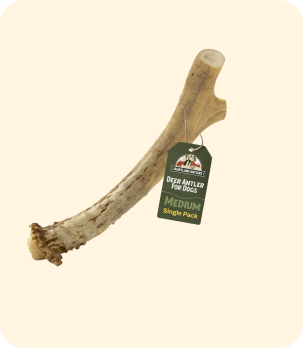
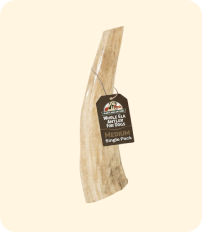
An antler is not a horn or a block of cheese. It is mineralized bone with a hard outer layer. A whole antler retains that outer surface; a split elk antler exposes the inner structure but still contains hard material. Heartland's range includes whole deer, whole elk and split elk antlers. It does not include split deer antlers.
The term “yak chew” often refers to a dried hard cheese chew. Do not assume that the name means yak milk is the only ingredient. Read the current ingredient panel for milk sources, flavorings and other ingredients. A recipe can differ across brands and across products from the same maker. For example, Himalayan Pet Supply describes its original product as a hard cheese chew; that description does not establish the recipe or instructions for another seller's product.
| Question | Antler | Hard cheese chew |
|---|---|---|
| What is it? | Bone material from an antler. | A dried cheese-based food product; check the exact recipe. |
| Is it intended to be eaten as a serving? | Do not treat a hard antler or a loose fragment as an edible serving. | Follow the maker's feeding directions and your dog's dietary limits. |
| Does a split or smaller version remove the hard-chew concern? | No. Hard material remains. | No. Size and hardness are separate checks. |
| What should the buyer verify? | Species, cut, dimensions, source, condition and retirement instructions. | Ingredients, calories, size, storage and instructions for the remaining piece. |
Milk protein matters for dogs with a diagnosed food allergy or a prescribed diet. A low-lactose claim is not the same as an absence of milk protein. Do not replace one chew with another during a veterinary diet trial without checking the plan. Single ingredient also does not mean universally allergy-safe.

Check hard-chew risks
AAHA identifies both antlers and yak milk chews as hard items that can damage teeth. This is the key limit of a comparison based only on how long each lasts. A dog can enjoy a chew and still apply enough force to injure a tooth.
Do not use “power chewer” as a safety category. Repeated crushing bites, trying to snap the object, or gulping loose pieces are reasons to reassess the choice. Supervision allows you to intervene; it does not make a hard object unable to fracture a tooth. A larger size can address one swallowing concern while leaving hardness unchanged.
Puppies, older dogs, dogs with worn teeth and dogs recovering from dental treatment need individual advice. Do not select either product on an age label alone. Ask your veterinarian about suitable flexible toys or food-based enrichment for your dog's mouth and diet.
Stop access if a chew cracks, develops a sharp edge, sheds a loose piece or becomes small enough to swallow. If you see a damaged tooth or a change in eating, arrange veterinary assessment. Breathing trouble, collapse or suspected choking needs urgent help. Do not wait for an advertised session time to end.

Follow the exact cheese-chew directions
Cheese chews contribute food to the diet. Check calories and the serving instructions rather than assuming one whole chew is one daily serving. AAFCO explains that treats generally do not replace complete and balanced food. Ask for calorie information if the package does not make it clear. Use the limits set for your dog, especially with weight management or a therapeutic diet.
Some manufacturers give a specific process for puffing a small cheese-chew remnant. That is product-specific advice, not a universal microwave recipe. Check the exact product, piece size, appliance directions and cooling instructions. Do not improvise heating times or apply cheese-chew instructions to antlers. If the directions are absent or unclear, contact the manufacturer or discard the remnant.
Keep the package until the chew is used or retired. It holds the lot details and care instructions you may need later. Follow its storage guidance. Wash hands after handling used chews, keep the surface clean and discard a product that has changed in condition or cannot be stored as directed. Neither category is guaranteed to be odor-free, sterile or free of residue.

Compare cost and actual use
There is no reliable universal formula such as “one antler equals a month of cheese chews.” Size, individual behavior, product condition and retirement decisions change the result. A low purchase price can be poor value if the dog cannot use the item appropriately. A durable item is not good value if hardness makes it unsuitable.
For a product that fits your veterinary advice, keep a simple record: purchase price, suitable supervised sessions, why it was retired and whether your dog remained engaged. Divide the purchase cost by those actual sessions if you want a cost comparison. Count early retirement as a real outcome. Do not keep an unsafe piece to make the arithmetic look better.
Variety need not mean a rotation of hard chews. Walks, scent games, training and suitable food puzzles can meet different needs. If you compare product types, the antler and rawhide guide explains a different material choice. Read the antler safety guide before the size guide; size is only part of the decision.

Frequently asked questions
Are yak chews softer or safer than antlers?
Some textures differ, but a hard cheese chew can still damage teeth. Do not use the category name as a safety guarantee. Assess the actual product and the individual dog.
Is a yak chew made only from yak milk?
Not necessarily. Check the current ingredient panel for the product in your hand. Milk sources and other ingredients can vary.
Can puppies or senior dogs have either chew?
Age alone does not establish suitability. Ask your veterinarian about teeth, development, diet and a more flexible option where appropriate.
Can I microwave the last piece?
Only follow the exact cheese-chew manufacturer's applicable instructions. Do not guess a time, give a hot piece, or heat antler using that method.
Which lasts longer?
Antlers can persist as hard objects while an edible cheese chew is consumed, but we cannot predict safe use time for your dog. Condition and suitability should decide when use ends.
To ask about Heartland's material, cut or dimensions, contact us. You can review the current antler catalog after you decide whether a hard antler is appropriate for your dog.