Antler vs. Cow Hooves for Dogs: The Tooth-Fracture Comparison Vets Warn About

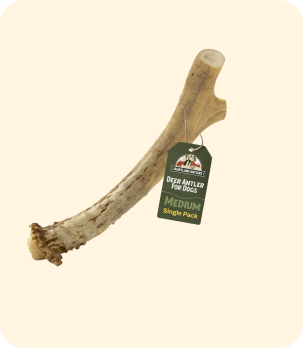
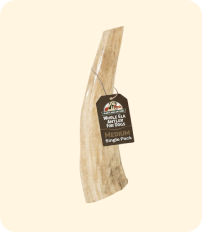
Antler vs cow hooves for dogs comes down to failure modes. Both are hard enough to crack a tooth, and neither one sits on the Veterinary Oral Health Council (VOHC) accepted list. But a cow hoof carries two problems a solid antler does not: it splinters into sharp, hollow shells, and its ring shape can loop behind a dog's lower canines and trap the jaw. A correctly sized Grade A elk antler carries the hardness risk alone, without the shattering or the jaw-trap. That is the whole reason it wins this matchup for most hard-chewing dogs.

This is a rare comparison. Usually the honest answer is "it depends on your dog." Here, when you line up the real risks, a right-sized antler comes out ahead on both durability and relative safety. That does not make an antler soft or risk-free. It means the cow hoof stacks more ways to go wrong.

Antler vs Cow Hooves for Dogs: The Comparison at a Glance

Here is how a whole Grade A elk antler and a standard cow hoof compare on the factors that decide a chew. Read the safety row twice. Neither is a soft chew, and this table does not pretend otherwise.

Factor Grade A Elk Antler Cow Hoof
Hardness Very hard. Solid dense cortex. Fails the fingernail test. Very hard. Rigid keratin shell. Also fails the fingernail test.
How it breaks down Grinds and flakes slowly. Dog earns the marrow over weeks. Splinters into sharp, curved shell fragments once the edges wear.
Shape risk Solid rod or split half. Nothing to loop over the jaw. Hollow ring can slip behind the lower canines and trap the jaw.
Odor Low. Faint natural marrow smell, dry. Strong. Described as rancid, ammonia-like, barn-like once wet.
Lifespan 3 to 6 weeks of daily sessions for a working-breed adult on a correctly sized whole. Days to a few weeks. Often cracked apart and pulled early for safety.
Ingredient count One. Naturally shed elk antler. No processing. One material (keratin), but often bleached or basted, and hard to digest.
VOHC accepted list Not listed. Not listed.

Are Cow Hooves Safe for Dogs?

Most veterinarians put cow hooves on the do-not-give list, and the reasons are specific, not vague. Veterinary dentists name cow hooves among the most common causes of a slab fracture, a break across one of the large cheek teeth. That kind of fracture is painful, it often exposes the tooth's pulp, and it usually ends in an extraction or a root canal. This is not a rare freak outcome. It is the classic hoof injury.

Then there is the splinter problem. As the rounded edges wear down, a hoof can crack into sharp, hollow shards. Swallowed pieces can cut the mouth or, worse, perforate the esophagus, stomach, or intestine. That is a surgical emergency, not a bad afternoon.

The shape adds a third hazard that is easy to overlook. A cow hoof is a ring. Vets report cases where the ring slips behind a dog's lower canine teeth and gets stuck, and the dog has to be sedated to have it cut free. A solid antler has no opening to loop over anything.

So the honest answer to "are cow hooves safe for dogs" is: for most dogs, no, and the risk profile is worse than the hardness alone suggests. Cracked tooth, sharp splinter, or trapped jaw. Three failure modes on one chew.

Antlers Are Still Hard. Here Is the Rule That Matters.

Time for the part a lot of antler sellers skip. An antler is a hard chew. It is not soft, it is not pliable, and it does not pass every safety test a vet would hand you. If you want to be fair to your dog, use the tests the dentists actually use.

  • The fingernail test. Press your thumbnail into the chew. If it does not give even a little, it is hard enough to break a tooth. Antlers fail this. So do hooves, bones, and most nylon chews.
  • The knee-cap test. Coined by veterinary dentist Dr. Fraser Hale, the rule is simple. Rap the chew against your own kneecap. If it hurts, it is too hard for your dog's teeth.
  • The nail-driving rule. If you could drive a nail with it, it is too hard.

By those tests, no long-lasting hard chew comes out clean, antler included. So why does a right-sized antler still win this comparison? Because tooth-fracture risk on a hard chew is driven mostly by two things you control: the size and shape of the chew, and how the dog is allowed to use it. A cow hoof piles the fracture risk on top of splintering and the jaw-loop shape. A solid antler lets you manage the one risk that is left.

That is the fit-first point. The chew that fits your dog and gets supervised beats the chew that is a size off and left alone. For the full breakdown of when an antler is and is not the right call, read the honest answer on antler chew safety.

Cow Hoof vs Elk Antler: The Mess Nobody Warns You About

Set the teeth aside for a second and talk about your house. Cow hooves smell. Owners describe the odor as rancid, ammonia-like, sometimes close to stale urine or a barn. The cause is anaerobic bacteria feeding on the keratin, and it gets stronger once the hoof is wet with saliva. Some hooves are bleached or basted to cut the smell, which adds processing to a chew you bought because it was natural.

A Grade A elk antler is close to odorless. There is a faint marrow smell up close, and that is it. Nothing soaks into the carpet. Nothing clears the room. One ingredient, naturally shed antler, no basting, no bleach.

If low odor and a single clean ingredient matter to you, that is a real point in the antler's column. See where antler lands against the rest of the aisle in what "natural" actually means for dog chews.

Hooves or Antlers for an Aggressive Chewer?

This is where the gap gets widest. An aggressive chewer is exactly the dog a cow hoof punishes. The harder a dog cranks down, the sooner the hoof cracks, and the sooner those sharp shell pieces show up. Most vets who tolerate hooves at all say pull them from a power chewer after a few days and replace them, because the breakage risk climbs fast.

A power chewer changes the antler math too, but in a manageable direction. A serious chewer needs a whole antler with the cortex intact, sized up so the dog cannot get a molar fully around it. The failure mode is slow grinding, not sudden shattering. That is a chew you can supervise instead of a chew you are racing against.

For the deeper playbook on matching a strong jaw to the right cut and size, read the guide to the best chew for aggressive chewers, then confirm the size with the field guide to antler fit. Size is the safety lever here, more than price and more than brand.

One Clarification: Cow Hoof Is Not Buffalo Horn

People mix these up, and the products are not the same. A cow hoof is the keratin foot capsule, hollow and ring-shaped, the one that splinters and smells. A buffalo horn is the solid keratin horn core, a different shape with a different risk pattern. If you were actually weighing horn, not hoof, we wrote that comparison separately in antler chew vs buffalo horn. Do not let a store shelf blur the two.

How to Make the Antler the Safer Pick

An antler earns the "safer of the two" title only if you set it up right. The chew does not manage itself.

  1. Size up. Pick a whole antler long and thick enough that your dog cannot wrap a back molar around it and torque. Wrong size is where fractures start.
  2. Match the cut to the dog. Whole for an experienced adult chewer. Split, with the softer marrow channel exposed, for a puppy over ten months, a senior, or a first-timer. Details in the Grade A antler guide.
  3. Supervise, especially early. Watch the first few sessions. Learn how your dog attacks it before you leave the room.
  4. Retire the nub. When the piece is small enough to swallow, take it away. Same rule you would want on any chew.

Do that, and you have a chew that carries one managed risk instead of three, lasts weeks instead of days, and does not stink up the house. That is the terminal-solution logic. Match the dog to the right piece once, and you stop cycling through the chew graveyard.

Frequently Asked Questions

Do cow hooves splinter?

Yes. Once the rounded edges wear down, cow hooves can crack into sharp, hollow shell fragments. Swallowed pieces can cut the mouth or perforate the digestive tract, which is why most vets steer owners away from them, especially for hard chewers.

Are antlers or cow hooves better for a dog's teeth?

Neither is soft, and both can fracture a tooth if the dog goes too hard on the wrong size. But a cow hoof adds splintering and a jaw-looping shape on top of the hardness. A correctly sized whole antler carries the hardness risk alone, which is the one risk you can manage with size and supervision.

Are cow hooves or antlers on the VOHC accepted list?

No. The Veterinary Oral Health Council (VOHC) publishes a list of accepted dental products, and neither cow hooves nor antlers appear on it. Treat both as long-lasting recreational chews, not as a dental treatment, and apply the fingernail and knee-cap tests before you hand either one over.

Which lasts longer, an antler or a cow hoof?

A correctly sized Grade A elk antler typically runs 3 to 6 weeks of daily sessions for a working-breed adult. A cow hoof can wear slowly too, but it is often cracked apart and pulled early for safety once a strong chewer gets to work, so the usable, safe life tends to be shorter.

Why do cow hooves smell so bad?

The odor comes from anaerobic bacteria feeding on the keratin, and it gets stronger once the hoof is wet with saliva. Owners describe it as rancid, ammonia-like, or barn-like. A naturally shed elk antler is close to odorless by comparison.

Is a cow hoof the same as a buffalo horn?

No. A cow hoof is the hollow, ring-shaped foot capsule that splinters and smells. A buffalo horn is the solid horn core, a different shape with a different risk pattern. They are separate products and should not be compared as if they were one.

The Bottom Line

Antler vs cow hooves for dogs is not a close call once you count the failure modes. A cow hoof can crack a tooth, splinter into sharp shells, and loop the jaw. A right-sized Grade A elk antler carries the hardness risk alone, lasts longer, and does not stink. It is still a hard chew, so size it correctly and supervise it. But among these two, the antler is the cleaner pick for most dogs.

Ready to match your dog to the right piece? Shop Grade A elk antlers and find the right fit.

Back to blog