Antler vs Bully Stick for Dogs: Cost, Safety & Which Chew Actually Lasts

Quick answer: For most adult dogs over 40 lbs, a Grade A elk antler is the better everyday chew — it lasts weeks instead of minutes, works out to under $1 a session, barely smells, and adds almost no calories. A bully stick wins for puppies, seniors, gentle chewers, and high-value training rewards because it's soft, fully digestible, and highly motivating. Power-chewer household? Run antlers as the daily staple and keep bully sticks for reward moments. That combo usually holds monthly chew spend under $30.

Here's the scenario we hear every week from customers: you buy a 12-pack of bully sticks on Monday, and by Sunday the bag is empty. Your German Shepherd or Pit Bull isn't misbehaving — the chew just can't keep up with the jaw. It's not a behavior problem. It's a math problem.

This guide breaks down the real antler vs bully stick decision the way a veteran-owned shop actually thinks about it: how long each one lasts, what it truly costs per session, the smell and mess, the calories, and — most importantly — the safety trade-offs on both sides. No cheerleading. We sell antlers, and we'll still tell you exactly when a bully stick is the smarter pick.

Antler vs bully stick: the side-by-side comparison

If you only read one thing, read this table. It's the answer-first version of everything below.

Factor Grade A Elk Antler Bully Stick
How long it lasts 4–6 weeks of daily sessions (power chewers) 20–40 minutes for a power chewer
Cost per session Under $1/day ($18–$28 for the whole antler) $2.50–$3.50 (a fresh stick each time)
Smell Very low, nearly odorless Strong, distinctive "barnyard" odor
Calories Negligible — gnawed, not consumed ~88 calories per 6-inch stick (fully eaten)
Mess No grease, no floor stains Can leave residue on floors and furniture
Digestibility Not digestible — chewed, not swallowed Fully digestible
Main safety watch-out Very hard — size correctly, supervise, retire nubs Calories & gulping the last inch
Best for Daily 40+ lb power chewers Puppies, seniors, gentle chewers, rewards

The verdict in one line: antlers win on longevity, cost, smell, calories, and mess; bully sticks win on softness, digestibility, and motivation. For a heavy daily chewer, the antler is the workhorse. For a puppy, a senior, or a training reward, the bully stick earns its place. Most households we talk to end up using both — more on that below.

What is a bully stick, exactly?

A bully stick is a single-ingredient chew made from dried bull pizzle (yes, really). That's it — no fillers, no chemicals. Because it's 100% beef muscle, it's high in protein and fully digestible, which is why it's a favorite for puppies and dogs with sensitive stomachs. According to the American Kennel Club, bully sticks are a safe, digestible alternative to rawhide when used with normal supervision.

The two things to keep in mind:

  • Calories add up. Because your dog actually eats the whole thing, the calories count. A study out of Tufts and the University of Guelph found a standard 6-inch bully stick carries roughly 88 calories — enough to represent up to 30% of a small dog's daily intake. For a lean, active large dog that's a rounding error; for a 12-lb couch companion, it matters.
  • They don't last. Priced around $2.50–$3.50 for a 6-inch stick (and $5–$7 for a 12-inch), a bully stick is gone in 20–40 minutes with a serious chewer. Great engagement — short runway.

What is a Grade A elk antler?

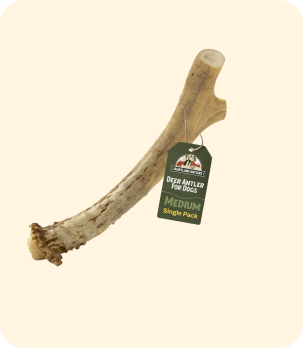
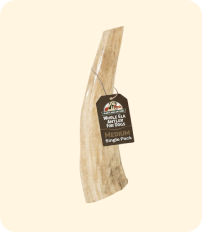
Our antlers are naturally shed by elk and deer each year (no animal is ever harmed), then hand-selected for cortex density and cut to size. The structure is what makes them work: a dense cortical-bone exterior wrapped around a nutrient-rich marrow core. As your dog works the ends, they access marrow that delivers calcium, phosphorus, and protein — the reward that keeps them coming back for weeks.

"Grade A" is our density standard. We reject porous, lightweight, or brittle antlers because those are the ones that splinter. A properly graded, correctly sized antler wears down slowly and evenly instead of cracking. If you want the full breakdown of why some antlers outlast others, our guide on how long antler chews last covers density, breed, and sizing in detail.

Not sure elk vs deer? Elk antlers are larger, denser, and marrow-rich — ideal for aggressive chewers. Deer antlers are a bit softer and often better for moderate chewers and smaller dogs. Browse both in our elk antler collection and deer antler collection.

The cost-per-session math (where the antler pulls away)

This is the part most comparison articles skip, and it's the part that changes minds. Duration is nice — but cost per session is the number that hits your wallet.

Bully stick economics for a daily chewer:

  • One stick per day: $75–$105 per month
  • Five sticks per week: $50–$70 per month
  • Three sticks per week: $30–$42 per month

Grade A antler economics for the same dog:

  • One antler lasts 4–6 weeks of daily sessions: $18–$28 per month
  • Cost per session: under $1

For a German Shepherd, that's roughly 3–5x cheaper per month. For a genuine chew-machine like a Belgian Malinois, the gap widens even further because they'd otherwise burn through multiple bully sticks a day. Our customers consistently report their monthly chew spend dropping from $60–$90 down to $18–$28 once an antler becomes the daily staple. We walk through the full return-on-investment case in are antler chews worth it.

Smell, mess, and calories: the daily-living factors

These rarely make the spec sheet, but they're what you actually live with.

Smell. Bully sticks have a strong, distinctive odor — some dogs love it, and that scent is part of what makes them so motivating. But it's noticeable in a living room, and it's the #1 complaint we hear from bully-stick users. Antlers are nearly odorless. If a chew that stinks up the couch is a dealbreaker, that alone points to antler.

Mess. Bully sticks can leave a greasy residue and, occasionally, stains on light floors or upholstery. Antlers are clean and dry — no oils, no marks.

Calories. Because a bully stick is fully eaten, its ~88 calories go straight into your dog's daily budget. An antler is gnawed, not consumed, so day-to-day calorie intake is negligible — a real advantage for dogs watching their weight.

Safety: the honest version for both chews

No chew is risk-free, and anyone who tells you otherwise is selling, not informing. Here's the straight talk on both.

Bully stick safety

Bully sticks are among the safer chews because they're digestible and don't splinter into hard shards. The two watch-outs: calories (covered above) and the last inch — some dogs try to gulp the final nub, which is a choking risk. Take it away when it gets small enough to swallow whole. A few older studies have also flagged bacterial contamination on some sticks, so buy from sources with good sourcing and handling.

Antler safety

Antlers are very hard — that's the whole point, and also the thing to respect. Veterinary dentists warn that any chew hard enough can fracture a tooth (a "slab fracture" of the upper carnassial is the classic injury). The widely used vet rule of thumb: if you can't dent it with your thumbnail, or it would hurt to be hit on the kneecap with it, chew with caution and supervise. The Veterinary Oral Health Council is a good reference point for how chews and dental products are evaluated.

How we manage that risk in practice:

  • Size correctly — too small is a choking hazard; when in doubt, go bigger (see the size guide below).
  • Match density to your chewer — hard-charging gulpers do best with the densest whole antlers; we cover this in our guide to antlers for aggressive chewers.
  • Supervise and retire the nub — pull it once it's small enough to swallow.
  • Choose the right shape — split antlers give easier marrow access and less tooth stress for tentative or senior chewers.

Worth noting: this hardness is exactly why antlers offer a dental benefit. The cortical-bone surface helps scrape soft plaque as your dog chews — we dig into the mechanism in antler chews and dog dental health. And if you're weighing natural chews against processed ones, our antlers vs rawhide comparison explains why rawhide's blockage risk makes antlers the safer long-lasting option for most power chewers.

Which is better for aggressive chewers?

For a determined power chewer — think Pit Bull, German Shepherd, Cane Corso, or Malinois — the Grade A elk antler wins clearly. A bully stick simply can't survive that jaw long enough to matter, and buying enough of them to fill the day gets expensive fast. The antler gives that dog a satisfying, weeks-long project. Just size up and pick maximum density.

For a gentler mouth — a Cavalier, a senior with worn teeth, a teething puppy under 12 months — the bully stick is often the better call. It's soft enough to be safe on developing or aging teeth, and it's the easier "starter chew" for a dog that hasn't figured out antlers yet.

The move most smart owners make: use both

You don't actually have to choose. The setup that works best for the majority of power-chewer households:

  • Grade A elk antler = the daily rotation staple that keeps them busy for weeks.
  • Bully stick = the high-value reward for training wins, vet visits, or a special moment.

That combination keeps most owners under $30 a month while giving their dog both the long-haul chew and the occasional treat. Best of both worlds, without the $90 bully-stick habit.

Antler size guide (size up when in doubt)

Correct sizing is the single most important safety step. Match the antler to your dog's weight:

  • Small dogs (5–25 lbs): 4–5" chew
  • Medium dogs (25–45 lbs): 5–6" chew
  • Large dogs (45–65 lbs): 6–8" chew
  • XL dogs (65–85 lbs): 8–10" chew
  • Giant dogs (85+ lbs): 9"+ chew

Sizing philosophy: when in doubt, go larger. A too-large antler is inconvenient; a too-small one is a choking hazard. You can filter every option by dog size in our all-sizes antler collection.

Frequently asked questions

Are antlers or bully sticks better for dogs?

It depends on the dog. For adult power chewers over 40 lbs, antlers are better — they last weeks, cost under $1 per session, and add no calories. For puppies, seniors, and gentle chewers, bully sticks are better because they're soft, fully digestible, and highly motivating. Many owners use both: antlers daily, bully sticks as rewards.

Which lasts longer, an antler or a bully stick?

An antler lasts dramatically longer. A Grade A elk antler gives a power chewer 4–6 weeks of daily sessions, while a bully stick is typically gone in 20–40 minutes. That longevity is the main reason antlers cost 3–5x less per month for heavy chewers.

Are antlers safe for dogs, or will they crack teeth?

Antlers are safe for most dogs when you size them correctly, match density to your dog's chewing style, and supervise. Because they're hard, there is a tooth-fracture risk with very aggressive gulpers — the vet guideline is to be cautious with anything you can't dent with a thumbnail. Split antlers reduce tooth stress for tentative or senior chewers.

Do bully sticks or antlers smell?

Bully sticks have a strong, distinctive odor that many dogs love but many owners dislike. Antlers are nearly odorless and leave no greasy residue, which makes them the cleaner choice for indoor chewing.

Ready to make the switch? Start with a correctly sized Grade A antler as your dog's daily chew and keep a few bully sticks on hand for rewards. Shop our veteran-owned elk antler collection, browse deer antlers for lighter chewers, or find the perfect fit in our all-sizes collection. Questions about your specific dog? Our chew experts actually chew this stuff over — reach out anytime.

Back to blog