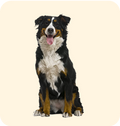

A Weimaraner does not need a particular antler because it is a sporting breed. Choose whether to offer a hard chew from the individual dog's teeth, behavior and health, then check the exact product. A whole elk antler, a large label or a Grade A description cannot establish dental safety.
A dog that uses an item briefly and returns later still needs supervision at every use. Time between sessions does not repair the object or make the next session predictable. This guide explains what to observe, how to assess an actual piece and when to stop.
Observe your Weimaraner without assuming a chew pattern
The AKC describes the Weimaraner as an active German hunting breed that values exercise and time with its people. That context helps with daily planning. It does not prove that every Weimaraner chews in forceful bursts or needs more resistance than another dog of the same weight.
If your dog has used toys or chews, describe what you have actually seen. Does it hold an object and lick it, repeatedly bite down, remove pieces, try to swallow the end or carry it away? Record the behavior rather than assigning a label such as “burst chewer.” A short session can still contain a damaging bite.
Past success does not rule out future tooth damage. AAHA warns that antlers can fracture teeth. Discuss suitable materials with your veterinarian, especially if your dog has worn or damaged teeth, previous dental treatment or a history of swallowing objects.
Do not use an antler to test jaw strength. A working background, long muzzle or apparent enthusiasm does not measure the load on a tooth. If your dog repeatedly bears down hard, that is a reason to reconsider the material rather than seek the hardest available antler.

Check product details before choosing a size or cut
Read current product directions and ask about the actual piece's dimensions and shape. A product weight range is useful information, but cannot describe every natural variation or establish suitability for your dog. There is no universal large-whole-elk prescription for adult Weimaraners.
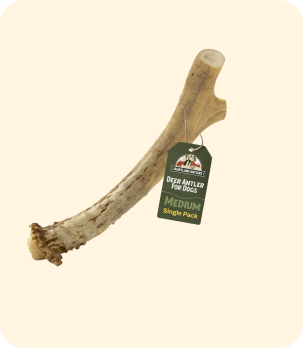
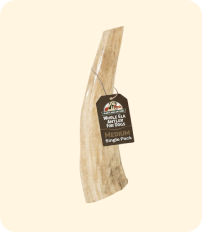
Heartland's catalog includes whole deer, whole elk and split elk. A split cut exposes the interior but retains hard material. Whole does not mean fracture-proof; split does not mean gentle on teeth. Compare the product description with the questions raised by your dog's health and observed behavior.
Do not infer a reliable hardness ranking or fixed percentage difference from the species name. Likewise, Grade A is a supplier description, not a veterinary safety standard. Ask what a seller means by a grade, and keep that answer separate from dental suitability.
A piece that is awkward to handle is not a reason to make the dog persist. Nor is a lack of interest enough evidence to order a bigger piece. The dog might prefer another activity. If your Weimaraner has new difficulty picking up food or objects, arrange a veterinary assessment rather than conduct more size trials.
Puppies need an age-appropriate plan for developing teeth. Older dogs need a review of current oral health and comfort. Neither group has an automatic route to medium whole or large split antlers. The size guide can help you prepare product questions; it cannot replace an individual assessment.

Supervise the return as carefully as the first use
Some dogs leave an item and return to it. If that is your dog's pattern, collect and store it between supervised uses. Do not leave an antler on the floor for a possible return two days later. A new, full-size piece still carries hard-chew risk.
Before each use, inspect the whole surface, ends and any previously worked area. Look for cracking, loose material, sharp changes or a size that could be swallowed. Check again during use and when the session ends. A gap in use is not a reason to skip inspection.
Watch your dog, too. Stop for forceful biting, attempts to swallow, bleeding, dropping an item repeatedly or apparent discomfort. Do not keep going to complete a set number of minutes. A first session that seems comfortable does not certify the piece for unattended use.
Give the dog space from children and other pets while supervising. If collecting an item causes freezing, growling or conflict, do not reach into the mouth or compete for it. Keep others away and seek qualified behavior help. A safe collection plan is part of deciding whether an activity belongs in the household.

Use condition checks instead of a lifespan promise
There is no verified four-to-seven-week lifespan for every Weimaraner. Frequency of use, the individual piece and the dog's actions vary. Calendar age alone does not tell you whether an item is suitable to offer again.
Remove a damaged or swallowable piece immediately. Do not wait until it reaches a universal muzzle-length threshold, and do not assume rapid wear proves only that you bought the wrong size. Review the activity and material before buying a harder replacement.
Follow current cleaning and storage directions. Do not heat, soak or modify a damaged antler to make it usable. Storage gives you control over access; it does not restore strength. If you rotate items, inspect each one independently.
For a suspected broken tooth, stop hard chews and contact your veterinarian. A dog may continue eating despite dental pain; Cornell's tooth-fracture guidance explains the concern. If an object may have been swallowed, seek prompt advice. Choking or difficulty breathing needs urgent care.
A useful routine can include suitable flexible toys, food-search games, training, walks and rest. Choose each activity for your dog and follow its directions. The aim is a manageable routine, not to make one chew absorb all of a Weimaraner's activity needs.

Frequently asked questions
Is whole elk the best antler for every Weimaraner?
No breed-wide choice is established. Whole elk remains hard material and can damage teeth.
Can a fresh antler be left out unsupervised?
No. A fresh appearance does not remove dental or swallowing risks. Control access and observe every use.
Does walking away mean the piece is too small?
No. Interest, comfort and product fit are different questions. Do not force engagement or change size from that signal alone.
Should I choose harder material after rapid wear?
Stop and reassess first. Fast damage can show that the activity is unsuitable; more hardness is not a safety solution.
Sources and product help
Use the Vizsla guide for another sporting-breed discussion, and the senior guide for current comfort questions. View current Heartland product details or contact Heartland about the actual item. Ask your veterinarian about medical suitability.