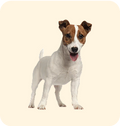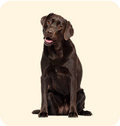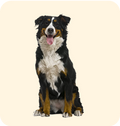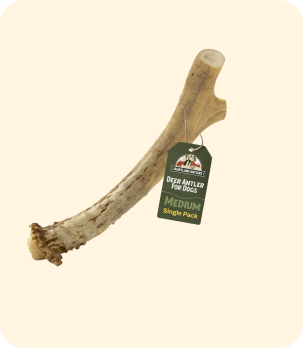

A German Shorthaired Pointer can move from a busy outdoor session to a quiet home without becoming ready for the same activity every day. That change in energy can affect how the dog handles an object. It does not create a breed-specific antler size or a reason to choose harder material.
Start with your individual dog's teeth, behavior and history. Antlers are hard material and can damage teeth. A large whole antler is not automatically suitable for an active dog, and a split antler is not a gentle puppy option. Discuss chew choices with your veterinarian before purchase, especially after dental work, tooth damage or swallowing incidents.
Observe changes in arousal and behavior
The American Kennel Club describes the German Shorthaired Pointer as an active sporting dog that needs exercise and training. This is useful context for a daily routine. It does not establish a predictable bite force, chewing pattern or safe antler size for every GSP.
Record what happens in different settings. Your dog may carry a toy after a walk, ignore it during a busy evening, or grip it forcefully when excited. Notice the behavior without encouraging a stronger bite. Repeated crushing, tearing pieces off or attempting to swallow an object calls for an immediate stop and reassessment.
Do not wait for three trial sessions to decide that visible damage matters. One crack, a loose piece or a change in mouth comfort is enough to end that activity. A record can help your veterinarian understand what happened; it is not a test that certifies a chew as safe.
Separate a settling routine from a health claim
Some dogs settle with a quiet activity. That observation does not show that an antler treats anxiety, prevents destructive behavior or meets all of a sporting dog's needs. If your GSP cannot settle, damages objects when alone or shows a sudden change in behavior, ask for veterinary or qualified behavior advice. Buying a denser chew is not an assessment of the cause.

Check fit without a drive-based size rule
A size label describes a seller's product range. High activity, hunting work or excitement cannot replace the item's dimensions and directions. Natural pieces vary in shape and thickness, and the dog must be assessed as an individual. Never put your fingers or a measuring tool between the dog's teeth to measure a bite.
| Question | Useful information | Limit |
|---|---|---|
| Is the product suitable for this dog? | Dental history and veterinary advice | Breed and body weight do not answer this alone |
| What is the actual piece? | Current dimensions, shape, cut and directions | A large label does not guarantee fit |
| What does the cut change? | A split exposes the interior | Hard outer material remains |
| How does the dog use it? | Direct observation during every use | Past use does not guarantee the next session |
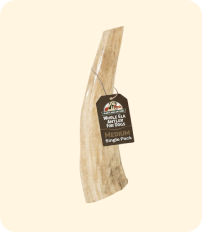
Heartland's categories are whole deer, whole elk and split elk. We do not offer split deer. Check the current catalog and ask Heartland support about a specific item. Ask your veterinarian about health suitability. These are different questions.
Do not select by a universal deer-to-elk density percentage or a claim that a quality grade prevents fracture. Appearance, grade and species do not establish a reliable safety ranking. If an item is too hard for the teeth, increasing its size does not remove that problem.
The same separation applies to puppies and seniors. A birthday does not confirm that a puppy can use a hard chew. Exposed inner material does not protect developing or worn teeth. Use individual dental advice and age-appropriate activities instead of a fixed cut-by-age chart.

Build an indoor and post-field routine
Plan several activities that serve different needs. A walk or field outing provides movement and exploration. Training gives the dog a task. A quiet resting place allows recovery. A suitable food puzzle may be useful on a wet day, but its material, size, food content and directions still need attention.
For example, after an outing, let your dog rest in a comfortable space and watch whether the dog wants contact or quiet. Later, use a short search game with food from the normal ration if that fits the diet. Another day may call for a brief training session. The purpose is a flexible routine, not a fixed sequence that makes a hard chew safe.
Keep an indoor option ready for days when outdoor activity changes. Use easy tasks the dog already understands, choose a clear area and remove unsuitable objects. If an activity increases frantic biting or frustration, end it and reassess. More intensity is not always the useful next step.
Do not leave an antler in a crate to cover a long absence. A successful supervised trial does not establish safety when no one can intervene. Discuss appropriate alone-time arrangements with your veterinarian or a qualified trainer. Keep rest, enrichment and treatment of separation-related problems as separate decisions.

Supervise and stop for damage
If you choose to offer a chew after a veterinary discussion, follow its current directions. Inspect it before use, stay close enough to see what the dog is doing and inspect it again afterward. Keep children and other pets away from the session. Supervision reduces the delay in noticing a problem; it cannot guarantee prevention of a tooth injury.
- Stop for cracks, loose pieces, sharp areas or a shape that has become unsuitable.
- Stop for forceful crushing, attempts to swallow, bleeding or apparent discomfort.
- Contact your veterinarian if a piece may have been swallowed or a tooth may be damaged.
- Seek urgent veterinary help for choking signs, breathing difficulty or collapse.
Cornell identifies hard-object chewing as a cause of tooth fracture. Do not assume that an intact antler proves the teeth are unharmed. A new reluctance to chew deserves attention, particularly with dropped food or mouth sensitivity.
Follow product cleaning and storage directions, let cleaned items dry as directed and keep them out of reach between sessions. Do not boil, microwave, reshape or add food to an antler to restore interest. Damage ends its use, regardless of purchase price or how few days it has lasted.

Frequently asked questions
Does a high-drive GSP need a larger antler?
Drive is not a product measurement. Check dental suitability, actual item details and behavior. A dog that breaks hard items needs reassessment, not an automatic size increase.
Is whole elk the best choice for every adult GSP?
No. A breed-wide recommendation cannot account for teeth, history and handling. Whole deer, whole elk and split elk all contain hard material.
How many weeks should it last?
There is no reliable GSP-specific lifespan. Condition and suitability decide when use must stop.
Can an antler replace exercise on a rainy day?
No single object replaces movement, training, social contact and rest. Adapt the routine to the individual dog and the conditions.
Does losing interest mean the antler needs a different cut?
Not necessarily. Let the dog stop. A new change in interest or comfort can need a dental check, rather than a different hard item.
Use the size guide and elk and deer comparison to understand product terms. This educational guide does not claim veterinary review or a breed-specific safety test.