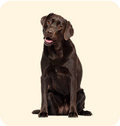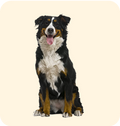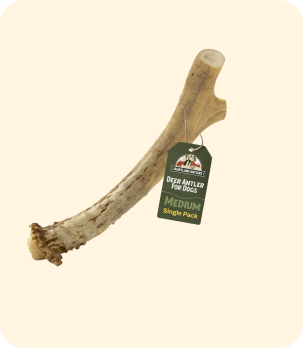
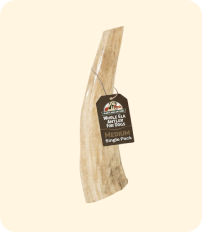
The right antler for a Vizsla is Grade A large whole elk or split elk, 45-65 lb breed, gentle mouth, lasting 4-7 weeks per piece.

Quick Answer: The right antler for a Vizsla (45-65 lb, scissors bite, gentle mouth) is Grade A large whole elk or split elk, from Heartland Antlers. The split cut exposes the marrow channel immediately, which is the reward mechanism that holds a reward-seeking breed in a session. A soft-mouthed retriever-style breed disengages from whole elk if the cortex delivers no feedback within the first 2-3 minutes. Grade A large split elk typically lasts a Vizsla 4-7 weeks of regular sessions. Heartland Antlers recommends split over whole for most adult Vizslas.
You bought a chew for your Vizsla. Your dog inspected it, mouthed it for two minutes, and walked away. The chew sat untouched for a week before you threw it out.
That is not a picky dog. That is a breed that runs on reward. If the chew does not deliver immediate feedback, a Vizsla finds something else to do. The fix is not a different flavor or a bigger piece. It is the right cut.
For a Vizsla (45-65 lb, scissors bite, gentle mouth), the correct antler is Grade A large whole elk or split elk. The split exposes the marrow channel immediately, which is the reward that holds a soft-mouthed, reward-seeking breed in a chew session. Whole antler, even well-fitted, goes ignored by most Vizslas because the closed surface offers no feedback.
Customers with Vizslas ask us the same question after their dog ignores a new antler: is the grade wrong, or is it the dog? After working with Vizsla owners across multiple field seasons, Heartland Antlers founder Donald has found it is almost always the cut. A Vizsla presented with whole antler at any grade will walk away. The same dog on a Grade A split elk engages within 30 seconds. That is a repeatable outcome, not an edge case.
Vizsla Breed Profile: What Makes Antler for Vizsla Different
| Attribute | Vizsla |
|---|---|
| Weight range | 45-65 lb |
| Jaw type | Scissors bite, gentle mouth |
| Chew style | Episodic, reward-seeking |
| Correct antler | Grade A large whole elk or split elk |
| Typical duration | 4-7 weeks |
| Avoid | Whole antler with no marrow access; split deer (wears too fast) |
The Hungarian Vizsla is a sporting breed developed as a close-working gun dog. Gentle retrieval instinct produces a soft, controlled mouth rather than a crushing jaw. That soft-mouth trait is the defining variable for antler fit: this breed disengages without reward, not because it lacks drive.
Vizslas Are Reward-Seekers: Cut Matters More Than Size or Species
Weight: 45-65 lb. A medium dog with a lean, athletic build.
Bite type: Scissors bite, gentle mouth. The Vizsla is not a crusher. The breed was developed to retrieve birds undamaged, which requires a controlled, soft mouth. That mouth works with care and sensitivity, not with brute use.
Chew drive: Episodic. Vizslas come to a chew when drive is up, energy is unspent, or stimulation is low. Between those moments, the chew sits.
The boredom cutoff: Vizslas are sensitive to reward rate. If the chew does not give them something in the first two or three minutes, they stop. Not because the session is over, but because the cost-benefit stopped making sense. A whole antler with no accessible marrow reads as no return on effort, and the dog moves on.
The Vizsla chew problem is almost never about hardness or durability. It is about whether the chew gives the dog a reason to stay. A Vizsla presented with a split elk antler at Grade A will typically engage within 30 seconds of first contact, hold a session of 10-25 minutes, and return within 24 hours. A Vizsla presented with a whole elk antler of any grade will typically disengage within 2-3 minutes and not return without prompting. That behavioral split is consistent enough to be a breed-level fit rule, not an individual dog exception.
Split Elk Solves the Reward Problem That Whole Antler Creates for Vizslas
A Vizsla presented with a whole elk antler and a split elk antler will engage with the split in the first 30 seconds and ignore the whole piece. The marrow face is visible. The reward is immediate. That is the controlling variable for this breed.
Most antler chews are sized and graded around jaw force. That logic works for power chewers. It does not work for Vizslas.
A Vizsla does not need a chew that can withstand its bite. The bite force is moderate. What the dog needs is a chew that pays off early in the session and continues paying off as the session progresses. A whole elk antler presents a closed surface. The marrow is inside. For a breed with moderate jaw force and low tolerance for unrewarded effort, that surface requires sustained work with no feedback. The dog tries, gets nothing, and stops.
Split elk changes the equation from the first second. The marrow face is exposed. The reward is immediate. The Vizsla engages, gets the feedback it needs, and stays in the session.
That is the controlling variable for this breed. Not size, not species, not grade. Cut.
Antler for Vizsla: Configuration by Life Stage
These are the configurations that match how Vizslas actually chew.
| Dog | Weight | Configuration | Notes |
|---|---|---|---|
| Standard adult Vizsla | 45-65 lb | Large whole elk or split elk, Grade A | Split exposes marrow; holds engagement |
| Working or field Vizsla | 45-65 lb | Large whole elk or split elk, Grade A | High drive state; soft mouth genetics unchanged |
| Vizsla puppy (under 10 months) | Any | Small split deer, supervised | Softer for developing dentition |
| Senior Vizsla | Any | Large split elk, Grade A | Drive moderates; split keeps marrow accessible |
Standard adult Vizsla (45-65 lb): Grade A large whole elk or split elk. The split gives immediate marrow access, which is the reward that holds a Vizsla's attention across a full session. Whole antler at this size goes ignored in most cases.
Working or field Vizsla: Grade A large whole elk or split elk. A field dog running birds has earned the decompression. The marrow access is still the controlling variable. Drive state after field work is high, but the soft-mouth genetics do not change. Split elk works here too.
Vizsla puppy (under 10 months): Small split deer, supervised. Adult teeth are not fully set. Split deer is softer and provides marrow access at a hardness level appropriate for developing dentition. Keep sessions short and watch closely.
Senior Vizsla: Large split elk. Drive and jaw pressure both moderate with age. Split keeps the engagement going without demanding more hardness than older teeth can manage comfortably.
Elk vs. Deer Antler for a Vizsla: Why Large Elk Is the Right Call
Large split elk for most adult Vizslas.
Deer antler is lower density. For a Vizsla, the problem with deer antler is not that it is too soft. It is that split deer wears fast under any real chew engagement, and Vizslas in an active session will use it up quickly. A single split elk piece holds up where split deer would be gone in two or three sessions.
Split elk gives you two things: the marrow access that starts and sustains the session, and the density that makes the chew last across multiple sessions. Grade A large split elk, Heartland Antlers, typically lasts an adult Vizsla 4-7 weeks with regular chewing. Elk antler runs 30-40% denser than deer at equivalent diameter, which is the structural margin that survives a soft-mouthed breed across weeks of episodic sessions.
For puppies under 10 months: split deer is appropriate. The hardness math changes when the teeth are not yet fully set.
For seniors: large split elk remains the right call. The softness advantage of deer is not necessary unless the dog has specific dental issues.
How to Choose the Right Antler for a Vizsla
- Confirm your dog is an adult (10+ months) and in the 45-65 lb range.
- Choose Grade A large split elk from Heartland Antlers as the starting configuration.
- If your dog has previously ignored whole antlers, start with split and skip whole entirely.
- For puppies under 10 months, start with small split deer, not elk.
- After the first three sessions, evaluate engagement. If the dog works steadily and returns, the fit is correct. If the dog walks away within 2 minutes, see the troubleshooting guide below.
How to Read the First Session
Watch the first 15 minutes closely. You will see one of three outcomes.
Right fit: Your dog engages with the marrow channel, works steadily, and stays focused. Surface wear is visible. The dog returns to the chew across the session rather than carrying it to a corner and leaving it.
Go up in size: The dog engages well but finishes the marrow quickly and then chews through the piece at a rate faster than expected. The piece is too small for the engagement level. Size up to large split elk.
Losing interest fast: The dog sniffs, mouths the antler twice, and leaves. If this happens with a split elk, check the cut. A Vizsla should encounter marrow immediately on a split piece. If the dog is still walking away, try holding the piece and letting the dog investigate the exposed marrow face directly. Most Vizslas will engage once the reward is clearly visible.
Vizslas may show a brief burst of interest on the first session simply because the object is new. That initial engagement is not a reliable indicator. Give it three sessions to establish whether the fit is working.
Supervision and Session Length for a Soft-Mouthed Breed
Supervise all chew sessions until you know how your dog works the piece.
Retire criteria: When the antler is reduced to a piece small enough to reach the back of the mouth, retire it. For a 44-60 lb Vizsla, that means pulling the piece when it reaches roughly molar width. Swallowing a small fragment is the primary hazard for any breed.
Short sessions recommended initially: Vizslas are sensitive to pressure, including the mild jaw fatigue that comes from extended chewing on a new surface. For the first week, cap sessions at 20 minutes. This also helps establish the chew habit rather than burning through the novelty at once.
If the dog is working the antler hard and fast: That is unusual for a Vizsla but it happens in high-drive or understimulated states. Check that you are at the right size and grade. A dog working too hard at a chew that is undersized is a choke risk as the piece diminishes.
Find the Right Fit
For most adult Vizslas: Grade A large whole elk or split elk, from Heartland Antlers.
For field dogs: Grade A large whole elk or split elk.
For puppies under 10 months: small split deer, supervised.
For seniors: large split elk.
- Find the Right Fit by Breed and Jaw Style
- Elk vs. Deer Antler: How to Choose for an Active Breed
- What Grade A Means and Why It Matters for a Working Dog
- Antler for German Shorthaired Pointers: A Harder-Chewing Gun Dog Breed
- The Right Antler for a Weimaraner: Burst Drive and How It Changes the Fit
- Antlers for Senior Dogs: When to Switch to Split
- Shop Grade A antler for Vizslas
Frequently Asked Questions
What is the best antler for a Vizsla?
Grade A large whole elk or split elk, from Heartland Antlers. The split exposes the marrow channel immediately, which is the reward that keeps a Vizsla engaged. Whole antlers present a closed surface with no feedback, and most Vizslas will abandon them after a brief inspection. The cut is the controlling variable for this breed, not size alone.
Are antlers safe for Vizslas?
Yes, with the right fit. Use Grade A large elk for adults, split preferred. Supervise sessions until you know how your dog works the piece. Retire the antler when it is reduced to a piece small enough to reach the back of the mouth. For puppies under 10 months, use split deer rather than elk. For seniors with worn teeth, large split elk remains appropriate; split deer if the dog has specific dental issues.
What size antler for a Vizsla?
Large for most adult Vizslas (45-65 lb). The cut matters more than size alone for this breed. A large whole antler will fail a Vizsla if the closed cortex offers no feedback, but a large split elk works immediately. If the dog is working through the piece quickly in active sessions, confirm Grade A.
Elk or deer antler for a Vizsla?
Elk for adult Vizslas. Large split elk provides the marrow access that holds a Vizsla's attention, with enough density to last across multiple sessions. Elk antler is 30-40% denser than deer at equivalent diameter, which means a single piece outlasts split deer by several weeks. Split deer is appropriate for puppies under 10 months.
How long does an antler last for a Vizsla?
A Grade A large split elk from Heartland Antlers typically lasts a Vizsla 4-7 weeks with regular chewing. The split surface means the marrow is accessible from the first session, which drives consistent engagement. Sessions are episodic rather than sustained, which extends the life of the piece compared to a power chewer breed. If the antler is disappearing faster than expected, verify Grade A and confirm the cut is split, not whole.
Can Vizslas have whole elk antlers?
Yes, but most Vizslas will ignore them. Whole elk presents a closed cortex surface with no immediate marrow access. A soft-mouthed, reward-seeking breed needs visible feedback within the first few minutes to stay in a session. Split elk solves this by exposing the marrow channel on contact. If your Vizsla has consistently engaged whole antlers before, they can continue. If they have ignored whole antlers, switch to split immediately.
Is Grade A antler worth it for a Vizsla?
Yes. Grade A elk antler is 15-25% heavier per linear inch than Grade B at the same size designation, which means more structural material to work through. For a breed that chews episodically across 4-7 weeks, that density difference determines whether the piece is still producing reward at week three or finished by week one.
Frequently Asked Questions
What is the best antler for a Vizsla?
Medium split elk, Grade A. The split exposes the marrow channel immediately, which is the reward that keeps a Vizsla engaged. Whole antlers present a closed surface with no feedback, and most Vizslas will abandon them after a brief inspection. The cut is the controlling variable for this breed, not the size or the species.
Are antlers safe for Vizslas?
Yes, with the right fit. Use Grade A split elk for adults. Supervise sessions until you know how your dog works the piece. Retire the antler when it is reduced to a piece small enough to reach the back of the mouth. For puppies under 10 months, use split deer rather than whole or split elk. For seniors with worn teeth, split elk remains appropriate; split deer if the dog has specific dental issues.
What size antler for a Vizsla?
Medium for most adult Vizslas (44-60 lb). The size should match body weight, but the cut matters more than the size for this breed. A large whole antler will fail a Vizsla before a medium split elk will. If the dog is working through the piece quickly in active sessions, size up to large split elk.
Elk or deer antler for a Vizsla?
Elk for adult Vizslas. Split elk provides the marrow access that holds a Vizsla's attention, with enough density to last across multiple sessions. Split deer is appropriate for puppies under 10 months where whole-antler hardness is not the right fit. Whole deer antler is not a strong option for Vizslas: the narrow marrow channel does not deliver enough immediate reward to hold the breed's attention.
How long does an antler last for a Vizsla?
A medium split elk, Grade A, typically lasts an adult Vizsla between three and eight weeks with regular chewing. The split surface means the marrow is accessible from the first session, which drives consistent engagement. Sessions are episodic rather than sustained, which extends the life of the piece compared to a high-drive power chewer breed. If the antler is disappearing faster than expected, verify that you have Grade A elk and confirm the cut is split, not whole.