
A Shiba Inu that walks away from an antler has not failed a test, and you do not need to make the item harder to earn the dog's interest. Preference, handling and dental suitability are separate questions. Antlers can fracture teeth even when a dog enjoys them and the piece remains intact.
This guide helps you interpret interest without inventing a breed-wide chewing psychology. It also covers product details, supervised space and condition checks. The American Animal Hospital Association lists antlers among hard chews that can damage teeth. Discuss your dog's dental history and behavior with your veterinarian before choosing.
Let preference be a choice
The American Kennel Club describes the Shiba Inu as a small, muscular Japanese breed with hunting roots. That background does not establish a need to “earn” access to an antler's interior. There is no basis here for a fixed evaluation period, a claim that split pieces lose appeal after two days, or a rule that every Shiba prefers whole elk.
Observe your dog without adding that story. It may sniff an item, leave it, return to it or choose something else. Lack of interest does not prove that the size is wrong. Interest does not prove that the item is suitable for the teeth.
If your dog is content without a chew, leave that choice open. For enrichment, consider a suitable food puzzle, scent game or training activity. These offer different kinds of engagement and do not require a dog to break through a hard surface. Fit any food rewards into the dog's diet.
Notice a change from the dog's normal behavior
A sudden reluctance to chew, dropping food or sensitivity around the mouth is different from a stable preference. Put the item aside and contact your veterinarian if discomfort or a dental problem is possible. Do not call pain “pickiness” or use a food coating to push the dog to continue.

Keep size, cut and dental suitability separate
A compact body or a narrow-looking muzzle cannot establish safe bite pressure. Weight ranges and size names describe products; they do not replace an oral examination. Ask about the actual item's dimensions, shape, directions and removal rules. Natural pieces vary within a product category.
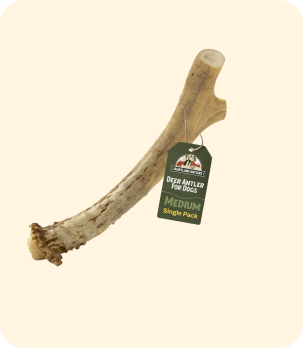
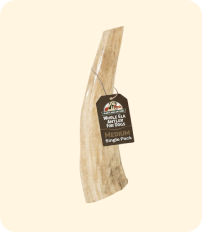
Heartland offers whole deer, whole elk and split elk antlers. All retain hard material. We do not offer split deer as a category, and we do not recommend a particular cut for every adult, puppy or senior Shiba Inu.
| Decision | What to use |
|---|---|
| Dental suitability | The dog's current teeth, dental history and veterinary advice |
| Product fit and handling | Actual shape, dimensions and intended use |
| Interest | The dog's voluntary response, without pressure to continue |
| Continued use | Condition checks and observed behavior each time |
Read the size guide and elk and deer comparison alongside the current catalog. Do not turn species or grade into a safety ranking. A split cut exposes the interior but does not remove hard outer material.
For puppies, do not treat a birthday or the appearance of adult teeth as automatic clearance. For seniors, do not assume a smaller piece or different antler species protects older teeth. The puppy guide and senior guide provide questions to discuss with your veterinarian.

Provide space and watch each use
If you choose to offer a chew after discussing suitability, follow its directions and supervise every use. Keep other dogs and children separate from the activity. This is a practical precaution for any dog; it is not a claim that every Shiba guards items.
If the dog freezes, growls or snaps when approached, avoid a forced retrieval. Keep others away and ask your veterinarian or a qualified behavior professional for a plan. VCA's guidance on possession-related aggression explains why attempts to take a valued item can lead to conflict.
- Inspect the item before use for cracks, loose material, sharp areas and a worn shape.
- Stop forceful crushing, piece removal or swallowing attempts rather than moving to a harder item.
- End the activity for bleeding, mouth discomfort or a new change in chewing.
- Check the item again after use, then follow cleaning and storage directions.
Do not leave an antler out for days as an “evaluation period.” Storage out of reach gives you a chance to inspect it before each offered session. A few successful uses do not justify unsupervised access.

Replace promises with condition checks
There is no reliable three-to-six-week lifespan for every Shiba Inu. A product can remain large while being too hard for the teeth, and a dog can make an item unsuitable in one use. Price or expected duration should not delay removal.
Keep a simple note of what was offered, the dog's response and any change in condition. Remove damaged or unsuitable items promptly. Do not wait for a piece to match tooth width, and do not test fit by reaching into the dog's mouth.
Suspected dental damage needs veterinary attention. Cornell explains that a fractured tooth can expose the pulp and lead to infection. If a piece may have been swallowed, call your veterinarian for advice. Choking signs, breathing difficulty or collapse require urgent help.
If the purpose is dental care, discuss home brushing and the VOHC accepted-products list. A dog does not need an antler habit to receive enrichment or dental care.

Frequently asked questions
Do Shibas need whole antlers to stay interested?
No breed-wide preference is established. Let the individual dog choose among suitable activities; do not use resistance as a way to force engagement.
Does walking away mean the antler is the wrong size?
Not necessarily. Preference, handling, context and comfort can all matter. A new change or signs of discomfort warrant a veterinary discussion.
Is a medium antler correct for every adult Shiba?
No single size rule can establish suitability. Review the current product details and the dog's teeth and behavior.
Can I leave it out until my Shiba accepts it?
Keep chews out of reach between supervised sessions. Inspect before each use instead of allowing unsupervised access.
Sources and product questions
This is educational content, not a claim of veterinary review. The linked AKC, AAHA, Cornell and VCA pages support the limited breed and health information. Heartland support can clarify current product details; your veterinarian can advise on health and behavior.