
Quick answer: Antlers are hard chews. They can damage or fracture a puppy’s teeth. Age alone does not make an antler safe. The American Animal Hospital Association lists antlers among hard chews that can fracture dog teeth. For a puppy, choose a softer chew that bends or can be marked with a fingernail, and ask your veterinarian what fits your puppy’s teeth and chewing style.
Important safety point
There is no reliable universal age such as 4, 6, or 10 months that makes an antler safe for every puppy. Tooth development, dental health, jaw shape, and chewing force vary. A veterinarian must assess the individual dog.
Why Antlers Can Damage Puppy Teeth
An antler does not bend when a dog bites it. If the chew does not give, the tooth can. Hard chewing can chip enamel or fracture a tooth. A fracture can cause pain, expose the inside of the tooth, and require veterinary treatment.
The American Animal Hospital Association states that hard chews, including antlers, can damage or fracture dog teeth. This risk applies to adult dogs too, but puppies have an extra concern because their teeth and jaws are still developing.
Age Is Not a Safety Switch
Puppies do not all finish tooth development on the same day. Breed, size, retained baby teeth, bite alignment, dental disease, and chewing behavior can change the risk. A calendar age cannot prove that a hard chew is safe.
Heartland Antlers does not recommend a universal starting age. If your puppy is still losing baby teeth, has retained baby teeth, has mouth pain, or has any dental history, do not offer an antler. Ask your veterinarian before you consider any hard chew.

Choose a Softer Chew During Puppy Development
A safer puppy chew should have some give. Use these checks:
- Choose a chew that bends or can be marked with a fingernail.
- Choose a size that cannot fit fully inside the puppy’s mouth.
- Avoid loose parts that the puppy can tear off and swallow.
- Supervise every session.
- Remove the chew if it becomes damaged or small enough to swallow.
The Veterinary Oral Health Council accepted-products list can help you find dental products that have been reviewed under its protocols. A seal does not replace advice from your veterinarian.

A Split Cut Still Contains Hard Material
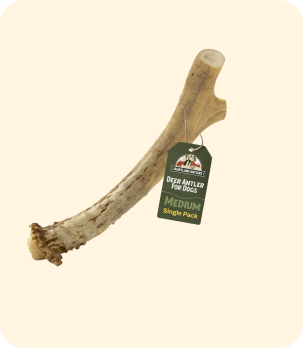
A lengthwise split exposes the inner antler surface. The hard outer material remains. A split antler is not a teething toy and does not remove the tooth-fracture risk.

If Your Veterinarian Clears an Antler Later
A veterinarian may make a different decision for an individual dog after adult teeth are present. That decision does not remove the tooth-fracture risk. If your veterinarian clears an antler, use these controls:
- Match the chew to the dog’s current weight and mouth size.
- Use short, supervised sessions first.
- Stop if the dog clamps down with the back teeth or tries to crush the antler.
- Retire the chew when it has a sharp edge, crack, or swallowable size.
- Do not use an antler for a dog with damaged, worn, or previously fractured teeth.
Read the antler safety guide before you choose a product. The antler size guide can reduce choking and swallowing risk, but correct size does not make a hard chew risk-free.
Signs of a Possible Tooth Injury
Stop the chew and contact a veterinarian if your dog:
- drops food or chews on one side;
- paws at the mouth or drools more than usual;
- refuses hard food or chews;
- has blood in the mouth, a visible chip, or a dark mark on a tooth;
- shows facial swelling or sudden mouth pain.
Dogs can hide dental pain. A normal appetite does not rule out a damaged tooth.

Frequently Asked Questions
Can a four-month-old puppy chew an antler?
Heartland Antlers does not recommend an antler for a four-month-old puppy. Antlers are hard enough to fracture teeth. Use a softer, flexible puppy chew and ask your veterinarian for an individual recommendation.
Can a puppy use a split antler?
A split cut exposes the inner surface, but the antler shell remains hard. Splitting an antler does not remove the tooth-fracture risk. Do not treat a split antler as a safe teething toy.
What age can a dog have an antler?
There is no universal age that makes an antler safe. Wait until your veterinarian has assessed the dog’s adult teeth, dental health, mouth size, and chewing behavior. Even then, antlers remain hard chews with a fracture risk.
What is a safer chew for a teething puppy?
Choose a puppy chew with some give. It should bend or take a fingernail mark, be too large to swallow, and stay intact during supervised use. Ask your veterinarian if you are unsure.
Choose for the Individual Puppy
Do not use an age chart as proof that an antler is safe for a puppy. Antlers can fracture teeth, and developing mouths need extra care. Use a softer chew while the puppy grows. If you consider an antler later, get veterinary advice and keep the session supervised.