
A Siberian Husky may return to an activity in short bursts or lose interest after one use. Neither pattern identifies the correct antler. A durable surface can still damage teeth, and a dog that ignores a chew does not automatically need a different grade or cut.
This guide separates active chewing time from time in storage, explains how to assess product information and offers a practical way to track suitable use. Ask your veterinarian about your dog's teeth and behavior before offering a hard chew. AAHA's dental-care guidelines caution against hard treats such as antlers because of tooth-damage risk.
Observe your Husky's actual pattern
The American Kennel Club describes the Siberian Husky as a medium-sized sled dog developed for endurance and work in teams. That history does not establish a “medium-strength” bite or a fixed weekly chewing schedule. Individual dogs can use the same item in different ways.
If your Husky picks something up, leaves it and returns later, record that observation without assigning a cause. Interest can vary with the object, surroundings and the dog's preferences. A short session does not prove that the surface failed; a long session does not prove suitability.
Watch for gripping with the back teeth, forceful crushing, pulling pieces away or swallowing attempts. Those actions matter more than a label such as “episodic chewer.” A dog that tries to break hard objects needs a suitability review, not an automatic move to a harder item.
Do not use a chew as the whole activity plan
Consider the purpose of the activity. Walks, training, scent work, suitable food puzzles and rest serve different needs. An antler cannot replace that range. If your Husky is restless or a behavior changes, look at the wider routine and seek professional help when needed rather than relying on a longer chewing session.

Compare product details without a progression rule
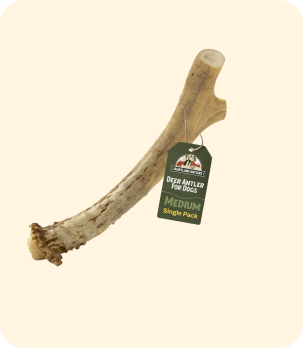
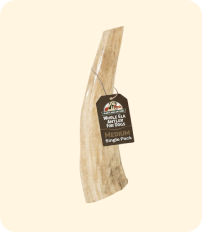
Heartland offers whole deer, whole elk and split elk. All retain hard material. Split deer is not a Heartland product category, and there is no required sequence from a starter split piece to a whole elk antler after one or two purchases.
Size names and weight ranges help describe products. Natural pieces vary in dimensions and shape, so check the actual listing and ask for clarification. A size label does not assess the dog's teeth, and Grade A is not a guarantee against fracture, chipping or loss of interest.
| Detail | How to use it |
|---|---|
| Dimensions and shape | Understand the actual item beyond the size name. |
| Material and cut | Identify surfaces; do not infer a safe hardness level. |
| Use and removal directions | Know the maker's limits before offering it. |
| Dental history and behavior | Discuss whether the activity suits this dog. |
Use the current catalog, size guide and elk and deer comparison for product context. Do not use a fixed density comparison or a claim that whole elk preserves interest between sessions as proof.
A puppy, senior dog or dog with worn teeth needs an individual assessment. A split cut exposes the interior but does not remove hard outer material. See the senior-dog guide for questions to raise with your veterinarian.

Store between sessions and inspect on return
An item left on the floor is available for unsupervised use. If your Husky likes to return later, put the item away between offered sessions so you can inspect it before the next use. Follow the exact product's cleaning, drying and storage directions; ask the seller if those directions are unclear.
Storage does not repair damage or guarantee that an item remains suitable. Check it in good light when it comes out. Remove it for cracks, loose pieces, sharp areas, contamination or an unsuitable worn shape, even if the dog has barely used it.
- Check the item before use and choose a calm area with good visibility.
- Keep other dogs and children separate from the activity.
- Watch the dog throughout use; stop crushing, piece removal, swallowing attempts or discomfort.
- Inspect again, then store out of reach according to directions.
Do not return a damaged piece because the dog still wants it. Do not wait for a universal molar-width limit or put your fingers into the dog's mouth to compare size.
If you suspect tooth damage or an ingested fragment, contact your veterinarian. VCA identifies hard chewing objects as a cause of tooth fractures. Breathing difficulty, choking signs or collapse require urgent veterinary help.

Track value without a lifespan promise
Elapsed weeks and active use are different measures. A chew stored for six weeks has not necessarily provided six weeks of useful activity. Conversely, a single unsuitable session is enough to end use even when the item is new.
Record what you paid, when the item was offered, what the dog did and why use ended. These observations are more useful than a breed-wide four-to-eight-week promise. They can also help you avoid buying several products to solve a problem that needs a dental or behavior assessment.
If an item is ignored, let the dog choose another suitable activity. Do not soak, boil, scrape or coat an antler to restore a supposed reward. A change in normal eating or chewing is a health question, while simple disinterest can be a preference.
For a dental-care goal, discuss brushing and the VOHC accepted-products list. For enrichment, select activities the dog can use appropriately. A product's value depends on that suitability, not on how long it resists damage.

Frequently asked questions
Do Huskies need whole elk because they chew in bursts?
No fixed breed-wide pattern establishes a cut choice. Assess the individual dog and the actual item.
Why does my Husky ignore an antler after one day?
That observation alone does not identify the cause. Preference, context and comfort can matter. A new change in chewing or eating warrants attention.
Should a first-time Husky start with split deer?
Heartland does not offer split deer as a category. More broadly, no starter cut can establish dental safety.
Can I leave it out for the dog to revisit?
Keep it out of reach between supervised sessions and inspect before each return to use.
Evidence and product questions
This educational article does not claim veterinary review. AKC supports the limited breed history; AAHA and VCA support the dental cautions. Contact Heartland for product details and your veterinarian for health advice.