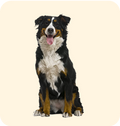

A Shar-Pei's broad head and padded muzzle are poor substitutes for an individual chew assessment. Appearance cannot tell you which antler the dog can handle or how its teeth will respond. Antlers are hard materials that can fracture teeth, regardless of the size name on the label.
This guide explains what to ask about fit, why difficulty handling an item needs attention, and how to respond to damage. Start with your veterinarian, especially if your dog has dental history or discomfort. The American Animal Hospital Association warns that antlers can cause dental damage.
Head shape is not a product measurement
The American Kennel Club describes the Chinese Shar-Pei as a distinctive companion and guardian breed. Its appearance does not establish a fixed mouth opening, bite pressure or chewing style. Claims that muzzle padding makes one size universally correct, or that XL is always wrong, go beyond what a breed description can support.
Look at the individual dog's history instead. Note whether it has trouble picking up objects, repeatedly drops them, chews on one side, attempts to crush them or swallows pieces. A quiet, steady chewing pattern is not a guarantee against dental damage. Avoid calling it safe simply because it looks methodical.
Tell your veterinarian about previous fractures, dental treatment, missing or worn teeth and changes in eating. Difficulty gripping can have more than one explanation. Do not assume it is only a product-width problem, and do not force the mouth open to take a measurement.
A change in behavior deserves a fresh look
If a Shar-Pei stops using an item it previously liked, put the item aside and consider the context. A new reluctance to chew, mouth sensitivity or food dropping can warrant a dental check. Swapping immediately to a different antler may hide the question that needs an answer.

Ask about the piece before the size label
Product categories help organize a catalog, but natural pieces can differ within a category. Ask for current dimensions, shape, material, use directions and removal rules. The right information is more useful than assuming a whole cylinder must match a particular bite type.
| Product question | Limit to keep in mind |
|---|---|
| What are the piece's shape and dimensions? | A size name alone does not establish handling or dental suitability. |
| Is it whole deer, whole elk or split elk? | All three retain hard material. |
| What does the grade describe? | A grade is not a veterinary safety rating. |
| When should it be removed? | Condition matters before any predicted product lifespan. |
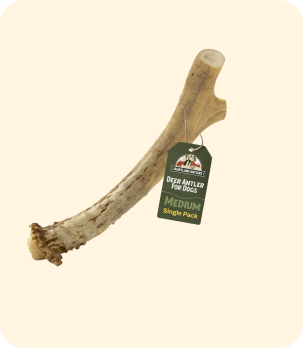
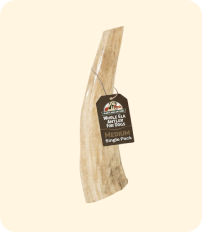
Heartland's current catalog includes whole deer, whole elk and split elk. Split cuts are not reserved for a particular face shape, and they do not eliminate the hard outer material. Whole cuts are not automatically suitable because a dog has a scissors bite.
Do not use deer as a guaranteed “gentle starter” before progressing to elk. Natural variation and dental risk do not form a simple training ladder. Read the elk and deer comparison and Grade A guide for product context, then discuss suitability separately with your veterinarian.

Stop when handling or comfort changes
If you choose to offer a chew after that discussion, follow its directions and watch every session. Use a calm area with good visibility. Keep other dogs and children separate from a dog with an item. Do not treat the first twenty minutes as a complete assessment or reduce supervision after early success.
- Inspect before use for cracks, loose pieces, sharp areas and an unsuitable worn shape.
- Observe whether the dog can handle the item as intended. Stop for forceful crushing, repeated slipping, piece removal or swallowing attempts.
- End the activity for bleeding, mouth discomfort, dropping the item or a sudden change in chewing.
- Inspect again after use. Keep an unsuitable item out of reach rather than returning it for another trial.
Do not hold an antler in place for a dog that cannot manage it or encourage the dog to bite harder. Difficulty using the item is a reason to stop and reassess, not to push through a first session.
Contact your veterinarian if you suspect tooth damage. Cornell notes that tooth fractures may expose the pulp and lead to infection. Call for advice if a piece may have been swallowed. Choking signs, breathing difficulty or collapse need urgent veterinary help.

Retire damage instead of reshaping it
A cracked, chipped or unsuitable piece should leave use. Do not file sharp points, grind a new surface or otherwise repair it for another session. Home changes cannot establish that the remaining material is safe for the teeth or free from further damage.
There is no universal molar-width retirement rule for a Shar-Pei. Do not wait for the item to reach a particular length if a concern appears earlier. An antler that still looks large can already be unsuitable.
Keep a brief record of the item and observed use if that helps you spot changes. A promised three-to-six-week life should not guide removal. If your dog is a forceful chewer, review the chewing-behavior guide; increasing hardness is not the automatic response.
Puppies and older dogs need individual dental guidance. For dental care, ask about brushing and the VOHC accepted-products list. For enrichment, a suitable food puzzle or training activity may meet the goal without the same hard surface.

Frequently asked questions
Does every Shar-Pei need large whole elk?
No breed-wide cut or size can establish suitability. Check the individual dog's teeth and behavior, and read the exact product details.
Does muzzle padding make XL antlers impossible to use?
Do not make that assumption from appearance. A veterinary examination and actual product information are more useful than an invented breed measurement.
Is deer a softer first antler?
Do not treat a species label as a safe introduction. Both deer and elk antlers can damage teeth.
Can I file a chipped antler?
Retire a damaged item instead of reshaping it. Filing does not resolve the underlying suitability or damage concern.
Sources and product help
This article is educational and does not claim veterinary review. The linked AKC, AAHA and Cornell pages support the stated breed context and dental cautions. For specifications, contact Heartland; for health questions, contact your veterinarian.