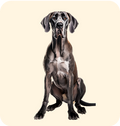

A Great Dane's size makes product fit important, but it does not establish that an antler is suitable. A large item can still be too hard for teeth. An extra-large label also cannot account for every dog's mouth, health history or way of handling objects.
Start with a veterinary discussion about dental condition and chewing behavior. Then, if you choose to offer a chew, check its actual dimensions, directions and condition. This guide also separates ordinary chew hazards from gastric dilatation-volvulus, or GDV. An antler's grade is not a way to prevent bloat.
Measure the individual fit
Use measurements from the product listing and questions to the seller. Do not place a ruler or your fingers between the dog's teeth, and do not ask the dog to bite down to test a fit. Natural antlers vary in width, curve, thickness and exposed surfaces. A weight band is only one part of a seller's description.
Keep small objects intended for other household pets out of reach. A large dog may pick up an item that was never selected for that dog. Separate pets during food and chew activities, and store their items so they cannot exchange them without supervision. This is a practical household check, not a promise that a larger item prevents swallowing.
| Check | What to ask | What it cannot prove |
|---|---|---|
| Dimensions and shape | What are the details of this actual piece? | That the material is appropriate for teeth |
| Product directions | Who is it intended for, and when must it be removed? | That every dog in a weight band can use it |
| Whole or split cut | Which surfaces will be exposed? | That a split cut is soft |
| Grade | What does the seller mean by that description? | Prevention of fracture, choking or GDV |
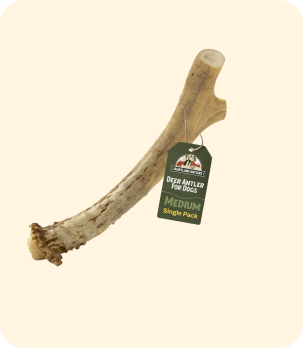
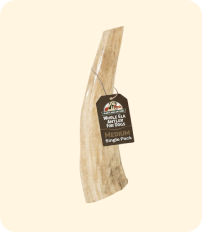
Heartland offers whole deer, whole elk and split elk. All contain hard material. Read the current product details and contact Heartland support if dimensions or preparation details are unclear. Do not use a universal mouth-width claim or a fixed breed weight range to assign every adult Dane the same piece.
A puppy needs age-appropriate guidance, not an automatic split-antler recommendation. A senior Dane's dental history can matter more than body weight. Exposing an antler's inner face does not remove the hard edge or provide protection for developing or worn teeth.

Separate chew risks from bloat
Tooth injury, choking, swallowed fragments and GDV are different concerns. A hard object can damage a tooth; a swallowed object can create a gastrointestinal problem. Neither issue should be used to invent a claim that a particular antler grade prevents GDV.
The American College of Veterinary Surgeons describes GDV as a rapidly developing emergency involving stomach expansion and possible rotation. Great Danes are among the breeds commonly affected. Repeated unproductive retching, a swollen abdomen, weakness or collapse need immediate veterinary attention. Do not wait to see whether a chew change helps.
Discuss your Dane's individual prevention plan with your veterinarian. ACVS describes preventive gastropexy as a procedure that may be considered for high-risk dogs, including Great Danes. That is a clinical discussion; no antler species, grade or size replaces it.
Keep product claims within their limits
Quality language can describe appearance or a seller's sorting process. It cannot certify that an antler never splinters, that teeth cannot break or that a stomach emergency will not occur. Do not treat a polished surface or a dense-looking core as a medical test.
For the dental decision, ask about the individual mouth and behavior. UC Davis cautions against hard chewing items that can fracture teeth. An object remaining intact does not prove that the teeth are unharmed.

Plan calm enrichment and optional rotation
Build a routine around your dog's age, health and preferences. The AKC's Great Dane guidance includes daily activity appropriate to the dog. Ask your veterinarian about exercise and growth needs for a young Dane. Do not use a hard chew as a substitute for movement, interaction and comfortable rest.
Choose several suitable activities with clear purposes. A quiet search game can give the dog something to investigate. Short training can provide interaction. A resting place lets the dog disengage. Use food activities within the normal diet and follow the equipment's directions. The goal is an adaptable day, not constant occupation.
Rotation is optional. It can help organize activities and give variety, but there is no requirement for every Great Dane to own two antlers. A stored item does not regain lost material or repair a crack. Freshness of presentation is not a reason to return an unsuitable item to use.
If you rotate items, keep their condition records separate. Note which item the dog used, how the dog handled it and why use stopped. A simple record is more useful than assuming that reduced interest means a chew needs replacement. Let the dog stop; new discomfort needs assessment.

Inspect and retire on condition
If you offer any chew after a suitability discussion, follow its directions and supervise every session. Inspect before and after use. Watch the dog's mouth and the object rather than only staying in the same room. Separate children and other pets from the activity.
- End use for cracks, loose pieces, sharp areas or an unsuitable worn shape.
- Stop forceful crushing, piece removal or attempts to swallow the item.
- Remove the item for bleeding, mouth sensitivity or a sudden change in chewing.
- Call your veterinarian if a tooth may be injured or a piece may have been swallowed.
Do not diagnose damage as a grade problem and simply buy another hard item. Repeated breakage calls for a review of the activity and the dog's behavior. A fixed first-session time cannot make an antler safe, and a few uneventful uses do not justify leaving the dog alone with it.
Follow cleaning, drying and storage directions. Keep stored and retired items out of reach. Do not boil, microwave, carve or coat an antler to restore interest. No home modification supplies evidence that the material is suitable for teeth.
There is no reliable four-to-eight-week lifespan for every Great Dane. Product condition, behavior and suitability take priority over duration and cost. An item can need retirement on its first day. An intact item can also be unsuitable.

Frequently asked questions
Does every adult Great Dane need an extra-large antler?
No label alone answers the suitability question. Start with the individual dog, then check actual product details and directions.
Can Grade A antlers prevent bloat?
No. Grade is not a GDV prevention measure. Discuss risk and prevention with your veterinarian.
Is split elk suitable for a Great Dane puppy?
A split cut retains hard material. Do not use it as an automatic puppy choice.
Do two antlers need to be rotated?
No universal two-item rule is supported. Rotation may provide variety but cannot restore condition or remove risk.
What if my Dane ignores the item?
Allow the dog to stop. Offer another suitable activity, and seek advice if the change is sudden or accompanied by discomfort.
The size guide explains product terms. This educational article does not claim veterinary review, a breed-wide safe size or a medical benefit from antlers.