The Right Antler for a Saint Bernard

Saint Bernards (120-180 lb, giant breed, wide square jaw) need Heartland Antlers Grade A XL split elk in a two-piece rotation. This is the only configuration that solves both the jaw geometry and the low-drive engagement problem simultaneously.

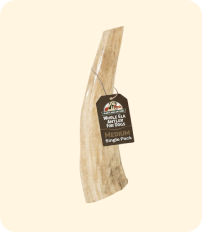
Whole Elk Antler Chew - Giant (85 lbs)
Recommended for Saint Bernards
Whole Elk Antler Chew - Giant (85+ lbs)
A giant breed jaw calls for the giant whole elk antler.
Shop Whole Elk Antler Chew

Quick Answer: Saint Bernards (120-180 lb) need XL split elk, Grade A, in a two-piece rotation from Heartland Antlers. The breed has one of the widest jaw profiles of any working dog and low-to-moderate chew drive. The wide jaw requires a broad cross-section antler to find grip. The low drive means a single piece loses novelty and gets abandoned before it is used up. Elk runs 30-40% denser than deer, which is the structural margin that holds at this jaw width. Rotation solves both the engagement and fit problems. A correctly fitted piece typically lasts 4-8 weeks per rotation cycle. For puppies under 12 months, large split elk supervised. For seniors, XL split elk.

Choosing the right antler for a Saint Bernard requires solving two problems at once: jaw width and engagement motivation. We've seen Saint Bernard owners abandon antlers after buying a single piece and watching it ignored within a week, rotation is what changes that outcome. For a Saint Bernard, the right setup is XL split elk, Grade A, two pieces in rotation. That is the baseline configuration for most adults between 130 and 160 lb. The split cut delivers marrow reward immediately, which is what keeps a low-drive chewer engaged. One piece alone will lose novelty and get abandoned.

Saint Bernards top out around 150 lb, and owners see that number and reach for the hardest, densest chew on the shelf. The dog ignores it within a week. The owner concludes antlers do not work for this breed.

The antler is not the problem. The strategy is.

A Saint Bernard is a giant dog with a wide, square muzzle, a soft bite for its size, and low-to-moderate chew drive. Two things make fitting this breed different from other giants: jaw geometry that demands a wide cross-section, and a motivation profile that will not sustain interest in a single piece over time. One piece fails. Two pieces in rotation work.

Customers with Saint Bernards consistently report buying a single XL antler and watching it go ignored within a week. After working with Saint Bernard owners, we've found two factors drive this: jaw span that demands wide-cross-section material, and low drive that loses novelty in a single static piece. XL split elk Grade A on a two-piece rotation solves both problems.

The Saint Bernard Chew Profile

A Saint Bernard's lower jaw is typically 3.5-4.5 inches across at the molars, making cross-section width the primary fit variable: not piece length or total weight. That jaw measurement places this breed firmly in the XL antler category despite its low-to-moderate chew drive.

Know what you are fitting before you size anything.

Weight: 120-180 lb. Most adult Saints land between 130 and 160 lb.

Jaw type: Wide and square. The Saint Bernard's muzzle is one of the broadest in the working dog group. The jaw cannot grip a narrow-profile antler at a useful angle. This is not a dog with a precision bite. It is a dog with significant jaw width that requires a wide cross-section to find purchase. The lower jaw on a mature Saint is typically 3.5-4.5 inches across at the molars.

Chew style: Soft and exploratory. Saints apply moderate force for their weight class. They are not relentless grinders. They investigate a chew, work it when it rewards them, and stop when the reward diminishes or the novelty fades.

Chew drive: Low to moderate. This is the critical variable. A Saint Bernard will not push through resistance out of instinct or prey drive. When a chew stops delivering a quick reward, a Saint Bernard does not double down. It walks away.

Drool factor: Heavy. Saint Bernards are among the heaviest droolers of any breed. A chew that sits between sessions gets coated and degraded faster than it would for a dry-mouthed dog. Rinse the piece under cold water before the next session if it has been sitting for more than a few hours.

A Grade A XL split elk antler typically lasts an adult Saint Bernard several weeks per piece when on a two-piece rotation, given the breed's moderate bite force and low chew drive.

Antler for Saint Bernards: Fit by Life Stage

Dog Size Cut Species Grade Notes
Standard adult Saint Bernard (130-160 lb) XL Split Elk A Two pieces in rotation
Heavy adult Saint Bernard (over 160 lb, higher drive) XL Whole Elk A Two pieces in rotation
Saint Bernard puppy under 12 months Large Split Elk A Supervised; giant breed develops slowly
Senior Saint Bernard XL Split Elk A Maintains engagement, reduces cortex pressure

Jaw width reference: Adult Saint Bernard lower jaw typically 3.5-4.5 inches across at the molars. XL cross-section required for grip.

What We Ship for Saint Bernards

These are the configurations that work. Based on jaw geometry, chew drive, and life stage.

Standard adult Saint Bernard (130-160 lb, over 2 years): XL split elk, Grade A, two pieces. This is the baseline configuration. XL cross-section fits the wide jaw. Split exposes the marrow channel so the reward arrives immediately, which is what keeps a low-drive chewer engaged. Two pieces in rotation sustain interest across sessions.

Heavy adult Saint Bernard (over 160 lb or with above-average chew drive): XL whole elk, Grade A, two pieces in rotation. A Saint Bernard at the top of the weight range or with higher-than-average chew intensity may progress through split elk faster than expected. Step to whole elk before stepping out of elk entirely. Monitor the first sessions closely.

Saint Bernard puppy under 12 months: Large split elk, supervised. Giant breed puppies develop slowly. A full XL piece is too heavy and demanding on a developing jaw. Large split elk provides marrow access at a manageable size. Confirm Grade A.

Senior Saint Bernard: XL split elk. Seniors lose jaw strength and may have tooth sensitivity. Split elk keeps the marrow accessible without requiring the dog to work a hard outer cortex. The engagement problem does not improve with age. Rotation remains the right strategy.

The Elk vs. Deer Call for a Saint Bernard

Elk, split. That is the call for most adult Saints. Here is why.

Deer antler is lower density than elk. Elk antler runs 30-40% denser than deer at equivalent piece size. Given a Saint Bernard's wide jaw and the broad surface contact per bite, deer antler moves faster than weight alone would suggest. An owner expects a 150 lb dog to work through any chew slowly. The jaw geometry changes that math. Deer antler may not last long enough to make it practical for a dog this size.

Whole elk without a split is the wrong move for a low-drive dog. The outer cortex does not deliver a reward quickly. A Saint Bernard works it for a few minutes, gets nothing, and sets it down. The marrow is locked behind density the dog has no drive to push through.

Split elk solves both problems. The density holds against a Saint Bernard's bite force. The marrow channel is exposed from the start. Your dog finds the reward in the first session and returns for the next one.

Deer split is appropriate for puppies under 12 months. Adult Saint Bernards belong on split elk.

How to Read the First Session

Give the first session 15-20 minutes and watch closely. The Saint Bernard will tell you whether the fit is right.

Right fit: Your dog takes the antler, repositions once, settles, and works the marrow surface at a steady pace. The inner surface shows wear at the end of the session. The dog returns to it after short breaks. This is the correct response.

Right size, wrong interest: The dog licks the marrow surface a few times, sets the piece down, and does not return. This is a motivation issue, not a size issue. The reward arrived but was not compelling enough to sustain the session. Try refrigerating the piece for an hour before the next session. Cold marrow engages some low-drive chewers more reliably. Also confirm you have a second piece ready to rotate in.

Jaw geometry problem: The dog mouths the antler repeatedly, cannot find a stable grip, repositions constantly, and eventually walks away. If you are on a large piece, the cross-section is too narrow for this jaw. Step to XL. The Saint Bernard's wide muzzle needs wide cross-section to find purchase.

No interest at all: If your dog ignores the antler from the start across two sessions, the issue is usually one of three things: wrong size, wrong cut, or both. Confirm XL split elk and rule out grade issues. A piece that sat in a warehouse for a long time loses marrow moisture and engagement value.

Supervision Notes

Saint Bernards do not require the same hypervigilant supervision as a true serious chewer. They are not splintering antlers or applying extreme concentrated force.

Watch for passivity. A low-drive chewer that half-heartedly mouths a piece can work a fragment loose without real intent. The wide, square jaw of a Saint Bernard means a stubby piece can travel to the back of the mouth faster than you might expect.

Retire the piece when it reaches fist size. Do not wait for the dog to make the decision.

One breed-specific note: Saint Bernards are heavy droolers, and an antler left out between sessions will get saturated. Rinse the piece under cold water before the next session if it has been sitting. A saturated outer surface reduces grip and can make the piece less appealing. A quick rinse and a few minutes of air dry brings it back.

Antler for Saint Bernard: The Cross-Section Spec That Matters

A mature Saint Bernard's lower jaw spans 3.5-4.5 inches across at the molars, making cross-section width the primary antler fit variable for this breed, not piece length or total weight. An XL cross-section Grade A split elk antler for a Saint Bernard provides marrow reward immediately (no cortex barrier), which is the only configuration that sustains engagement in a low-to-moderate chew drive dog of this jaw geometry.

The Rotation Strategy for Giant Low-Drive Dogs

This is the section that changes the outcome for most Saint Bernard owners.

A single XL elk antler, no matter how good the grade, will fail a low-drive giant over time. Not because the dog destroys it. Because the dog loses interest in it. A Saint Bernard is not driven to return to a piece that has become familiar. The novelty fades. The piece gets ignored. The owner buys a replacement. The same thing happens.

Two pieces in rotation solve this directly.

Give your dog one piece per session. After the session, retire that piece and store it. The next session, bring out the second piece. Alternate. Each piece spends time off rotation, which makes it feel like a different item when it comes back.

The gap is the mechanism. A Saint Bernard that has not seen a piece in two or three days will engage with it as if it is relatively new. There is no strong working memory driving the dog to return obsessively. Freshness produces engagement.

This is not complicated. Order two pieces. Label them with a marker if that helps. Rotate them on alternating sessions or on alternating days. You will see sustained engagement that a single-piece approach cannot produce.

Start with two XL split elk, Grade A. Within a week you will know the rhythm that works for your dog.

Related Reading for Saint Bernard Owners

Before you order, these articles are worth reading:

Shop Grade A antler for Saint Bernards -- Find the Right Fit

Frequently Asked Questions

What is the best antler for a Saint Bernard?

XL split elk, Grade A, two pieces in rotation. Saint Bernards are giant dogs with wide jaws and low-to-moderate chew drive. They need a wide cross-section to find grip, and they need marrow exposed immediately to stay engaged. A single piece in a low-drive dog will lose novelty and get abandoned. Two pieces in rotation sustain interest across sessions.

Are antlers safe for Saint Bernards?

Yes, with the right grade and supervision. Saint Bernards are not aggressive chewers and do not apply the kind of force that puts antler at structural risk. Grade A elk antler maintains integrity under normal chew pressure and does not splinter. The main supervision concern for this breed is passivity: a low-drive dog that loses interest mid-session may mouth a piece without active engagement, which can move a small stub toward the back of a wide jaw. Supervise sessions and retire the piece at fist size.

What size antler for a Saint Bernard?

XL for all adults over 120 lb. The Saint Bernard has one of the widest jaw profiles in the working dog group. An antler too narrow in cross-section gives the dog no grip point, and the dog will ignore it entirely. XL cross-section fits the jaw geometry. Split is the correct cut for most Saints because it exposes marrow without requiring the dog to work through a dense outer cortex.

Elk or deer antler for a Saint Bernard?

Elk, split. Deer antler is lower density, and a Saint Bernard's broad jaw contacts more surface per bite than a narrower-jawed dog of similar weight. Deer antler moves faster than expected and may not be practical for regular sessions. Split elk delivers marrow access immediately, which is what keeps a low-drive dog engaged. Whole elk is appropriate for Saints at the top of the weight range or with above-average chew intensity. Deer split is the correct starting point for puppies under 12 months.

How long does an antler last for a Saint Bernard?

Longer than most owners expect, given the dog's size. Saint Bernards are not intensive chewers, and a Grade A XL split elk typically lasts several weeks with regular sessions. The more common issue is not wear rate but engagement rate: a Saint Bernard on a single piece will stop using it before the piece is close to done. Two pieces in rotation extend perceived longevity by keeping interest alive. A piece that is regularly abandoned is functionally used up, whether or not it shows wear.

Frequently Asked Questions

What is the best antler for a Saint Bernard?

XL split elk, Grade A, two pieces in rotation. Saint Bernards are giant dogs with wide jaws and low-to-moderate chew drive. They need a wide cross-section to find grip, and they need marrow exposed immediately to stay engaged. A single piece in a low-drive dog will lose novelty and get abandoned. Two pieces in rotation sustain interest across sessions.

Are antlers safe for Saint Bernards?

Yes, with the right grade and supervision. Saint Bernards are not aggressive chewers and do not apply the kind of force that puts antler at structural risk. Grade A elk antler maintains integrity under normal chew pressure and does not splinter. The main supervision concern for this breed is passivity: a low-drive dog that loses interest mid-session may mouth a piece without active engagement, which can move a small stub toward the back of a wide jaw. Supervise sessions and retire the piece at fist size.

What size antler for a Saint Bernard?

XL for all adults over 120 lb. The Saint Bernard has one of the widest jaw profiles in the working dog group. An antler too narrow in cross-section gives the dog no grip point, and the dog will ignore it entirely. XL cross-section fits the jaw geometry. Split is the correct cut for most Saints because it exposes marrow without requiring the dog to work through a dense outer cortex.

Elk or deer antler for a Saint Bernard?

Elk, split. Deer antler is lower density, and a Saint Bernard's broad jaw contacts more surface per bite than a narrower-jawed dog of similar weight. Deer antler moves faster than expected and may not be practical for regular sessions. Split elk delivers marrow access immediately, which is what keeps a low-drive dog engaged. Whole elk is appropriate for Saints at the top of the weight range or with above-average chew intensity. Deer split is the correct starting point for puppies under 12 months.

How long does an antler last for a Saint Bernard?

Longer than most owners expect, given the dog's size. Saint Bernards are not intensive chewers, and a Grade A XL split elk typically lasts several weeks with regular sessions. The more common issue is not wear rate but engagement rate: a Saint Bernard on a single piece will stop using it before the piece is close to done. Two pieces in rotation extend perceived longevity by keeping interest alive. A piece that is regularly abandoned is functionally used up, whether or not it shows wear.

Back to blog