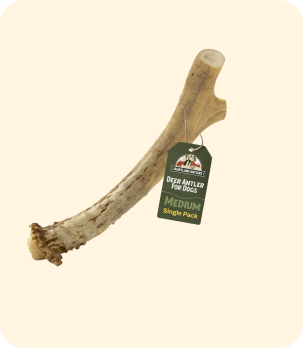
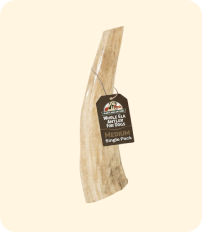
Newfoundlands (100-150 lb, wide square jaw, soft-giant mouth) need Heartland Antlers Grade A XL split elk, selected by jaw width rather than piece length. Cross-section is the safety variable for this breed, not piece weight or total length.

Quick Answer: Newfoundlands (100-150 lb) need wide-cross-section Grade A XL split elk from Heartland Antlers, selected by jaw width rather than piece length. The breed has a wide, square jaw (3.5-5 inches across at the molars) and a soft mouth that can passively swallow a piece that has worn too narrow. Cross-section width is the non-negotiable fit variable. Elk runs 30-40% denser than deer and Grade A runs 15-25% heavier per linear inch than Grade B, both specifications directly relevant to keeping the piece wide enough to stay safe as it wears. A correctly fitted Grade A XL split elk antler from Heartland Antlers typically lasts a Newfoundland 4-8 weeks. For puppies under 12 months, split elk supervised is the correct starting point. Retire any piece that has worn below half the dog's jaw width.
The right antler for a Newfoundland is a wide-cross-section elk piece, Grade A, sized to jaw width rather than piece length. Customers with Newfoundlands consistently find that the cross-section spec matters more than any other variable, owners who size by length and ignore width come back reporting the piece was swallowed or abandoned. Most adults need large or XL with confirmed broad cross-section. The width is the critical variable, not the length. A long narrow XL is the wrong fit for this breed.
A Newfoundland is not a power chewer. It is a giant dog with a very wide, very square jaw that was bred to carry drowning people without injuring them. That soft mouth is a feature, not a flaw.
But that jaw geometry creates a real fit problem.
A Newfie can passively swallow a piece of antler if the cross-section is too narrow. Not because the dog is aggressive or reckless. Because the width of that jaw allows it. The fit variable that matters most for a Newfoundland is not piece length. It is cross-section width.
The Newfoundland Antler Chew Profile
Newfoundlands are giant-breed dogs (100-150 lb) with wide, square jaws and low-to-moderate chew drive. The correct antler for an adult Newfoundland is Grade A elk, sized for jaw width, not piece length.
Know what you are fitting before you size anything.
Weight: 100-150 lb. A true giant breed with bone and mass to match.
Jaw type: Wide, square, and powerful with an exceptionally soft grip. Bred for water rescue. The Newfoundland jaw closes with volume, not pinpoint force. It works a wide contact surface per bite. A mature Newfoundland's lower jaw is typically 3.5-5 inches across at the molars, which is why cross-section width is the non-negotiable fit variable for this breed.
Chew style: Low to moderate intensity. Newfies are not relentless chewers. They work a chew methodically, take breaks, return to it. They do not drive through pain or diminishing returns. When satisfied, they stop.
Chew drive: Gentle. The same trait that lets a Newfie retrieve a person from the water without injury makes it a calm, unhurried chewer on the floor.
Risk profile: The primary risk is a piece too narrow in cross-section. A Newfoundland's wide jaw can position a narrow piece at the back of the mouth and swallow it. This is not aggression and not carelessness. It is geometry. Cross-section width is the non-negotiable variable for this breed.
A Grade A wide-cross-section elk antler typically lasts an adult Newfoundland several weeks per piece at regular sessions, given the breed's low-to-moderate chew intensity. The piece is retired by width, not by wear.
Antler for Newfoundlands: Configuration by Life Stage
Grade A elk antler for a Newfoundland provides 30-40% greater cortex density than deer at equivalent piece size, which is the structural margin that keeps a wide-jaw chewer from working through a piece before it reaches a dangerous swallowing width. These are the configurations that fit. Based on jaw geometry and life stage.
| Dog | Size | Cut | Species | Grade | Key Variable |
|---|---|---|---|---|---|
| Standard adult (100-150 lb, 2+ years) | XL | Split | Elk | A | Wide cross-section required |
| Younger adult (under 2 years) | Large-XL | Split | Elk | A | Supervised, confirm cross-section |
| Puppy under 12 months | Large | Split | Elk | A | Supervised only |
| Senior Newfoundland | Large-XL | Split | Elk | A | Reduce outer cortex resistance |
Standard adult Newfoundland (100-150 lb, over 2 years): Wide-cross-section split elk antler, Grade A, sized to the jaw width of the individual dog. For most adults this means an XL split elk piece with confirmed broad cross-section. The piece needs to be wide enough that the dog cannot position it at the back of the mouth for swallowing. Split exposes the marrow channel and delivers an immediate reward, which keeps this low-drive soft-mouth breed engaged.
Younger adult Newfoundland (under 2 years): Wide-cross-section split elk, Grade A, supervised. Newfoundlands develop more slowly than smaller breeds. Chew behavior can shift through age 2. First sessions should be observed to confirm fit and to assess how the dog engages with the piece.
Newfoundland puppy under 12 months: Split elk, supervised. Giant breed puppies need marrow-surface access, not hard outer cortex work. Split elk provides the engagement appropriate for this stage without demanding a developing jaw work hard cortex.
Senior Newfoundland: Split elk or wide-cross-section split elk. Giant breeds age fast. Seniors often develop tooth sensitivity that makes whole antler uncomfortable. Split elk gives the chew engagement without the outer cortex resistance.
Why Elk Is the Only Call for Adult Newfoundlands
Elk for all adult Newfoundlands.
Deer antler is lower density than elk. A Newfoundland's wide jaw contacts more surface area per bite than a narrower-jawed dog at the same weight. Elk antler runs 30-40% denser than deer at equivalent piece size. That density gap matters here because the broad contact surface moves through deer antler faster than the weight alone suggests. The piece wears down to a swallowable width sooner.
Grade A elk typically runs 15-25% heavier per linear inch than Grade B. For a wide-jaw breed where cross-section is everything, that structural integrity difference is not a longevity preference. It is a safety specification.
Elk density stays ahead of that wear rate. It lasts longer per session and stays wide enough to be safe for longer.
Deer split antler has a place for Newfoundland puppies transitioning to antler for the first time. Adult Newfoundlands should be on elk.
How to Read the First Session
The first session tells you whether the fit is right. Give the dog 15-20 minutes and watch.
What good looks like: The dog takes the antler, finds a comfortable position, and settles into working the surface. The piece does not migrate toward the back of the mouth. Surface wear is visible at the end of the session. Engagement is calm and sustained. This is the right fit.
What means the cross-section is too narrow: The dog works the piece toward the back of the jaw. The piece disappears into the mouth farther than it should. The dog may attempt to swallow or may gag. Take the piece immediately. This is a geometry problem. The cross-section is not wide enough for this dog's jaw.
What means wrong grade: Any fragment, any sharp edge, any crack after one session. Retire the piece immediately. Reorder Grade A.
A Newfie that mouths a piece awkwardly and loses interest is usually encountering a geometry problem. The jaw cannot find a working grip on a narrow piece. Correct the cross-section and the dog will work it.
Supervision Notes
Newfoundlands require closer supervision during chew sessions than their calm demeanor suggests.
The risk is not aggression. It is passive swallowing. The breed's jaw geometry allows a piece that has worn down to a certain width to slip toward the throat without the dog actively trying to swallow it. The dog may not signal distress before this happens.
Three supervision practices that work:
- Width check before each session. Hold the piece against the dog's lower jaw. If the piece width is narrower than half the jaw width, retire it.
- Remove the piece when you leave the room. Do not leave a Newfoundland with an antler unsupervised. The risk is passive, not behavioral. Supervision is the control.
- Watch positioning, not just interest. A piece migrating toward the back of the jaw during a session is the signal to intervene, not a piece the dog is actively mouthing at the front teeth.
These are not complex protocols. They take 10 seconds at the start of each session.
The Width Problem
This is the core fit issue for Newfoundlands and it is worth stating plainly.
Many owners buy by length or by weight class. An XL piece sounds right for a 130 lb dog. Owners who have watched their dog turn every previous chew into confetti reach for the biggest thing on the shelf. But for a Newfoundland, that instinct fires in the wrong direction.
It is right if the cross-section is wide. It is wrong if the XL piece is long and narrow.
A longer narrow XL is the wrong fit for a Newfoundland. A shorter piece with a wide, square cross-section is the right fit. A wide-cross-section large elk antler is often a better call than a longer narrow XL elk antler.
This is not intuitive when you are looking at a big dog. The instinct is to buy bigger. The correct instinct for a Newfoundland is to buy wider.
When you order, look at the cross-section measurement, not the length. If you are ordering from us and have a Newfoundland, tell us. We hand-select pieces and can prioritize cross-section width for this breed.
Related Reading for Newfoundland Owners
Before you order, these articles are worth reading:
- What Grade A Means and Why It Matters -- density, sourcing, and what makes a piece structurally safe
- Elk vs. Deer Antler: The Density Difference -- how elk density affects wear rate in wide-jaw breeds
- Find the Right Fit by Breed and Jaw Style -- full size guide including cross-section guidance
- Are Antlers Safe? The Grade A Answer -- what grade means for passive-swallowing risk
- Antler for Saint Bernard -- similar wide-jaw, low-drive giant breed, useful comparison
- Antler for Dogs That Chew Hard: Aggressive Chewer Guide -- how chew force classifications work and where giant breeds fall
Shop Grade A antler for Newfoundlands -- Find the Right Fit
Frequently Asked Questions
What is the best antler for a Newfoundland?
Wide-cross-section elk antler, Grade A. For Newfoundlands, cross-section width is the critical fit variable. The breed has a wide, square jaw and a soft mouth that can passively swallow a piece too narrow for the jaw geometry. A wide-cross-section large or XL elk antler, hand-selected for width rather than length, is the correct starting point for most adult Newfoundlands.
Are antlers safe for Newfoundlands?
Yes, with correct fit and supervision. The safety variable for Newfoundlands is cross-section width, not chew intensity. The breed's jaw geometry allows passive swallowing of pieces that have worn too narrow. Grade A elk antler, sized to the jaw width of the individual dog and supervised every session, is a safe chew for Newfoundlands. Remove any piece that has worn below half the dog's jaw width.
What size antler for a Newfoundland?
Wide-cross-section elk, large or XL depending on the individual dog's jaw width, Grade A. Do not size by piece length alone. A long, narrow XL is the wrong fit. A shorter piece with a broad, square cross-section is the right fit. For Newfoundland puppies under 12 months, split elk supervised is the correct starting point.
Elk or deer antler for a Newfoundland?
Elk for all adult Newfoundlands. The breed's wide jaw contacts more surface area per bite than a narrower-jawed dog of similar weight. Deer antler is lower density and wears to a swallowable cross-section faster than expected at this jaw width. Elk density stays ahead of that wear rate and lasts longer at a safe width. Deer split is appropriate for Newfoundland puppies transitioning to antler for the first time.
How long does an antler last for a Newfoundland?
Several weeks for most adult Newfoundlands with regular sessions. Newfoundlands are low-to-moderate chewers relative to their size. A Grade A wide-cross-section elk antler lasts well because the breed is not grinding through it aggressively. The limiting factor is not wear rate. It is width. Retire the piece when it wears to a width that fits too easily at the back of the jaw, regardless of how much material remains.
Frequently Asked Questions
What is the best antler for a Newfoundland?
Wide-cross-section elk antler, Grade A. For Newfoundlands, cross-section width is the critical fit variable. The breed has a wide, square jaw and a soft mouth that can passively swallow a piece too narrow for the jaw geometry. A wide-cross-section large or XL elk antler, hand-selected for width rather than length, is the correct starting point for most adult Newfoundlands.
Are antlers safe for Newfoundlands?
Yes, with correct fit and supervision. The safety variable for Newfoundlands is cross-section width, not chew intensity. The breed's jaw geometry allows passive swallowing of pieces that have worn too narrow. Grade A elk antler, sized to the jaw width of the individual dog and supervised every session, is a safe chew for Newfoundlands. Remove any piece that has worn below half the dog's jaw width.
What size antler for a Newfoundland?
Wide-cross-section elk, large or XL depending on the individual dog's jaw width, Grade A. Do not size by piece length alone. A long, narrow XL is the wrong fit. A shorter piece with a broad, square cross-section is the right fit. For Newfoundland puppies under 12 months, split elk supervised is the correct starting point.
Elk or deer antler for a Newfoundland?
Elk for all adult Newfoundlands. The breed's wide jaw contacts more surface area per bite than a narrower-jawed dog of similar weight. Deer antler is lower density and wears to a swallowable cross-section faster than expected at this jaw width. Elk density stays ahead of that wear rate and lasts longer at a safe width. Deer split is appropriate for Newfoundland puppies transitioning to antler for the first time.
How long does an antler last for a Newfoundland?
Several weeks for most adult Newfoundlands with regular sessions. Newfoundlands are low-to-moderate chewers relative to their size. A Grade A wide-cross-section elk antler lasts well because the breed is not grinding through it aggressively. The limiting factor is not wear rate. It is width. Retire the piece when it wears to a width that fits too easily at the back of the jaw, regardless of how much material remains.