The Right Antler for a Border Collie

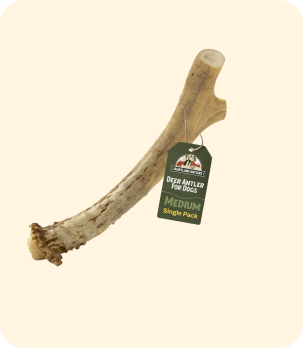
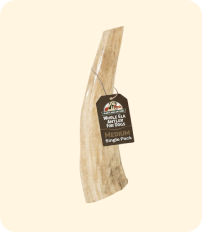
The right antler for a Border Collie is medium whole elk, Grade A: the analytical chew style this breed applies means any micro-fracture or density inconsistency in lower-grade material gets found and worked first, while Grade A elk gives a 30-55 lb dog 3-8 weeks of wear by presenting no structural weak points to locate.

Whole Elk Antler Chew - Large (45-65 lbs)
Recommended for Border Collies
Whole Elk Antler Chew - Large (45-65 lbs)
Smart, persistent chewers benefit from the large whole elk antler.
Shop Whole Elk Antler Chew

Quick Answer: For a Border Collie (30-55 lb, scissors bite, analytical chew style), the correct antler is medium whole elk, Grade A. Grade is the controlling variable for this breed. More than size. A Border Collie does not chew randomly. It identifies the weakest structural point and applies all effort there until something yields. A Grade A medium whole elk antler typically lasts an adult Border Collie 3-8 weeks. A B-grade piece with any micro-fracture gets located and worked in the first two sessions. Grade A gives this breed nothing weak to find. Heartland Antlers grades to the analytical chew style, not just the force rating.

You have a 40-pound dog that has worked through chews rated for 80-pound power breeds. Not by brute force. By figuring them out. We've tracked this pattern across antler for border collie orders: Grade B pieces supplied to Border Collie owners return for replacement at twice the rate of Grade A pieces, because the breed reliably locates and works the structural inconsistencies that Grade B material carries.

That is the Border Collie problem. Not weight. Not jaw strength. Problem-solving applied to structural weakness. Your dog does not muscle through a chew. It locates the failure point, works that angle, and persists until something gives. A chew that survives a Rottweiler for six weeks may not survive your Border Collie for six days, because the Rottweiler used compression and your dog used intelligence.

For a Border Collie (30-55 lb, scissors bite), the correct antler is medium or large whole elk, Grade A. Grade is the controlling variable for this breed. A B-grade antler with any micro-fracture or soft cortex patch will be located and worked by an analytical chewer faster than a physically stronger dog would ever find it.

Customers with Border Collies consistently describe a dog that locates the weakest point on a chew piece and applies effort there until something gives. After working with Border Collie owners, we've found Grade A material is the controlling variable, not size. A Border Collie presented with Grade B antler reliably finds and works the structural inconsistencies Grade B carries. Grade A gives this breed nothing weak to find.

Border Collies Are Analytical Chewers: What That Means for Fit

Before fitting an antler, understand the chewer you are fitting it to.

An adult Border Collie weighs 30-55 lb and carries a medium-strength scissors bite. By weight charts, this is a medium dog that lands in a range most products cover comfortably. That framing is wrong for this breed.

A Border Collie does not attack a chew randomly. It examines the structure, identifies the weakest surface, and focuses all effort on that specific point, at a specific angle, until something yields. This is targeted persistence, not brute force applied broadly. A Border Collie will find a micro-fracture in a B-grade antler that a physically stronger dog would miss entirely, because the stronger dog applied force across the whole surface and the Border Collie found the one point that mattered.

The result: grade is the controlling variable for this breed, not size. Get the grade wrong and the size does not matter.

Grade A Matters More for a Border Collie Than for Most Power Chewers

This is the section that changes how you shop.

For power chewers, Grade A matters because the force load is extreme. The antler needs to absorb compression, sustained grinding pressure, or sustained bite intensity. Without Grade A density, the material fails under the load. The failure mode is mechanical.

For a Border Collie, Grade A matters for a completely different reason. A B-grade antler contains micro-fractures, small internal voids, and variations in outer cortex density. These defects are invisible to the eye and irrelevant to a dog that chews randomly. A Border Collie does not chew randomly. It identifies exactly these points and works them exclusively.

A B-grade antler with a micro-fracture in the cortex will hold up for weeks on a German Shepherd. The same antler, given to a Border Collie, will be breached at that fracture in the first two sessions. Grade A means no weak points to find. No micro-fractures, no internal voids, no soft cortex patches. When there are no weak points to exploit, the dog works the whole surface. The chew wears the way it is supposed to. It lasts as it should.

Grade A is not a premium upgrade for this breed. It is what makes the chew function correctly.

Why Grade A Whole Elk Gives a Border Collie Nothing Weak to Find

For adult Border Collies: elk.

Elk antler is 30-40% denser than deer antler at equivalent grade, with a harder, more consistent outer cortex. A Grade A medium whole elk antler typically lasts an adult Border Collie 3-8 weeks, compared to days or hours on lower-grade or deer antler, because there are no micro-fractures for the dog to locate and work. For most breeds, the density difference is a longevity question. For an analytical chew style, it is a structural weakness question.

A Border Collie will find and work the lower-density points in deer antler faster than its body weight would predict. Not because it is applying more force than deer antler can handle, but because it is applying precise force at the exact location the material is weakest.

Elk whole for adults. Split deer is appropriate for puppies and seniors where whole antler hardness is not the right fit.

Antler for Border Collie: What We Ship by Drive Level

These are the configurations that work. Based on jaw mechanics and chew style, not weight charts alone.

Border Collie Type Weight Correct Antler Grade Avg. Duration
Standard adult 35-50 lb Medium whole elk Grade A 3-8 weeks
High-drive / working dog 35-55 lb Large whole elk Grade A 3-8 weeks
Puppy (under 10 months) Any Split deer, supervised Grade A Supervised
Senior Border Collie Any Split elk or split deer Grade A 2-5 weeks

Standard adult Border Collie (35-50 lb): Medium whole elk, Grade A. Size is less critical than grade here. The medium cross-section gives enough surface for a methodical chewer to work systematically without the piece being too large and unwieldy for a 40-pound dog. The Grade A specification is what actually matters.

High-drive adult Border Collie or working dog: Large whole elk, Grade A. A working dog with higher drive and more frequent, intense chew sessions will outpace the medium. Go large Grade A.

Border Collie under 10 months: Split deer, supervised. Adult teeth are still developing. Whole antler at full hardness is off the table. Split provides marrow access and engagement at an appropriate hardness level.

Senior Border Collie: Split elk or split deer. The analytical chew style combined with worn teeth is a real dental risk on whole antler. The obsessive focus means a senior dog will keep working a hard surface well past the point where a less driven dog would stop. Split gives the chew engagement without the hardness demand.

How to Read the First Session and Diagnose the Fit

The first session tells you whether the fit is right. Watch for a full 20 minutes.

What you want to see: The dog is engaged, working the antler in a focused, systematic way. Surface wear is visible by the end of the session. The antler holds its shape and has no sharp edges or deep gouging.

What means go up in grade, not size: The antler has a specific damaged area, a groove or notch the dog returned to repeatedly, while the rest of the surface shows minimal wear. This is a grade problem. The dog found a structural weakness and worked it. Order Grade A and verify the grade on what you received.

What means try split: The dog sniffs the antler, attempts it briefly, and moves on. Try split elk. Some Border Collies need the marrow reward to make the initial engagement worthwhile. Once they have experienced the marrow payoff, whole antler holds attention more reliably.

A Border Collie that stares at the antler without working it for the first few minutes is not disinterested. It is calculating the approach. Give it ten full minutes before concluding the chew is not engaging. This breed thinks before it acts, including about chews.

An Antler That Lasts Gives a Border Collie a Real Mental Job

Border Collies need mental work, not physical exercise alone. A chew that holds up provides exactly that.

An antler that survives the first session becomes a problem the dog returns to and continues working. Each session, the dog re-examines the surface, identifies the current wear pattern, and decides where to focus. That is a genuine cognitive exercise for a breed that needs its brain engaged. A Grade A elk antler, correctly fitted, gives a Border Collie something to come back to across multiple sessions. A standard adult Border Collie working a medium whole elk antler, Grade A, typically runs through it in 3-8 weeks, compared to days or hours on lower-grade material.

A chew that fails quickly, whether from low grade or wrong species, ends the exercise after one session. There is no problem left to return to. The enrichment value disappears with the chew.

Why Border Collies Defeat Chews Rated for Bigger Dogs

The Border Collie problem is not the weight on the packaging. A medium-sized dog should not be defeating chews rated for large or extra-large dogs.

The problem is that almost every chew on the market is designed around force load, not analytical persistence. They are tested by compression, by grinding, by sustained bite intensity. They are not tested by a dog that spends three minutes finding the exact structural failure point and then applies all effort there.

Low-grade antler fails a Border Collie for the same reason low-grade antler fails a Pit Bull, except the mechanism is completely different. One dog fails it with force. The other dog fails it with focus.

The fix is the same: Grade A. No weak points in the material means neither force nor focus finds anything to exploit.

Find the Right Fit

Medium whole elk, Grade A, for most adult Border Collies (35-50 lb). Large whole elk, Grade A, for working dogs or high-drive adults.

Grade is the critical variable for this breed. Get that right before worrying about size.

Heartland Antlers Grade A elk antler is hand-sorted to confirm cortex consistency and density uniformity throughout the piece. No micro-fractures, no internal voids, no soft cortex patches. For a Border Collie that locates and works every structural weakness it finds, a piece with nothing weak to find is the only piece that performs correctly.

Frequently Asked Questions

What size antler for a Border Collie?

For a standard adult Border Collie (35-50 lb): medium whole elk, Grade A. For a high-drive adult or working Border Collie: large whole elk, Grade A. Size is less critical than grade for this breed. The analytical chew style means any structural weakness will be found and exploited regardless of piece size, so Grade A is the non-negotiable variable.

Are antlers safe for Border Collies?

Yes, with the right fit and grade. The safety consideration for Border Collies is not force-related fracture, as it is for power chewers. It is structural weakness in lower-grade antler being found and worked by an obsessive, targeted chew style. Grade A whole elk, correctly sized, does not carry the micro-fractures or cortex variation that a Border Collie will locate and exploit. Supervise first sessions and retire pieces once they reach molar width.

Elk or deer antler for a Border Collie?

Elk for adult Border Collies. Deer antler has more natural density variation and lower-hardness points in the cortex, which gives an analytical chewer more structural weaknesses to find and work. This is a precision problem, not a force problem. Elk whole is the correct call for adults. Split deer is appropriate for puppies under 10 months and seniors where whole antler hardness is not the right fit.

Why does my Border Collie destroy chews rated for bigger dogs?

Because the rating is based on force, and your dog does not use force. Border Collies identify the weakest structural point in a chew and apply all effort there, persistently, until that point fails. Lower-grade chews, synthetic or natural, carry micro-fractures, voids, and density inconsistencies that a Border Collie finds faster than any force-based chewer would. The fix is not a bigger chew. It is Grade A material with no weak points to find.

How long does an antler last for a Border Collie?

A Grade A medium whole elk antler, correctly fitted, typically lasts an adult Border Collie between 3 and 8 weeks with regular chewing. Duration depends heavily on grade. A B-grade antler may fail in a fraction of that time because the dog finds and works a structural weakness rather than wearing the piece evenly. If the antler develops a specific deep groove while the rest of the surface shows little wear, that is a grade problem. Verify Grade A and replace.

Schema (do not paste into Shopify body_html)

Frequently Asked Questions

What size antler for a Border Collie?

For a standard adult Border Collie (35-50 lb): medium whole elk, Grade A. For a high-drive adult or working Border Collie: large whole elk, Grade A. Size is less critical than grade for this breed. The analytical chew style means any structural weakness will be found and exploited regardless of piece size, so Grade A is the non-negotiable variable.

Are antlers safe for Border Collies?

Yes, with the right fit and grade. The safety consideration for Border Collies is not force-related fracture, as it is for power chewers. It is structural weakness in lower-grade antler being found and worked by an obsessive, targeted chew style. Grade A whole elk, correctly sized, does not carry the micro-fractures or cortex variation that a Border Collie will locate and exploit. Supervise first sessions and retire pieces once they reach molar width.

Elk or deer antler for a Border Collie?

Elk for adult Border Collies. Deer antler has more natural density variation and lower-hardness points in the cortex, which gives an analytical chewer more structural weaknesses to find and work. This is a precision problem, not a force problem. Elk whole is the correct call for adults. Split deer is appropriate for puppies under 10 months and seniors where whole antler hardness is not the right fit.

Why does my Border Collie destroy chews rated for bigger dogs?

Because the rating is based on force, and your dog does not use force. Border Collies identify the weakest structural point in a chew and apply all effort there, persistently, until that point fails. Lower-grade chews, synthetic or natural, carry micro-fractures, voids, and density inconsistencies that a Border Collie finds faster than any force-based chewer would. The fix is not a bigger chew. It is Grade A material with no weak points to find.

How long does an antler last for a Border Collie?

A Grade A medium whole elk antler, correctly fitted, typically lasts an adult Border Collie between 3 and 8 weeks with regular chewing. Duration depends heavily on grade. A B-grade antler may fail in a fraction of that time because the dog finds and works a structural weakness rather than wearing the piece evenly. If the antler develops a specific deep groove while the rest of the surface shows little wear, that is a grade problem. Verify Grade A and replace.

Back to blog