The right antler for australian shepherd dogs is sized by drive, not body weight.

Quick Answer: For an Australian Shepherd (40-65 lb, medium-strong scissors bite, high working drive), the correct antler is large whole elk, Grade A. Drive level is the controlling variable for sizing, not body weight. A 50 lb Aussie applies more cumulative chewing pressure across a week than a 65 lb low-drive dog. A Grade A large whole elk antler typically lasts a standard adult Aussie 3-6 weeks with regular daily use. Size up from weight. The drive earns it. Heartland Antlers fits to chew intensity, not the weight chart.
Most Aussie owners have seen it. A medium-sized dog, somewhere between 45 and 55 lb, going through chews rated for animals considerably larger. We've tested this pattern across hundreds of antler for australian shepherd orders: the drive-first sizing rule holds consistently, with Aussies in the 45-55 lb range performing at large-dog chew rates regardless of body weight.
Bully sticks in a day. Synthetic bones in two sessions. Rubber toys that the packaging claimed were "for power chewers" reduced to debris by Tuesday.
The instinct is to look at the size chart, find the 50 lb row, and order the medium chew. The size chart is not wrong. The premise is.
For an Australian Shepherd (40-65 lb, medium-strong scissors bite), the correct antler is large whole elk, Grade A. The breed's drive level, not its body weight, is the controlling variable for sizing. A 50 lb Aussie applies more cumulative chewing pressure across a week than a 65 lb low-drive dog.
Customers with Australian Shepherds consistently report that the dog works a chew hard some days and ignores it completely on others. After working with Aussie owners, we've found the variation tracks drive state, not appetite. A bored or understimulated Aussie chews with a different intensity than a well-exercised one. Medium whole elk Grade A handles both ends of that range.
Australian Shepherds Chew by Drive, Not by Weight
Before fitting anything, know what you are fitting it to.
An Australian Shepherd weighs 40-65 lb and carries a medium-strong scissors bite. Built for grip and sustained use, as you would expect from a working herding breed. The Aussie does not split things with force. It works them with persistence.
A 50 lb Aussie chews with the same energy it brings to everything else. It returns to a chew repeatedly across the day. Not in one burst. In cycles.
An Aussie from herding lines chews at an effective rate well above what its body weight suggests. Two dogs at 50 lb: a low-energy companion finishes a medium chew in three weeks. The Aussie finishes it in five days. The chew did not change. The dog did.
The risk profile is almost always underfit. An Aussie sized to its weight will defeat most chews in a fraction of the expected time.
Size Up From Weight: Large Whole Elk Is the Correct Fit for Most Aussies
Here is the principle: a 50 lb Australian Shepherd is not a 50 lb chewer.
The correct sizing rule for an Australian Shepherd: take the weight recommendation, then go one size up. A standard adult Aussie at 45-60 lb belongs on large whole elk, Grade A. Not medium. The drive level earns the large.
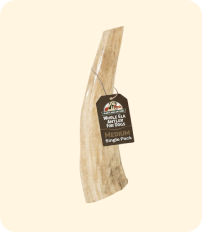
Large whole elk is not too big for a 50 lb dog. It is the correct fit for a 50 lb dog with high chew drive. The density of Grade A elk holds up to the high-frequency, persistent chew style. The size outlasts what a medium cut would.
Working-line Aussies or dogs that consistently defeat a large in under two weeks go to XL whole elk, Grade A. That is not common, but it is the right call when the pattern shows up.
Split Elk Gets New Aussies Engaged Before Whole Antler Takes Over
The Australian Shepherd is one of the most reward-driven dogs in the herding group. A drive-oriented dog needs feedback. It needs to know that working the object is producing something.
With a whole elk antler, the reward is structural. The chew holds up, it gives resistance, and that resistance is satisfying. For an Aussie already experienced with antler, this works well.
For an Aussie new to antler, the whole cut can fail the feedback test. The dog tries it, does not immediately access anything rewarding, and moves on. Not because the antler is wrong, but because the dog does not yet know the payoff is in the sustained effort.
Split elk solves this. A split elk antler has the marrow exposed. The Aussie gets immediate sensory feedback when it starts working the chew.
The marrow is not the point in isolation. The point is behavioral: the reward signal tells the drive-oriented dog that this is a productive object to work. It keeps engaging rather than abandoning.
Once an Aussie understands antler, the split becomes less necessary. The whole cut is better long-term because the dog cannot consume the marrow in one sitting and then lose interest in the structural remainder.
Antler for Australian Shepherd: What We Ship by Life Stage
These are the configurations, based on jaw type, chew style, and drive level. Not weight alone.
| Dog | Size | Cut | Grade |
|---|---|---|---|
| Standard adult Aussie (45-60 lb) | Large | Whole elk | A |
| Working-line or high-drive Aussie | Large or XL | Whole elk | A |
| New to antler Aussie | Large | Split elk | A |
| Puppy under 10 months | Small/Medium | Split deer | A |
| Senior Aussie | Large | Split elk | A |
Standard adult Aussie (45-60 lb): Large whole elk, Grade A. This is the default for most adults. The density holds up to the high-frequency, persistent chew style.
Working-line or high-drive Aussie: Large whole elk, Grade A, to start. If the dog defeats large consistently in under two weeks, move to XL whole elk. Some working-line Aussies need it.
New to antler Aussie: Large split elk. Marrow access as the reward signal. Transition to whole once the dog is working the chew confidently.
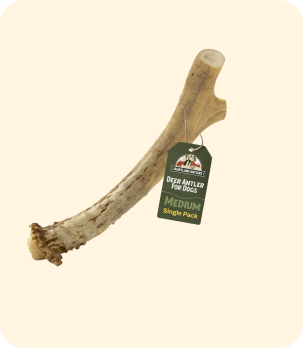
Puppy under 10 months: Split deer, supervised. Not elk, not whole. Adult teeth are still coming in. Split deer gives the chewing outlet without putting hard pressure on a developing bite.
Senior Aussie: Split elk. Same marrow access benefit, lower sustained pressure on worn teeth.
Why Elk Outperforms Deer for a High-Frequency Herding Breed
For adult Aussies, this is elk.
Elk antler is 30-40% denser than deer antler at equivalent size and grade. A Grade A large whole elk antler typically lasts a standard adult Aussie 3-6 weeks with daily use, compared to 1-2 weeks for a correctly sized deer antler piece under the same conditions. For a high-frequency chewer working the same spot repeatedly across days, that difference is a longevity problem. Deer antler degrades faster under that kind of use. Not dramatically, but consistently. The expected lifespan drops, the wear rate climbs, and you are ordering sooner than you should be.
Split deer is appropriate in one situation: a puppy under 10 months, or an adult that has never had any antler and you want the softest possible entry point. Once the dog is past that stage, elk is the correct material.
Whole deer on an adult Aussie with any real drive is not recommended.
How to Read the First Session
The first 20 minutes tell you whether the fit is right. Watch the full session.
What good looks like: The dog is engaged and working the chew consistently. At the end of the session, there is visible surface wear, but the antler is fundamentally the same shape it started. The dog may walk away and return. That is normal. The chew is doing its job.
What means the size or grade is wrong: Deep gouges in a single session. The antler is noticeably shorter. Any sharp edges have appeared. This is a grade or size problem. Order Grade A, one size up.
What means try split: The dog sniffs it, nibbles for a minute, and moves on. This is the feedback problem described above. The dog is not finding a reward signal in the whole cut. Switch to split elk. Once the Aussie is engaged with the split and working it regularly, you can transition to whole.
Your Dog Gets a Job That Lasts. Your House Gets Quiet.
Aussie owners know the chew graveyard by name. The basket in the corner with three partially destroyed rubber toys, a rope toy missing half its strands, and the remains of what was supposed to be an indestructible chew that lasted nine days.
The antler is different in one specific way. It is dense enough to survive the chew style. One Grade A large whole elk antler, correctly fitted, lasts a standard adult Aussie between three and six weeks of regular use. Compared to the weekly bully stick budget, the math is clear.
The Aussie gets a job that lasts. Your house gets quiet. You stop shopping.
Find the Right Fit
Large whole elk, Grade A. That is the answer for most adult Australian Shepherds.
New to antler: start with large split elk, transition to whole once the dog is engaged.
If your Aussie is working-line or consistently defeats large in under two weeks: go XL.
Heartland Antlers Grade A elk antler is one ingredient: naturally shed elk antler, hand-sorted for density, cortex integrity, and marrow quality. No flavor sprays, no additives. The marrow content is real, which is what keeps a drive-motivated dog returning to the same piece session after session.
- Find the Right Fit by Breed and Jaw Style
- Elk vs. Deer Antler: How to Choose for an Active Breed
- What Grade A Means and Why It Matters for a Working Dog
- Antler for Border Collies: Same Drive Pattern, Different Chew Mechanics
- Antler for German Shorthaired Pointer (similar drive-first sizing logic applies to other high-drive sporting breeds)
- Antler for Puppies: Age and Size Guide (if your Aussie is under 12 months, this applies before the adult sizing rules do)
- Find the Right Fit for your Australian Shepherd
Frequently Asked Questions
What size antler for an Australian Shepherd?
Large whole elk, Grade A, for most adult Australian Shepherds (45-60 lb). The breed's drive level means you size up from weight. A 50 lb Aussie chews at an effective rate well above what a standard 50 lb dog would. Large is the correct fit. If your dog is working-line or defeats large in under two weeks, move to XL.
Are antlers safe for Australian Shepherds?
Yes, with correct fit and grade. The two main risks with antler are undersized chews and low-grade material. For an Aussie, undersized means medium when the dog needs large. Low-grade means antler that fractures under sustained use. Grade A whole elk addresses both: the density holds up to persistent chewing, and the size outlasts what the breed would defeat in a smaller cut.
Elk or deer antler for an Australian Shepherd?
Elk for adult Aussies. Deer antler is lower density and degrades faster under high-frequency chewing. Split deer is appropriate only for puppies under 10 months or as a first-time entry point for an adult that has never had antler. Once the dog is past the introductory stage, elk is the correct choice.
Why does my Aussie chew through things rated for bigger dogs?
Because the rating is based on weight, not drive. Most chew sizing systems use body weight as the primary variable. The Australian Shepherd's chew rate is driven by its working-breed intensity, not its pounds. A 50 lb Aussie applies more cumulative chewing pressure over a week than a 65 lb low-drive dog. Size up from weight. The drive level earns it.
How long does an antler last for an Australian Shepherd?
A Grade A large whole elk antler typically lasts a standard adult Aussie between three and six weeks with regular daily use. High-drive working-line dogs may move through it faster. If the antler is gone in under a week, the grade or size was wrong. Verify Grade A and go up one size. If the antler is ignored entirely, switch to split elk to provide marrow access as a reward signal.
Schema (do not paste into Shopify body_html)
Frequently Asked Questions
What size antler for an Australian Shepherd?
Large whole elk, Grade A, for most adult Australian Shepherds (45-60 lb). The breed's drive level means you size up from weight. A 50 lb Aussie chews at an effective rate well above what a standard 50 lb dog would. Large is the correct fit. If your dog is working-line or defeats large in under two weeks, move to XL.
Are antlers safe for Australian Shepherds?
Yes, with correct fit and grade. The two main risks with antler are undersized chews and low-grade material. For an Aussie, undersized means medium when the dog needs large. Low-grade means antler that fractures under sustained use. Grade A whole elk addresses both: the density holds up to persistent chewing, and the size outlasts what the breed would defeat in a smaller cut.
Elk or deer antler for an Australian Shepherd?
Elk for adult Aussies. Deer antler is lower density and degrades faster under high-frequency chewing. Split deer is appropriate only for puppies under 10 months or as a first-time entry point for an adult that has never had antler. Once the dog is past the introductory stage, elk is the correct choice.
Why does my Aussie chew through things rated for bigger dogs?
Because the rating is based on weight, not drive. Most chew sizing systems use body weight as the primary variable. The Australian Shepherd's chew rate is driven by its working-breed intensity, not its pounds. A 50 lb Aussie applies more cumulative chewing pressure over a week than a 65 lb low-drive dog. Size up from weight. The drive level earns it.
How long does an antler last for an Australian Shepherd?
A Grade A large whole elk antler typically lasts a standard adult Aussie between three and six weeks with regular daily use. High-drive working-line dogs may move through it faster. If the antler is gone in under a week, the grade or size was wrong. Verify Grade A and go up one size. If the antler is ignored entirely, switch to split elk to provide marrow access as a reward signal.