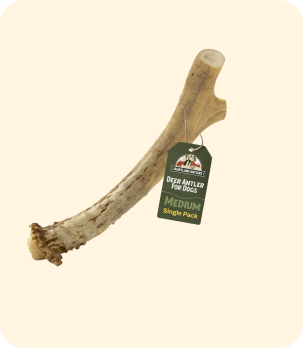
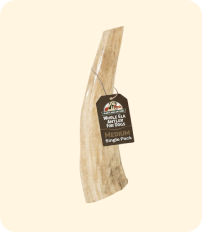

The right antler for a Shih Tzu is Grade A small split deer, 9-16 lb breed, brachycephalic jaw, lasting 3-5 weeks per piece.

Quick Answer: A Shih Tzu (9 to 16 lb, brachycephalic skull, undershot jaw) needs small split deer, Grade A, from Heartland Antlers. The undershot jaw cannot close around a cylindrical whole antler, so the flat face of a split piece is the only format that works. Deer density, not elk, keeps effort appropriate for a light chewer whose chewing sessions cost real breathing effort. This is an anatomical requirement, not a preference. Grade A small split deer typically lasts a Shih Tzu 3-5 weeks of short daily sessions.
Choosing the right antler for a Shih Tzu is not a sizing decision, it is an anatomy decision. Your Shih Tzu keeps carrying the antler around the room but never actually chewing it. You picked a cut, matched the weight on the chart, and did everything the guide said. The guide was not written for this breed. Heartland Antlers founder Donald has seen Shih Tzu owners try whole elk, split elk, and whole deer before landing on small split deer at Grade A, and in every case, the dog that never chewed before starts showing sustained ten-minute sessions on the first correct piece.
Customers with Shih Tzus consistently describe a dog that mouths an antler briefly and sets it down, repeating this pattern for days without establishing a real session. After working with Shih Tzu owners, we've found the three-factor anatomy requires all three conditions to be met at once: a flat face for the underbite, a marrow surface within reach of the compressed jaw, and a diameter the narrow molar gap can span. Small split deer is the only configuration that meets all three.
Shih Tzu Breed Profile: Why Antler for Shih Tzu Requires a Different Approach
| Attribute | Shih Tzu |
|---|---|
| Weight range | 9-16 lb |
| Jaw type | Undershot jaw, brachycephalic skull |
| Chew style | Light chewer, short sessions, breathing effort |
| Correct antler | Grade A small split deer |
| Typical duration | 3-5 weeks |
| Avoid | Whole antler (any species), elk antler |
The Shih Tzu is a brachycephalic toy breed with an undershot jaw and compressed muzzle anatomy. These two structural features make generic antler sizing guidance wrong for this breed regardless of weight. The flat face of a split antler is the only cut that matches the undershot bite geometry.
How to Choose the Right Antler for a Shih Tzu
- Confirm your dog's jaw type: the Shih Tzu has an undershot jaw (lower teeth protrude forward past upper teeth). This is normal breed anatomy, not a dental problem.
- Select small split deer, Grade A, from Heartland Antlers. Do not start with whole cut or elk.
- For puppies under 10 months: same configuration, supervised sessions of 5-10 minutes.
- On the first session, watch for the dog to position the flat marrow face against the jaw. If the dog is repositioning constantly, the piece may be too large. If the dog engages the flat face and works steadily, the fit is correct.
- Keep sessions to 10-15 minutes for a brachycephalic breed. End the session if you hear labored breathing.
The Shih Tzu Chew Profile: Three Factors That Disqualify Most Antler Formats
Shih Tzus weigh between 9 and 16 pounds. Weight-based guides read that range, hand you a small antler, and consider the problem solved. They are missing the anatomy.
The Shih Tzu is a brachycephalic breed. The skull is compressed front to back. The muzzle is short, wide, and flat. Airways are narrowed. All of that affects what chewing costs the dog in terms of breathing effort, and how much sustained chewing is reasonable per session. A Shih Tzu (9 to 16 lb, muzzle compressed to roughly 20 to 25 percent of skull length, narrowed nasal passages) works harder to breathe during physical effort than a standard-muzzle dog of the same weight.
On top of the brachycephalic structure, the Shih Tzu has an undershot jaw. The lower jaw protrudes forward past the upper. This is standard breed anatomy. It means the bite geometry is not a scissors grip. The upper and lower teeth do not close around an object in a clean, balanced bite. The lower jaw leads. The upper sits back. A cylindrical object, like a whole antler, meets that geometry and rolls. There is no stable contact point. The dog cannot get purchase.
Chew force in a 9 to 16 lb Shih Tzu is light. Dense elk antler is built for dogs that can drive consistent jaw pressure into it. A Shih Tzu is not that dog. The Shih Tzu chew profile is: light jaw force, undershot geometry, brachycephalic anatomy, and a body weight at the low end of the small-dog range. All four of those factors point to the same answer.
Why Small Split Deer Is the Only Correct Configuration for a Shih Tzu
Split deer is the complete answer for this breed. The two variables work together and cannot be separated.
The cut fix. Whole antler is a cylinder. A cylinder against an undershot jaw produces the same result every time: the jaw cannot close cleanly around it, the piece rolls, and the dog walks away. Split antler has a flat face. The undershot jaw can set against that flat surface and apply pressure without the piece shifting. A Shih Tzu (9 to 16 lb, undershot jaw, flat wide lower bite surface) working small split deer, Grade A, will show visible marrow engagement within the first 10 minutes. The same dog working a whole antler carries it from spot to spot and never chews.
The species fix. Deer antler at Grade A is less dense than elk. The dog can make visible progress on the marrow. That progress is what keeps the session going. For a light chewer, reachable marrow is the difference between a dog that engages for ten minutes and one that carries the piece to a corner and leaves it. Elk density requires consistent jaw pressure this breed cannot produce. It sits in the mouth and does not yield. The dog loses interest. It is not pickiness. The resistance is wrong for the jaw.
The size fix. Small, sized for this weight class. The compact jaw span of a 9 to 16 lb Shih Tzu needs a cross-section it can hold without constantly repositioning. Small split deer fits the jaw geometry for this breed.
What We Ship for Shih Tzus
These are the configurations that fit. Not defaults from a size chart.
| Dog | Weight | Configuration | Notes |
|---|---|---|---|
| Adult Shih Tzu | 9-16 lb | Small split deer, Grade A | Required cut for undershot jaw; correct default |
| Shih Tzu puppy (under 10 months) | Under 10 lb typical | Small split deer, Grade A, supervised | Developing teeth; short sessions |
| Senior Shih Tzu | 9-16 lb | Small split deer, Grade A | Lower jaw strength with age; split keeps marrow accessible |
Adult Shih Tzu (9 to 16 lb): Small split deer, Grade A. The small cross-section matches the compact jaw without being too narrow to hold steady. Split is the required cut: the flat face of the split gives the undershot jaw a surface to press against and work. Deer antler's lower density keeps jaw effort appropriate for a light chewer in a brachycephalic body. This is the correct default for most adult Shih Tzus.
Shih Tzu puppy (under 10 months): Small split deer, Grade A, with close supervision. Developing teeth need the lower resistance of deer over elk. Small is right for a jaw still growing. Sessions should be short. Supervision is not optional for a puppy on any antler. See Antlers for Puppies: Age and Size Guide for the full puppy protocol.
Senior Shih Tzu: Small split deer, Grade A. Jaw strength decreases with age. The split cut keeps marrow accessible without requiring sustained bite pressure to reach it. The lower density of deer over elk is the right call as chew force diminishes. Keep sessions short and monitor jaw effort. See Antlers for Senior Dogs for the full age-based framework.
The Elk vs. Deer Call for a Shih Tzu
Split deer. That is the complete answer for this breed. The choice does not change based on individual variation.
Elk antler is denser than deer. That density is well-matched to a dog that can drive consistent, forceful pressure into the antler over time. A Shih Tzu does not work that way. The jaw is light, the muzzle is short, and brachycephalic anatomy means every chewing session costs the dog breathing effort.
Dense elk antler sitting in the mouth of a Shih Tzu does not reward that effort with progress. The dog loses interest. It is not pickiness. The resistance is wrong for the jaw.
Deer antler at Grade A is less dense. The dog can make visible progress on the marrow. That progress is what keeps the session going. For a light chewer, reachable marrow is the difference between a dog that engages for ten minutes and one that carries the piece to a corner and leaves it. Deer for this breed, every time.
How to Read the First Session
Give the first session ten to fifteen minutes. A Shih Tzu is not a long-session chewer by nature. Watch what the dog does, not just whether it chews.
Right fit: Your dog takes the small split deer to a spot, positions the flat face where the jaw can set, and chews steadily. You see surface wear on the marrow after the session. The piece is still solid. The dog returns to it across multiple days. This is correct.
Undershot jaw not getting purchase on whole cut: The dog picks up the antler, repositions it repeatedly, and eventually sets it down. This is not disinterest. This is an undershot jaw meeting a cylinder it cannot stabilize. Switch from whole to split and observe again.
Loses interest quickly: The dog sniffs the piece, mouths it once or twice, and walks away. Two possible causes. First, check the cut: if it is whole, switch to split. Second, check the species: if it is elk, switch to deer. Dense elk with no visible marrow access offers nothing to a light chewer.
Supervision Notes
Stay in the room for the first session. That applies to every dog on every new chew.
For Shih Tzus specifically, the brachycephalic anatomy sets a firm limit on session length. Ten to fifteen minutes is a full session for this breed. Chewing is physical effort. Flat-faced dogs manage airflow differently during exertion. If you hear labored breathing or notice the dog stopping frequently to catch air, the session is over.
Watch the piece across sessions. When the antler is worked down to roughly the width of the dog's molar, retire it. A Shih Tzu has less room to manage a lodged piece than a longer-muzzled dog. The retirement threshold is the same as any breed by rule, but the margin for error is smaller.
Grade A antler is consistent in density. It will not develop sharp fracture edges the way lower-grade pieces do. For a small dog with a delicate mouth and a short muzzle, grade is not optional.
Antler for Shih Tzu: The Anatomical Case for Small Split Deer
A small split deer antler for a Shih Tzu (9-16 lb, brachycephalic skull, undershot jaw) is the only configuration that resolves all three fit variables simultaneously: the split cut provides a flat contact surface for the undershot jaw, deer density keeps jaw effort appropriate for a brachycephalic dog managing airflow during exertion, and small cross-section matches the compact bite geometry of a short-muzzled breed. No other configuration addresses all three.
Why Most Antler Guides Skip This Breed Correctly
Most antler guidance divides dogs into three buckets: small, medium, and large. Shih Tzus land in "small." The guide recommends a small antler. Article done.
The problem is that "small dog" is not a jaw type. It is a weight range. A 12 lb Dachshund has a long, narrow, hunting jaw with use that is disproportionate to its body. A 12 lb Shih Tzu has a flat face, an undershot jaw, and light chew force. Both are small dogs. They need entirely different antlers.
Brachycephalic breeds are consistently underserved by generic sizing frameworks because those frameworks were built around dogs with standard muzzle length and scissors-bite geometry. Applying that advice to a Shih Tzu produces the same result every time: the wrong cut, the wrong species, a dog that does not engage, and an owner who concludes that their dog does not like antlers.
Small split deer, Grade A, is not a compromise. It is what actually works for this anatomy.
Where to Go Next
For most adult Shih Tzus: small split deer, Grade A. That is the correct default and the right starting point.
Find the Right Fit by Breed and Jaw Style to run the full fit check against your dog's weight and chew style.
Elk vs. Deer Antler: Which Is Right for a Smaller Dog explains why deer density is the correct call for light-jawed brachycephalic breeds.
Antlers for Senior Dogs: When to Switch to Split covers how the configuration adjusts as jaw strength decreases.
Antlers for Puppies: Age and Size Guide covers the right configuration for dogs under 10 months.
The Right Antler for a Yorkshire Terrier covers a similar size range with a different jaw geometry and terrier chew drive.
The Right Antler for a French Bulldog covers another flat-faced breed with similar sizing considerations.
Shop Grade A antler for Shih Tzus
Frequently Asked Questions
What is the best antler for a Shih Tzu?
Small split deer antler, Grade A. The split cut is the critical variable: the flat face of the split gives the Shih Tzu's undershot jaw a surface it can set against and work, which a cylindrical whole antler cannot provide. Deer antler's lower density keeps jaw effort appropriate for a light chewer in a brachycephalic body. The extra small size matches the compact jaw without the piece being too large to hold steady.
Are antlers safe for Shih Tzus?
Yes, with the correct cut, size, and grade. The main considerations for Shih Tzus are jaw geometry, light chew force, and brachycephalic physiology. Small split deer in Grade A addresses all three: the split cut solves the undershot jaw problem, deer density keeps effort appropriate, and Grade A antler has consistent density without the fracture risk of lower grades. Keep sessions to ten to fifteen minutes, supervise closely, and retire the piece when it reaches molar width.
What size antler for a Shih Tzu?
Extra small. Most adult Shih Tzus weigh 9 to 16 pounds, and the compact, wide-flat jaw of this breed needs a cross-section it can hold without constantly repositioning. Small split deer fits the jaw geometry and the body weight together. Do not size up based on weight alone; the Shih Tzu's short muzzle and undershot jaw are the determining factors, not body mass.
Elk or deer antler for a Shih Tzu?
Deer antler for Shih Tzus. Elk is denser than deer, and that density requires a dog with meaningful bite force to make progress toward the marrow reward. A Shih Tzu is a light chewer. Dense elk antler does not yield enough feedback per session to hold the dog's interest. Deer antler at Grade A gives the right resistance: visible progress on the marrow, appropriate effort for the jaw, and sessions that last without frustrating the dog.
How long does an antler last for a Shih Tzu?
A small split deer antler, Grade A, typically lasts a Shih Tzu between three and five weeks with regular short sessions. Because Shih Tzus are light chewers and sessions should be kept to ten to fifteen minutes for a brachycephalic breed, the antler goes down slowly. If the piece is heavily reduced after one session, check the grade. Grade A antler is denser than lower grades and will last significantly longer. If your dog loses interest quickly and makes no progress, confirm you are using split deer and not whole cut or elk.
Can a Shih Tzu chew elk antler?
Elk antler is not recommended for Shih Tzus. Elk runs 30-40% denser than deer at equivalent diameter. For a 9-16 lb dog with light jaw force and brachycephalic anatomy, that density means the antler does not yield visible progress per session. The dog puts in breathing effort and gets no marrow reward. Small split deer at Grade A is the correct density for this jaw.
Why won't my Shih Tzu chew their antler?
The most common cause is the wrong cut or species. A Shih Tzu's undershot jaw cannot grip a cylindrical whole antler cleanly. If you are using whole cut, switch to split immediately. If you are using elk, switch to deer. A Shih Tzu working small split deer, Grade A, typically engages the flat marrow face within the first few minutes of the first session.
Frequently Asked Questions
What is the best antler for a Shih Tzu?
Small split deer antler, Grade A. The split cut is the critical variable: the flat face of the split gives the Shih Tzu's undershot jaw a surface it can set against and work, which a cylindrical whole antler cannot provide. Deer antler's lower density keeps jaw effort appropriate for a light chewer in a brachycephalic body. The extra small size matches the compact jaw without the piece being too large to hold steady.
Are antlers safe for Shih Tzus?
Yes, with the correct cut, size, and grade. The main considerations for Shih Tzus are jaw geometry, light chew force, and brachycephalic physiology. Small split deer in Grade A addresses all three: the split cut solves the undershot jaw problem, deer density keeps effort appropriate, and Grade A antler has consistent density without the fracture risk of lower grades. Keep sessions to ten to fifteen minutes, supervise closely, and retire the piece when it reaches molar width.
What size antler for a Shih Tzu?
Extra small. Most adult Shih Tzus weigh 9 to 16 pounds, and the compact, wide-flat jaw of this breed needs a cross-section it can hold without constantly repositioning. Small split deer fits the jaw geometry and the body weight together. Do not size up based on weight alone; the Shih Tzu's short muzzle and undershot jaw are the determining factors, not body mass.
Elk or deer antler for a Shih Tzu?
Deer antler for Shih Tzus. Elk is denser than deer, and that density requires a dog with meaningful bite force to make progress toward the marrow reward. A Shih Tzu is a light chewer. Dense elk antler does not yield enough feedback per session to hold the dog's interest. Deer antler at Grade A gives the right resistance: visible progress on the marrow, appropriate effort for the jaw, and sessions that last without frustrating the dog.
How long does an antler last for a Shih Tzu?
An small split deer antler typically lasts a Shih Tzu between three and five weeks with regular short sessions. Because Shih Tzus are light chewers and sessions should be kept to ten to fifteen minutes for a brachycephalic breed, the antler goes down slowly. If the piece is heavily reduced after one session, check the grade. Grade A antler is denser than lower grades and will last significantly longer. If your dog loses interest quickly and makes no progress, confirm you are using split deer and not whole cut or elk.