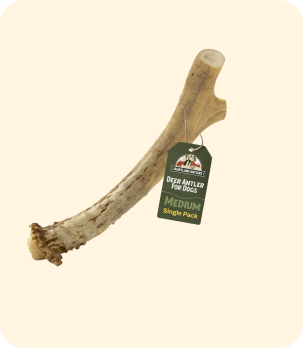
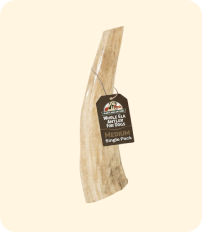
The right antler for a Bullmastiff is Grade A XL whole elk, main shaft section, wide cross-section, 100-130 lb breed, lasting 3-6 weeks per piece.

Quick Answer: For an adult Bullmastiff (100-130 lb), the correct antler is XL whole elk, Grade A, with a wide cross-section from the main shaft, from Heartland Antlers. A Bullmastiff's extremely wide, short jaw can allow a narrow XL piece to slip past the molars regardless of length. A Grade A XL whole elk antler from the main shaft typically lasts a Bullmastiff 3-6 weeks with regular moderate chewing. Heartland Antlers hand-selects for wide-cross-section XL pieces matched to this breed's jaw geometry.
You bought an XL antler. It looked right. Long piece, big dog, seemed proportionate. Your Bullmastiff picked it up, moved it to its spot, and you stepped away. Came back to find a much shorter antler than you expected.
In our experience supplying antler for bullmastiff owners, the cross-section width issue is the single most common fit failure we see with this breed. Dogs receiving tine-cut XL pieces instead of main-shaft sections show the early retirement pattern at a significantly higher rate than dogs receiving wide main-shaft cuts.
The piece was long enough. It was not wide enough. For an adult Bullmastiff (100-130 lb), the correct antler is XL whole elk, Grade A, with a wide cross-section from the main shaft. A Bullmastiff's jaw is so wide that a narrow XL piece can slip past the molars. Length does not prevent that. Cross-section does.
Customers with Bullmastiffs consistently report that medium or large elk holds through several sessions and then fails abruptly, split along the cortex or cracked at a stress point. After working with Bullmastiff owners, Heartland Antlers founder Donald has found the fracture traces to cross-section width, not piece length. The wide jaw needs a main-shaft cut, not a tine. XL whole elk from the main shaft, Grade A, distributes that load without failing.
Bullmastiff Breed Profile: What Makes Antler for Bullmastiff Different
| Attribute | Bullmastiff |
|---|---|
| Weight range | 100-130 lb |
| Jaw type | Extremely wide, short, mild underbite |
| Chew style | Moderate, patient, returns periodically |
| Correct antler | Grade A XL whole elk, main shaft, wide cross-section |
| Typical duration | 3-6 weeks |
| Avoid | Narrow XL pieces, tine sections, deer antler |
The Bullmastiff is a giant guarding breed developed to knock down and hold intruders. The jaw is disproportionately wide relative to its length, which creates a specific safety variable: narrow pieces can slip past the molar row regardless of the dog's chew drive level.
How to Choose the Right Antler for a Bullmastiff
- Confirm your dog is 100-130 lb adult Bullmastiff range.
- Select XL whole elk, Grade A, specifically from the main shaft section, from Heartland Antlers. Ask about cross-section width, not just length, when ordering.
- Evaluate the cross-section: the piece needs to be wide enough to sit across the molar row without slipping toward the throat.
- On the first session, watch that the piece sits on the molars rather than sliding toward the back of the jaw. If it moves toward the throat, pull it and size up in diameter.
- Keep sessions to 15-20 minutes for a brachycephalic breed. End the session if you hear increased respiratory effort.
The Bullmastiff Chew Profile: Why Jaw Width Is the Safety Variable
The Bullmastiff is a giant breed built for guarding. Not coursing, not retrieving, not sustained endurance work. Its job was to knock down intruders and hold them. The jaw was built accordingly.
Weight: 100-130 lb
Jaw type: Extremely wide, short, and square. The muzzle is compressed and flat. The Bullmastiff carries a mild underbite and a jaw width that rivals breeds 30 lb heavier. The distance between the outer molars on each side of the jaw is large enough that a standard narrow XL piece can slide between them.
Chew drive: Moderate. This is not a compulsive chewer. A Bullmastiff does not attack chews relentlessly the way a Pit Bull or Malinois does. It chews with patience when interested, but will disengage and come back later rather than grinding a piece for an hour straight.
The actual risk: Swallowing. Not from jaw force, but from jaw geometry. A Bullmastiff's wide, short muzzle means a narrow piece can slide back in the mouth without the molars intercepting it. Low chew drive does not protect against this. A dog that is mouthing a piece casually can still inhale a narrow piece that fits the gap in the jaw. Cross-section width is the safety variable, not chew intensity.
A Grade A XL whole elk antler from the main shaft section provides a cross-section diameter of roughly 1.5 to 2 inches, enough to sit across the Bullmastiff's molar row. A tine section of the same antler can be as narrow as 0.75 inches, which is not adequate for this jaw width.
Grade A elk runs 15-25% heavier per linear inch than Grade B at the same size. That density difference is what prevents uneven degradation, the pattern where a lower-grade piece works narrow at the contact zones faster than it should. A correctly selected XL whole elk main shaft piece, Grade A, from Heartland Antlers, typically lasts a Bullmastiff 3-6 weeks of regular moderate chewing.
Antler for Bullmastiff: What Size and Cross-Section Does This Breed Need
These configurations are based on jaw geometry first, body weight second.
| Bullmastiff Type | Weight | Correct Antler | Section | Grade |
|---|---|---|---|---|
| Standard adult | 100-130 lb | XL whole elk, wide cross-section | Main shaft | Grade A |
| Rotation pair | 100-130 lb | Two XL whole elk | Main shaft | Grade A |
| Puppy (under 12 months) | Any | XL split elk, supervised | Main shaft | Grade A |
| Senior Bullmastiff | Any | XL split elk | Main shaft | Grade A |
Standard adult Bullmastiff (100-130 lb): XL whole elk, Grade A, wide cross-section. The piece needs both the length and the diameter to stay outside the back of the jaw. Wide-cross-section XL is the call. Not all XL pieces are the same diameter. We hand-select for pieces where the cross-section width is substantial, not just the length.
Rotation pair for an adult Bullmastiff: Two XL whole elk, Grade A. Even at moderate chew drive, a Bullmastiff works a piece steadily. Two pieces on rotation keeps both structurally fresh and maintains the dog's interest across multiple weeks.
Bullmastiff under 12 months: XL split elk, supervised. Giant-breed jaw geometry develops through 18 months. The adult width is already present early, which means the cross-section requirement applies from the start. Split elk provides marrow access and appropriate density for a developing jaw. Supervised sessions only.
Senior Bullmastiff: XL split elk. Marrow access without demanding sustained bite pressure. The wide jaw geometry stays consistent with age. Split format keeps the senior dog engaged without heavy jaw effort.
Why XL Elk Beats Deer Antler for a Bullmastiff
Elk, every time. No close call here.
Deer antler is lower density and narrower in cross-section at equivalent sizes. For a Bullmastiff, deer antler introduces two problems at once: it will exhaust faster under a wide jaw applying moderate pressure, and the typical cross-section of a deer antler at any available size does not provide enough width to sit safely in a Bullmastiff's mouth.
XL whole elk is the only species and cut that reliably provides the cross-section width this jaw requires. The density is appropriate for a moderate chewer. The diameter of XL elk antler at the main shaft is what physically prevents the piece from shifting past the molars.
Deer antler does not provide adequate width for this jaw geometry. This is not a preference call. It is a geometry call.
Elk antler is 30-40% denser than deer antler at equivalent sizes. For the Bullmastiff's wide jaw, that density also means the piece holds its cross-section width longer under moderate use, staying safely above the swallowing threshold for more sessions before retirement. Bullmastiff owners who have tried deer and switched to XL elk main shaft report the piece stays structurally sound throughout its working life rather than narrowing unpredictably.
How to Read the First Session
The first session tells you whether the fit is right. Watch for 20 minutes.
Width-right fit: Your Bullmastiff settles in and chews steadily. The piece is visibly too wide to slide back in the jaw. It sits across the molars and the dog works it from the side. Surface wear after the session but structure intact. This is what you want.
Too narrow: The dog mouths the piece and it moves around more than it should. The piece slips back toward the throat rather than sitting on the molars. Any sign of gagging or the dog repositioning the piece frequently to keep it from sliding. This is the swallowing risk for a Bullmastiff. Pull the piece immediately and size up in cross-section width, not just length. A longer piece with the same narrow diameter does not fix the problem.
Too hard for the dog's drive: The Bullmastiff sniffs it, engages briefly, then disengages and does not return. With a moderate-drive chewer, this sometimes means the piece is fully intact Grade A elk and the dog would rather have marrow access. Try split elk if whole elk produces consistent disengagement within the first few sessions.
Supervision Notes for a Brachycephalic Breed
Supervise the first three sessions with any new piece.
Bullmastiffs are brachycephalic. Short muzzle, compressed airway. Keep sessions to 15-20 minutes and observe breathing. If the dog is chewing steadily and you hear increased respiratory effort, end the session. This is not an emergency, but it is a signal. Shorter sessions with more frequency work better than long sessions for flat-faced breeds.
Retire the piece when it reaches roughly the width of two fingers held together. For a Bullmastiff, a smaller piece does not become safer as it gets shorter. The remaining diameter is the variable that matters. A short stub that still has a wide cross-section is safer than a longer piece that has been worked narrow. Pull it before the cross-section narrows to the point where the jaw can no longer intercept it.
Floor surface matters for a giant breed. Bullmastiffs are 100 lb dogs working a chew on hard floors. Give them a mat or rug to lie on. Not just for comfort. Hard floors make it harder for a large dog to stabilize a piece, which means more repositioning and less productive chewing.
The Cross-Section Problem: Why Length Alone Is the Wrong Metric for a Bullmastiff
Most antler sizing by weight gives you length as the primary variable. A 100 lb dog gets an XL piece. The assumption is that a longer piece is harder to swallow.
That assumption fails for a Bullmastiff.
A long piece with a narrow diameter fits the gap between a Bullmastiff's molars. The dog does not need to bite through it. It can slide past the tooth row. Length does not stop this. Width does.
Cross-section width is the measurement that determines whether a piece stays outside the back of the jaw or can travel past it. For a breed with normal jaw proportions, this is rarely a concern at XL size. For a Bullmastiff, whose jaw is disproportionately wide relative to its length, it is the central fit question.
Before ordering, the evaluation is not "is this piece long enough for a 120 lb dog?" It is "is this piece wide enough to span the jaw?" XL elk antler from the main shaft, not the brow tine, provides the cross-section this breed needs. Tine sections, even from XL elk, can be narrow. Main shaft sections are wider. This is the distinction worth asking about when you order.
Grade A is non-negotiable. Lower-grade antler degrades unevenly, and uneven degradation produces narrowing at worked contact zones. A piece that starts at the right width can work itself narrow faster in lower-grade material. Grade A maintains consistent density and holds its structure longer.
Find the Right Fit for a Bullmastiff
XL whole elk, Grade A, wide cross-section, for adult Bullmastiffs. The angle is width, not length.
Read these next:
- What Grade A Means for a Power Chewer
- How We Grade Antlers for Aggressive Chewers
- Find the Right Fit by Breed and Jaw Style
- Elk vs. Deer Antler: Which Holds Up to a Crushing Jaw
- Antler for a Cane Corso
- Antler for a Rottweiler (another giant power chewer with a wide jaw)
Heartland Antlers hand-selects XL whole elk from the main shaft section specifically to ensure wide cross-section diameter. One ingredient: naturally shed elk antler, no coatings, no additives. For a Bullmastiff, that hand-selection step is the difference between a piece that sits safely across the molar row and one that can slide past it.
Frequently Asked Questions
What is the best antler for a Bullmastiff?
XL whole elk, Grade A, with a wide cross-section from the main shaft. The Bullmastiff's jaw is extremely wide and short with a mild underbite, which means a narrow XL piece can slip past the molars even at moderate chew drive. Wide-cross-section XL elk is the correct call because the diameter physically prevents the piece from traveling to the back of the jaw. Length is secondary to width for this breed.
Are antlers safe for Bullmastiffs?
Yes, with the right size, cross-section, and grade. The primary safety consideration for Bullmastiffs is not chew force but jaw geometry. A wide, short jaw can allow a narrow piece to slip past the molars. XL elk with adequate cross-section width addresses this directly. Supervise the first sessions, keep sessions short given brachycephalic physiology, and retire any piece when the remaining cross-section narrows below the safe threshold for this jaw width.
What size antler for a Bullmastiff?
XL, with wide cross-section. Most 100-130 lb dogs size to XL by weight, and that guidance is correct for the Bullmastiff. The additional requirement is cross-section width. Not all XL pieces are the same diameter. Main shaft sections of XL elk provide the width this breed's jaw requires. Tine sections, even at XL, can be too narrow for a Bullmastiff's jaw geometry.
Elk or deer antler for a Bullmastiff?
Elk. Deer antler does not provide adequate cross-section width at any available size for a Bullmastiff. Deer antler is also lower density than elk, which means it exhausts faster under a wide jaw. Both factors point to elk. XL whole elk, Grade A, is the correct call for adult Bullmastiffs with no exception for deer at this jaw size.
How long does an antler last for a Bullmastiff?
A Grade A XL whole elk antler from Heartland Antlers typically lasts a Bullmastiff 3 to 6 weeks with regular moderate chewing. Bullmastiffs are not high-intensity chewers, so a well-selected piece at the right width will hold up through many sessions before needing replacement. If the piece is significantly reduced after one or two sessions, confirm Grade A and check that the cross-section is wide enough. A piece worked narrow quickly often indicates grade inconsistency or that the piece was undersized in diameter at the start.
Why does cross-section matter more than length for a Bullmastiff?
The Bullmastiff's jaw is unusually wide for its length. A long but narrow piece can slide past the molar row without the teeth intercepting it. That creates a swallowing risk even for a dog with moderate chew drive. Cross-section width is what physically prevents the piece from traveling past the jaw. A main shaft section of XL elk has a cross-section diameter of roughly 1.5 to 2 inches, which is wide enough to span the molar row. A tine section of the same antler can be as narrow as 0.75 inches, which is not sufficient.
What is the difference between main shaft and tine sections for a Bullmastiff?
Main shaft sections come from the central trunk of the antler, which is the widest part. Tine sections come from the branches, which are narrower. For a Bullmastiff, main shaft is the only appropriate section. A tine-cut XL piece may meet the length requirement but fails the width requirement. Heartland Antlers hand-selects main shaft sections specifically for wide-jaw breeds like the Bullmastiff.
Schema (do not paste into Shopify body_html)
Frequently Asked Questions
What is the best antler for a Bullmastiff?
XL whole elk, Grade A, with a wide cross-section from the main shaft. The Bullmastiff's jaw is extremely wide and short with a mild underbite, which means a narrow XL piece can slip past the molars even at moderate chew drive. Wide-cross-section XL elk is the correct call because the diameter physically prevents the piece from traveling to the back of the jaw. Length is secondary to width for this breed.
Are antlers safe for Bullmastiffs?
Yes, with the right size, cross-section, and grade. The primary safety consideration for Bullmastiffs is not chew force but jaw geometry. A wide, short jaw can allow a narrow piece to slip past the molars. XL elk with adequate cross-section width addresses this directly. Supervise the first sessions, keep sessions short given brachycephalic physiology, and retire any piece when the remaining cross-section narrows below the safe threshold for this jaw width.
What size antler for a Bullmastiff?
XL, with wide cross-section. Most 100-130 lb dogs size to XL by weight, and that guidance is correct for the Bullmastiff. The additional requirement is cross-section width. Not all XL pieces are the same diameter. Main shaft sections of XL elk provide the width this breed's jaw requires. Tine sections, even at XL, can be too narrow for a Bullmastiff's jaw geometry.
Elk or deer antler for a Bullmastiff?
Elk. Deer antler does not provide adequate cross-section width at any available size for a Bullmastiff. Deer antler is also lower density than elk, which means it exhausts faster under a wide jaw. Both factors point to elk. XL whole elk, Grade A, is the correct call for adult Bullmastiffs with no exception for deer at this jaw size.
How long does an antler last for a Bullmastiff?
A Grade A XL whole elk antler typically lasts a Bullmastiff 3 to 6 weeks with regular moderate chewing. Bullmastiffs are not high-intensity chewers, so a well-selected piece at the right width will hold up through many sessions before needing replacement. If the piece is significantly reduced after one or two sessions, confirm Grade A and check that the cross-section is wide enough. A piece worked narrow quickly often indicates grade inconsistency or that the piece was undersized in diameter at the start.