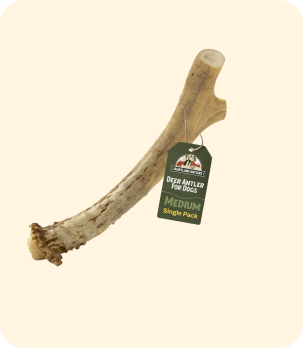
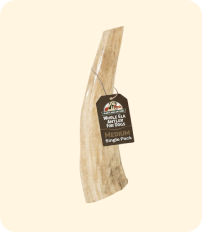
Throw away an antler chew the moment the worn stub can fit fully inside your dog's mouth, or sit crossways behind the back molars with the jaw closed. That is the point a chew stops being a chew and turns into a swallowable object. For most dogs it lands when roughly two inches or less remain. Everything before that stage is normal wear. The nub is the one genuinely dangerous phase in a Grade A antler's life, and it is easy to catch if you know the test.
A whole antler spends weeks as a safe, heavy job for your dog. Then it crosses a line. This piece is about finding that line early, on purpose, before it becomes a problem you have to react to.
When should you throw away an antler chew?
Retire it at the size threshold, not on a calendar. A chew is done when it is small enough to be swallowed whole. The rule most vets and chew makers repeat is simple: if the antler fits entirely in your dog's mouth, it is too small and comes out now.
Two other triggers pull a chew out early, before it ever reaches nub size:
- Sharp edges or a cracked shell. Run a thumb down the surface. If it catches on a splintered ridge or a jagged break, it is done, regardless of how much length is left.
- A piece that could snap off. If a section is loose, thin, or hollowed out at the marrow channel, retire the whole thing rather than wait for it to break in your dog's mouth.
Size is the main event, though. A Grade A elk antler wears down slowly and evenly, so you usually get a long, boring middle where nothing about it is risky. The choking window opens only at the very end. Your job is to close it before your dog gets there.
This is a different question from how long a chew is worth in weeks. If you want the cost math and the lifespan ranges, that lives in how long antler chews last for dogs. Here we are only talking about the safety line at the end.
How small is too small for an antler chew?
Use two hands-on tests. Either one failing means the chew retires.
The mouth test. Take the stub and hold it near your dog's open mouth. If the whole piece would fit inside with room to close the jaw around it, it is too small. A safe chew is always bigger than the mouth working it. This is the check the whole category agrees on, from breed-specific antler makers to general vet advice.
The molar test. Set the stub against the back teeth. If it can sit crossways behind the molars, or slip flat across the top of the tongue toward the throat, it has reached swallow size. A correctly sized chew is too long and too wide to ever lie down flat back there.
For a rough number, many chew makers put the line at about two inches of remaining length, or "as big as your dog's nose, or larger." Treat those as a heads-up, not the final word. A two-inch stub is dangerous for a Great Dane and fine for a Yorkie, which is why the mouth and molar tests beat any single measurement. The test scales to your dog. A ruler does not.
One more honest note: bigger dogs reach the danger zone with more antler left than you would expect, because a Cane Corso or a Rottweiler can get a wide stub to the back of the mouth that a smaller dog never could. If you own a large, strong-jawed breed, retire earlier and do not second-guess it.
The weekly nub check: a 30-second inspection routine
You do not need to weigh or measure anything. You need a habit. Pick one fixed moment, handing the antler over, or picking it up at night, and run the same quick check every time. Once a week is the floor. Daily is better for a hard chewer.
- Look at the length. Has it dropped since last week? Slow gnawers surprise owners here, because a chew that looked huge a month ago can quietly reach nub size without any single dramatic day.
- Feel the surface. Thumb down each side. Smooth ground-down antler is fine. A rough splintered patch or a sharp lip is a retire signal.
- Run the mouth test. The five-second version from above. If it is close, it is close enough to pull.
- Check the marrow channel. On a worn piece the hollow center can thin the walls. If the shell around it feels papery, retire it.
Supervision is the whole game here, and it is a skill, not a fear. Owners who watch their dog chew catch the nub stage weeks before it becomes an emergency. This is the same logic behind matching the antler to the dog in the first place, covered in are antler chews safe for dogs. Safe chewing is a system: right chew, right size, eyes on it, pulled at the right time.
What to do with the worn antler stub
Once a stub fails a test, get it away from the dog and out of reach in the same motion. Do not set it on a low shelf where it becomes a counter-surf prize. Two clean ways to handle it:
- Trash it. A worn antler nub is spent. It has no safe use left as a chew, and there is no trimming or sanding it back into service. Into the bin, ideally one with a lid.
- Return it to the ground. Antler is one ingredient, naturally shed bone, so a stub buried in the yard or tossed in a wooded area breaks down over time the way a dropped antler would in the wild. It will not harm soil. Just place it where the dog cannot dig it back up.
What you do not do is keep it in the toy bin "just in case." The nub is the one shape of antler you never want back in rotation. Trade it out for a fresh, full-sized chew and the risk resets to zero.
If your dog already got ahead of you and swallowed a piece, that is a different situation with its own playbook. Read my dog swallowed a piece of antler for the watch-and-call guidance. This article is about staying on the near side of that line. That one is about what to do if you cross it.
Why the right-sized elk whole means fewer nubs
Here is the part most safety articles skip. How often you deal with a dangerous nub depends almost entirely on the chew you started with.
Start too small and you are back at the retirement line in days, over and over, which means more nubs, more disposal, more chances to miss the moment. Start with a correctly sized Grade A elk whole and the dense outer shell takes weeks to grind down. Elk runs 30 to 40 percent denser than deer at the same size, so it holds its shape far longer under a power chewer's jaw. Fewer trips to nub size means fewer risky moments and less shopping.
Fit is the lever. An antler that is one size too big for your dog is not a problem, it just lasts longer and reaches the danger zone later. An antler that is too small was already close to the line the day it arrived. Sizing up, within reason, buys you time and safety at once. The full sizing method is in what size antler does your dog need.
Cut matters too. A whole antler keeps its cortex intact and wears slowly, so an experienced adult chewer earns the marrow over weeks. A split antler exposes the softer marrow channel and goes faster, which is right for a puppy or a senior but reaches nub size sooner. If you are weighing the two, split vs whole elk antler for dogs lays out which cut matches which dog.
The pattern is the same one that runs through everything we make. The right chew, sized right, gives your dog a long safe job and gives you fewer decisions. You retire less often. You shop less often. You stop guessing about the moment it turns risky, because a well-fit whole antler makes that moment rare and easy to see coming.
When it is time to size up, a hand-selected Grade A elk whole is the durable, one-ingredient way to do it. Find the right fit in our elk antler collection.
Frequently Asked Questions
How small is too small for an antler chew?
Too small is any size that fits fully inside your dog's mouth or can sit crossways behind the back molars with the jaw closed. A safe chew is always larger than the mouth using it. As a rough guide, many chew makers retire antlers at about two inches of remaining length, but the mouth test matters more than the number because it scales to your dog's size.
When should I replace my dog's antler?
Replace it at the size threshold above, or sooner if you see sharp edges, cracks, splinters, or a section that could snap off. Do not wait for a set number of weeks. Check the stub with a quick mouth test once a week for slow chewers and daily for hard ones, and pull it the first time it comes close.
Is an antler nub a choking hazard?
Yes. A worn nub is the one stage in an antler's life that is genuinely dangerous, because it has reached a size a dog can swallow whole or lodge in the throat or gut. A full-sized Grade A antler is not a swallowable object. The nub is. That is why the retirement test is about size, not age.
Can I do anything with a worn-down antler stub?
Not as a chew. A spent nub has no safe use left, and it cannot be trimmed or reshaped back into a safe size. Throw it away in a covered bin, or return it to the ground outdoors where the dog cannot dig it up, since antler is naturally shed bone and breaks down over time. Do not keep it in the toy rotation.
How often should I inspect my dog's antler chew?
Weekly at a minimum, daily for a strong or fast chewer. Pick one fixed moment, handing it over or collecting it at night, and run the same check each time: look at the length, feel the surface for sharp or splintered spots, run the mouth test, and check the marrow channel for thin walls. Thirty seconds catches the nub stage long before it becomes an emergency.
Does a bigger antler mean I retire it less often?
Yes, within reason. A correctly sized or slightly oversized Grade A elk whole takes weeks to wear down and reaches the danger zone later, so you deal with fewer nubs and shop less often. Starting too small puts you near the retirement line almost immediately. Fit is the main lever on how often you face the risky end stage.