
Quick answer: Choose a bully stick alternative for the reason you want to switch. Compare ingredients and calories for an edible reward, material and wear for a toy, or product-specific evidence for dental care. Antlers, hard cheese and nylon are not automatic upgrades in safety. All hard materials can present dental risks.
You may want less odor, a different food ingredient, a lower cost or an activity that lasts longer. These are separate goals. A new product can meet one goal while adding a different limit. Start with what matters for your dog, then compare the exact item.
Identify why you want to switch
- Odor or mess: Read the product's storage and cleaning instructions. Descriptions such as low odor do not guarantee no smell in use.
- Cost: Record the amount paid and actual suitable uses. Do not assume a fixed monthly saving from a category label.
- Diet: Check ingredients, calorie information and serving guidance. Discuss new treats with your veterinarian if the dog follows a restricted diet.
- Fast consumption: Describe whether the dog chews, tears off pieces or gulps. A harder replacement can shift the risk to the teeth.
For a dog with pain, repeated vomiting or suspected swallowed material, stop using the item and seek veterinary advice. VCA explains that foreign-body obstruction can be serious. Do not keep testing alternatives to solve a medical problem. For routine selection, bring the original label and your observations to your veterinarian.

Compare alternatives by purpose
| Alternative | Reason to consider it | What to check first |
|---|---|---|
| Flexible food toy or puzzle | A reusable enrichment activity using an appropriate food portion | Fit, material, damage, cleaning instructions and food used inside |
| Edible dental product | A specific plaque or tartar-control purpose | Exact accepted product, size, calories and directions |
| Tendon or ear treat | A different edible texture or animal ingredient | Recipe, hardness, hygiene, serving guidance and swallowed-piece risk |
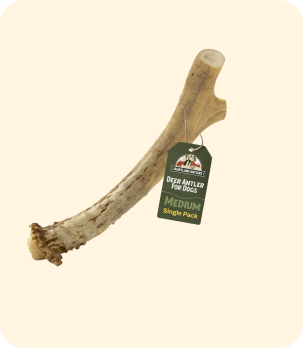
| Whole or split antler | A different material and chewing experience | Hardness, dimensions, condition and dental suitability; split cuts retain hard material |
| Hard cheese chew | A different edible ingredient and texture | Exact recipe and hardness; use only that maker's preparation instructions |
| Nylon chew toy | A non-edible toy in a specified shape and size | Dental risk, wear, ingestion and replacement instructions |
| Wood chew | A different material for owners exploring non-animal options | Hardness, splinters, loose pieces and the exact product's guidance |
This is a comparison of purpose, not a ranking of lifespan or safety. The products do different jobs. A dental treat need not occupy a dog for a long time to serve its stated purpose. A toy that remains intact is not useful if the dog ignores it or if it is unsuitable for the teeth.
Use the VOHC list to check an exact dental product and its accepted plaque or tartar claim. For daily enrichment, a suitable food puzzle can use part of the dog's food allowance, with the plan adjusted to the dog's diet.

Understand the limits of hard alternatives
AAHA's guidance identifies tooth-damage risks with very hard chews, including antlers and hard cheese. It also notes that pieces can be swallowed or cause choking. Changing from an edible stick to hard material does not remove every risk.
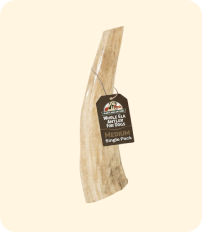
Heartland offers whole deer, whole elk and split elk antlers. A split cut exposes the inner surface, but the hard outer material remains. Neither whole antler nor split antler is a default choice for a forceful chewer, puppy, senior or dog with dental disease. A grading or size label does not prove suitability.
Read our antler and bully stick comparison, antler and cheese-chew guide and aggressive-chewer guide. Use the information to form questions, rather than to infer a guaranteed winner.
For a nylon toy, read the maker's own instructions. For example, Benebone states that its nylon chews are non-edible and hard. It advises removal if the toy appears to be eaten and identifies tooth injury as a risk. Natural and manufactured materials both require careful selection.
Do not use a general microwave time for cheese-chew remnants. Products and appliances differ. Follow the exact product instructions, including preparation, cooling and use limits. A preparation method described for one product does not apply to every hard remnant.

Make a careful switch and track value
- Define the goal. Write down whether you want a food reward, enrichment, dental care or a different material.
- Check suitability. Discuss the dog's teeth, diet and chewing behavior with your veterinarian.
- Read the item instructions. Confirm size, use, cleaning, storage and replacement rules.
- Observe each use. Stay close, inspect the item and remove it for damage, loose pieces, poor fit or discomfort.
- Keep a simple record. Note price, interest, suitable uses and why you removed it.
Calculate cost per suitable use from that record. There is no need to assume a fixed price or duration for either category. Discard an unsuitable item even if it has had little use. Our antler wear guide and antler value guide provide related questions to consider.
If you decide to review Heartland products, compare the elk range, split elk range and all sizes. Ask Heartland support about current item details. Suitability for the individual dog's teeth is a veterinary question.

Frequently asked questions
What can I give my dog instead of bully sticks?
Options include an appropriate food toy, a specific dental product or a different edible treat. Antler, hard cheese, nylon and wood are other materials to compare, but their hardness and wear require separate attention.
Are antlers safer than bully sticks?
We do not have comparative evidence that supports that general claim. Antlers can damage teeth. Edible treats still need checks for ingredients, hygiene, portion and swallowed pieces. Choose for the dog and the exact product.
What is the longest-lasting alternative?
There is no guaranteed answer across dogs. Product size, material, behavior and replacement rules change the result. A fixed weeks-to-months claim should not determine the choice.
Are tendons or cheese chews safe for puppies and seniors?
Do not assume this from the category. Hardness and dental condition vary. Ask your veterinarian for an appropriate option, especially during tooth development or when dental disease is present.
Do all bully sticks have the same calories?
No fixed calorie number should be applied to every stick. Use the actual product's calorie information and serving guidance. Ask the maker for missing information.