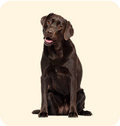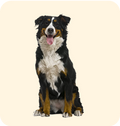

A Miniature Schnauzer's interest in a chew is useful information, but it does not establish a correct antler cut. Neither a terrier label nor a small body size predicts the pressure one dog will use. Start with the dog's teeth, behavior and product handling.
Antlers are hard and can damage teeth. A split cut does not remove that risk, and a quality grade is not a dental rating. Discuss suitability with your veterinarian before choosing a hard chew. This guide explains the product categories, interest, observation and retirement decisions without a fixed breed-wide prescription.
Look at the dog before the terrier label
The AKC describes Miniature Schnauzers as lively dogs that need daily exercise. That context helps with routine planning. It does not show that every Miniature Schnauzer seeks marrow, uses the same bite pressure or needs a particular antler species.
Describe the behavior you can see. Your dog may carry an item, lick it, scrape one area, grip it with the back teeth, tear pieces away or attempt to swallow. Do not assume that concentrated attention is harmless. A dog repeatedly trying to crush a hard object needs the activity to stop and be reassessed.
Use dental history as part of the decision. Tell your veterinarian about fractures, worn teeth, dental procedures, missing teeth and changes in comfort. The appearance of a small mouth does not establish what the teeth can tolerate. Nor does a dog staying interested prove that an item is suitable.
Interest can end without a product failure
Some dogs briefly inspect an object and leave it. Allow that choice. Do not diagnose a density mismatch from one short encounter or assume that exposing an inner surface will make the activity suitable. A new loss of interest or a change in chewing can also need a health check.

Compare current cuts and actual dimensions
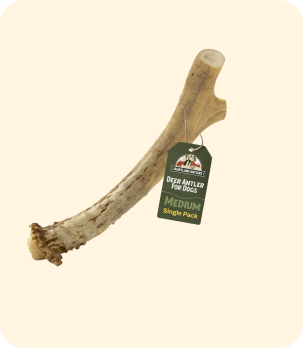
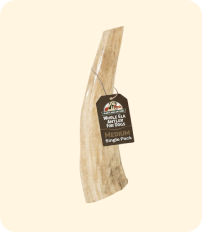
Heartland offers whole deer, whole elk and split elk. Split deer is not a current Heartland product category. Use the current catalog for item dimensions, shape, pack details and directions rather than an old breed chart.
A lengthwise split exposes the antler's interior while leaving hard outer material. A whole antler retains its surrounding outer surface. Neither description establishes a soft chew, a safe puppy option or a solution for senior teeth. Read the product format separately from the dog's dental assessment.
| Product detail | What it helps answer | What it does not answer |
|---|---|---|
| Actual dimensions | How the item compares with the seller's directions | Whether the teeth can tolerate the material |
| Shape and cut | Which surfaces are exposed and how the item is formed | Whether interest or comfort will be improved |
| Species | Whether the material is deer or elk antler | A universal hardness or safety ranking |
| Grade | The seller's sorting description | Prevention of splinters or tooth injury |
Natural pieces vary. A small or medium label does not describe every contour, and size terms can differ between sellers. Ask Heartland support about unclear specifications. Do not place a ruler or fingers between the dog's teeth to test fit.
A larger item is not the automatic answer to tossing, mouthing or losing interest. Those actions need context. If the dog cannot handle a product as directed or tries to swallow it, stop use. If it bites forcefully enough to damage hard objects, review the material and activity with your veterinarian instead of buying more resistance.

Plan engagement without pushing harder chewing
Give a Miniature Schnauzer several appropriate ways to be active. A sniffing walk, familiar training task, suitable food puzzle and quiet rest serve different needs. The day does not need to depend on one chew. Match the intensity to the individual dog's age and health.
For a short indoor task, use an easy search game or a familiar cue before offering a rest period. A food task should fit the normal diet and equipment directions. Avoid assuming that more difficulty is always better; frustration and frantic biting are reasons to change the task.
Food restrictions matter for every treat or edible chew. If a veterinarian has prescribed a diet, ask which rewards and flavored items can be included. A simple ingredient list does not remove the need to check the product against the care plan.
Keep choice separate from pain
Let the dog walk away from an object. Do not coat an antler with food, reshape it or apply heat to encourage a longer session. A new reluctance to chew, dropped food, one-sided chewing or sensitivity around the mouth deserves veterinary advice.
UC Davis warns that hard chewing items can fracture teeth. Do not replace a dental check with a softer-looking cut. A split antler still includes hard material.
Keep children and other pets separate during food and chew activities. If the dog guards an object, do not force a hand into the mouth. Get qualified help with a safe removal and management plan. Breed intensity does not make guarding a problem that a different antler can solve.

Inspect every use and stop on condition
If a chew is offered after a suitability discussion, follow its directions and supervise every session. Five uneventful uses do not create permission for unattended chewing. Watch the actual behavior and inspect the item before and after.
- Remove an item for cracks, loose pieces, sharp areas or an unsuitable worn shape.
- Stop forceful crushing, piece removal and swallowing attempts.
- End use for bleeding, sudden changes in chewing or apparent mouth discomfort.
- Contact your veterinarian if a tooth may be damaged or a piece may have been swallowed.
Breathing difficulty, collapse or choking signs need urgent veterinary help. Do not assume that a missing piece is harmless because it is small. Keep product details and the remaining item available for the veterinary discussion when safe.
Follow cleaning and drying directions before storage. Keep each item out of reach until the next inspection. Do not try to repair cracks or improve a worn surface. A stored antler does not regain material or become easier on teeth.
There is no reliable three-to-five-week lifespan for every Miniature Schnauzer. Record use and condition if you want to compare value. An intact product is not necessarily suitable, and a damaged one should not stay in use to meet a promised duration or justify its cost.

Frequently asked questions
Is medium split deer the correct starting point?
No. Heartland does not offer split deer, and no single cut and size suits every Miniature Schnauzer.
Does a small dog need the softest-looking antler?
Appearance is not a dental test. All antler formats retain hard material.
Can a puppy or senior use a split cut?
Do not assign cuts by age alone. Ask about the individual teeth and suitable activities.
Does Grade A mean the item cannot splinter?
No. Grade is not a guarantee against damage, fragments or tooth injury.
When can supervision end?
Continue active supervision whenever a chew is offered. Familiarity does not remove the need to watch.
The Jack Russell guide and size guide address related questions. This educational guide does not claim veterinary review, customer testing or a breed-specific safety result.