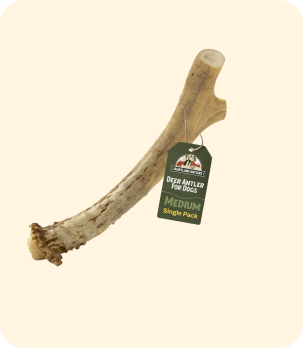
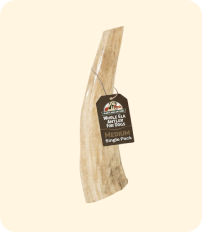

Quick answer: An Australian Cattle Dog's strong interest in chewing does not establish that a whole elk antler is appropriate. Hardness and durability are different from dental safety. Choose activities for the individual dog's mouth, health and behavior with veterinary advice.
Blue Heelers often appear in shopping guides for power chewers. That label can push the decision toward the hardest object available. A better process starts with what your dog actually does: gentle mouthing, forceful crushing, pulling pieces off or swallowing them. Record the behavior before you choose equipment.
Durability and dental safety are different questions
A piece can resist wear while a tooth remains at risk. AAHA identifies hard antlers among items that can damage teeth. Greater hardness is therefore not a solution to every destructive-chewing problem.
Whole and split cuts expose different surfaces. Neither proves safety for a working breed. Our cut comparison and elk versus deer guide explain those distinctions. Avoid a purchase rule built on a universal density percentage or a promised number of weeks. This article has no controlled breed-specific test that supports either claim.

Check the individual dog before selecting a size
Start with a current weight and the current product label. The store's Medium label covers 25 to 45 lb and Large covers 45 to 65 lb, so a broad 35 to 50 lb breed estimate crosses two labels. A single Medium recommendation for that entire range would be inaccurate. Check the full size guide and current catalog.
The boundary between labels is a reason to ask about the actual item, not a reason to assume a larger antler solves the problem. Take account of the dog's mouth, previous dental treatment and behavior. Your veterinarian can help assess whether hard chews should be used at all.
- Current weight: measure instead of relying on a breed average.
- Chew style: note crushing, tearing and attempts to swallow.
- Dental history: mention prior fractures, discomfort and treatment.
Photographs and a short description can make that discussion concrete. Avoid putting your fingers or equipment between the back teeth for a fit test.

Give a busy dog more than one activity
Plan a choice of supervised activities: a sniff walk, a short reward-based training session and a food puzzle chosen for your dog. Adjust the length and difficulty to the dog's response. Check toys after use and count food rewards as part of the daily food allowance.
A harder chew should not carry the whole job of managing boredom or distress. If destructive behavior continues or appears when the dog is left alone, discuss the pattern with a veterinarian or qualified behavior professional. An antler is not a treatment for fear, separation-related distress or noise anxiety.
Our enrichment guide gives more ways to vary the day. Our aggressive-chewer guide explains why intensity calls for more care, rather than an automatic move to harder material.

Stop when the behavior or item changes
Remove access if the dog tries to crack off or gulp pieces. Inspect the item away from the dog and retire damaged or swallowable pieces. Supervision is useful for observing changes; it does not eliminate tooth-fracture risk.
If you notice a damaged tooth or difficulty eating, contact your veterinarian and stop hard chews. Cornell describes the pain and infection risks of fractured teeth. A dog that still wants to chew has not demonstrated that its mouth is uninjured.

Keep a short equipment record
Record the item, date offered, observed behavior and reason for removal. This will not predict an antler's lifespan, but it helps you identify unsuitable patterns and discuss them with your veterinarian. Ask Heartland support for product dimensions or pack details when these are needed.
Frequently asked questions
Is whole elk the best antler for a Blue Heeler?
A breed name cannot establish the best or safest material. Whole elk remains hard. Ask your veterinarian about your dog's teeth and chewing behavior before selecting an antler.
Does every Australian Cattle Dog need Medium?
No. Use current weight and the current label. Heartland's Medium range is 25 to 45 lb; Large is 45 to 65 lb. Neither label establishes dental suitability.
Will an antler keep my Cattle Dog calm for weeks?
There is no reliable promise of duration or a treatment effect for anxiety. Build an activity plan for the individual dog and seek professional advice for persistent distress or destructive behavior.