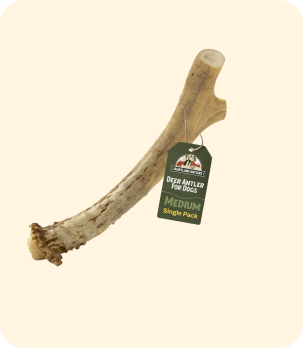
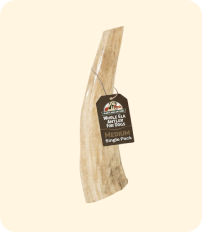
Quick Answer: Grade A whole elk antler is the correct chew for aggressive chewers. The material is dense cortical bone with no failure points introduced by manufacturing. Correctly sized Grade A whole elk antler lasts an aggressive chewer 3 to 6 weeks with daily sessions, versus days for rubber, bully sticks, or rawhide. The grade is not optional for this dog type: Grade B antler has micro-fractures that a high-pressure jaw will find. Get the grade right, size up from the weight chart, and the chew holds.

| Chew Type | Lasts (Aggressive Chewer) | Failure Mode | Safe for Power Chewer |
|---|---|---|---|
| Grade A Whole Elk Antler | 3-6 weeks daily sessions | Gradual cortex abrasion (fine powder) | Yes, when correctly sized |
| Grade B Elk Antler | Days to 1-2 weeks | Fractures along micro-fractures in cortex | No, fracture risk every session |
| Rubber/Synthetic Bone | Days to 1 week | Fatigues and tears, produces fragments | No, chunk and fragment risk |
| Bully Stick | 20-40 minutes | Fully consumed in one session | Yes, but not durable |
| Rawhide | 20-45 minutes | Softens and swells, large swallowable mass | No, obstruction risk |
| Nylon Chew | 5-10 days | Nylon chunks, non-digestible | No, GI obstruction risk |
You know the shelf. The defeated rubber toy with the chunk missing. The bully stick that lasted one sitting. The "indestructible" bone that split in two sessions. If your dog is an aggressive chewer, you have that shelf, and you have stopped trusting the label.
Grade A whole elk antler is the last thing on that shelf. Not because it is marketed differently. Because the material is different.
This guide covers what makes an aggressive chewer different from a casual one, why other products fail, what Grade A means structurally, and how to size for a crusher jaw. After reading it, you will know exactly what to buy and why it works.
We've found through working with aggressive chewer owners that the most common failure pattern is not the antler. It is the grade. Customers who tell us their dog "broke" an antler are nearly always describing a Grade B or ungraded piece with cortex compromise. When we move them to Grade A whole elk in the correct size, the fracture problem stops. That is not a guarantee claim. It is what the grade specification produces when applied correctly.
What "Aggressive Chewer" Actually Means
Aggressive chewer is not a size category. It is a behavior category.
An aggressive chewer finishes most chews in under an hour. They destroy rubber toys that smaller dogs ignore. They have fractured products labeled "indestructible." They return to a chew and work it with sustained focus, not casual interest.
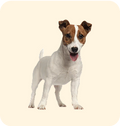
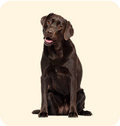
Size does not define it. A 14 lb Jack Russell Terrier with obsessive drive and a scissor jaw is an aggressive chewer. A 90 lb Labrador who picks up a chew occasionally and sets it down is not. The variable is chew intensity, jaw pressure, and duration of focused engagement.
Chew style matters too. Compression biters apply full load to a single point. Grinders work end-to-end across the surface. Shakers grip and rattle. Each style creates a different failure pattern in the chew. The shared outcome: sustained focused pressure, regardless of style, destroys products that were not built to handle it.
Why Grade A Elk Antler Is the Right Answer
One ingredient. Natural bone mineral, shed from elk each year, harvested from the field.
Grade A elk antler has approximately 30-40% greater cortical density than comparable deer antler pieces, which is why it outlasts deer antler by 2-4x under sustained grinding pressure from working-breed dogs. Grade, however, is the variable that separates a chew that lasts a month from one that fractures in a session.
Grade A means the outer cortex is fully intact. No fracture points introduced by harvesting or processing. No thin sections from a poorly cut piece. Maximum density from base-of-rack material where the antler is thickest and most structurally uniform.
Grade A is not a marketing claim. It is a structural specification. The cortex is the load-bearing layer. If it is intact and uniform, the antler handles sustained pressure. If it is compromised, it has failure points waiting to be found.
Not all antlers sold as antlers are Grade A. Grade is the variable that most buyers do not know to ask about, and it is the only variable that determines whether the chew survives an aggressive chewer.
"Indestructible" Is the Wrong Specification
Almost every product marketed to aggressive chewers uses the word indestructible. Most of them are not. Give any of them to a real aggressive chewer and the label answers itself.
Grade A whole elk antler is not indestructible either. An American Bully working a piece daily for four weeks has a measurably smaller antler at the end of that period than on day one.
That is the point.
The correct specification is not a chew that your dog cannot wear down. That product does not exist, and if it did, a dog should not be engaging with it. The correct specification is a chew that wears through controlled abrasion rather than fracture. The outer cortex of a Grade A elk antler wears as fine calcium phosphate powder, the same mineral the antler is made of. No sharp fragments. No large breakaway chunks. No sudden structural failure.
Three to six weeks of daily hard use for an aggressive chewer is the outcome of Grade A whole elk at correct sizing. Over those weeks, the antler gets smaller in a straight line. The dog works against a surface that responds the same way every session. That is the experience.
A correctly sized Grade A piece that is gone in under a week means the sizing was wrong, not the grade. Move up one size. The grade holds. The variable is fit.
Controlled wear is the right specification. Indestructible was always the wrong target, and every brand still using that word knows their product will not survive a real aggressive chewer.
Why Most "Tough" Chews Fail Aggressive Chewers
Every product marketed to aggressive chewers fails by the same mechanism. It does not have the structural density to resist sustained focused pressure.
Rubber: Compresses under jaw load, which feels durable in the moment. But rubber has memory. Under repeated sustained compression, it fatigues and tears. A high-drive dog working a rubber toy daily finds the tear point within days.
Synthetic bones: Brittle under sustained pressure. They hold up to casual chewing. They do not hold up to the load an aggressive chewer applies over multiple sessions. The failure is sudden and produces fragments.
Bully sticks: Real food, real value, but they are a consumable. An aggressive chewer finishes a bully stick in one session. That is not a problem with the product. That is a mismatch between a consumable and a dog that requires hours of chewing, not minutes.
Rawhide: Softens and swells under sustained jaw pressure and saliva. The structural integrity it starts with is gone after the first few minutes of real chewing. An aggressive chewer turns rawhide into a swallowable mass quickly. That is a safety problem, not just a durability problem.
None of these products fail because of poor manufacturing. They fail because none of them are dense enough to resist what an aggressive chewer applies to them over time.
Why Grade B Breaks and Grade A Does Not
A 100 lb Rottweiler applies sustained compression to a single load point. A Belgian Malinois with scissor jaws works end-to-end, finding the weakest cross-section. A Jack Russell shakes and then grinds.
Every one of these chew styles is a structural test. The antler either passes or it fails.
Grade B antler has micro-fractures in the cortex. These are small discontinuities introduced by harvesting damage, age of the shed, or poor selection at the processing stage. They are not visible. Under casual chewing from an average dog, they may never become a problem.
Under an aggressive chewer, they become the failure point. The jaw finds it, applies load, and the antler snaps along the fracture line. The result is fragments with sharp edges.
Grade A antler does not have those fractures. The cortex is continuous. Under sustained pressure, it absorbs the load rather than finding a discontinuity to fail along. The surface wears gradually, the way it is supposed to. The marrow core is exposed slowly over weeks of sessions, not in one sitting.
The grade argument is not about longevity for its own sake. It is about structural safety under the exact conditions an aggressive chewer creates.
Which Breeds Are Aggressive Chewers
These breeds produce aggressive chewers at high rates. This is not every dog of the breed, and other breeds can absolutely qualify. But if you have one of these dogs and they are a high-drive individual, they are almost certainly in aggressive chewer territory.
Crusher jaws: Pit Bull, American Bully, Cane Corso, Rottweiler. Wide muzzle, dense musculature, sustained compression load. These dogs find fracture points in lower-grade material fast.
High-drive working jaws: Belgian Malinois, German Shepherd, Akita. Scissor or gripping jaw with relentless drive. They do not stop. They do not get bored. They work the chew until it is gone or until something more interesting intervenes.
Prey-drive terrier jaws: Jack Russell Terrier, other working terriers. Small body, disproportionate drive. A Jack Russell will work a chew with the same sustained focus as a dog four times its size. Undersizing for this type is a common mistake.
Other consistent producers: Rhodesian Ridgeback, Doberman, Alaskan Malamute. High energy, large jaws, sustained engagement.
If your dog's breed is not on this list and they still destroy everything, the behavior tells you more than the breed does. Size them accordingly.
How to Size for an Aggressive Chewer
The failure mode for aggressive chewers is always undersizing. Not oversizing.
An oversized antler is harder to work comfortably, but it does not fracture. An undersized antler for an aggressive chewer gets treated like a compression test until it fails.
Size guidance by jaw type:
Crusher jaws (Pit Bull, American Bully, Cane Corso, Rottweiler): Size up from what the weight chart recommends. If the chart says large, go XL. These breeds generate compression per pound that exceeds average at every weight bracket. XL whole elk, Grade A, is the standard configuration.
Scissor-jaw grinders (Malinois, German Shepherd, Akita, Rhodesian Ridgeback): Large-to-XL whole elk. The sustained grinding from end to end means the full length of the chew will be worked. A longer, denser piece handles the wear distribution better than a shorter piece of the same diameter.
Terrier and small high-drive dogs: Whole, not split. The instinct is to give a smaller dog a split antler because of size. For an aggressive chewing terrier, split antler exposes more surface area and the softer marrow core. They work through it faster. Whole antler at the correct length for the dog's muzzle holds up significantly longer.
Puppies under 10 months, regardless of breed: Split elk, supervised. Developing teeth are not ready for the hardness of whole elk under sustained pressure.
When in doubt, go up. A dog that cannot get their jaw fully around an oversized piece will still engage with it. They will work the ends, roll it, and lick the marrow. They will not fracture it.
Find the Right Fit
For a full breakdown of sizing by jaw type, weight, and chew intensity, read the What Size Antler for Your Dog guide.
For the complete Grade A classification criteria, including how to inspect a piece before it goes to your dog, read the Grade A antler guide.
For side-by-side elk vs deer performance under heavy pressure, the elk vs deer antler comparison covers exactly when elk is the right call.
For the safety breakdown that explains how Grade A eliminates the main splinter risk, read: Are Antlers Safe for Dogs?
When you are ready to order: Shop Grade A elk antler.
Frequently Asked Questions
Are antlers good for aggressive chewers?
Yes. Aggressive chewers are the exact dogs antlers were built for. The material is dense natural bone mineral with no binders, no fillers, and no failure points introduced by manufacturing. The qualification is grade. Grade A whole elk antler is the correct specification for an aggressive chewer. Lower-grade antler has micro-fractures that a high-pressure jaw will find and exploit. With the right grade and correct sizing, a whole elk antler is one of the only chews that holds up to sustained aggressive chewing.
What is the strongest antler for a dog?
Grade A whole elk antler is the densest and most structurally sound option. Elk outperforms deer at every comparable grade due to species density. Within elk, whole antler is harder than split because the outer cortex is fully intact on all sides. Grade A is the specification that ensures no harvesting damage, no micro-fractures, and a uniformly dense cortex. For an aggressive chewer, the correct answer is Grade A whole elk in the largest size appropriate for the dog's jaw.
Can aggressive chewers break antlers?
An aggressive chewer can break lower-grade antler. A correctly sized Grade A whole elk antler is designed to withstand sustained aggressive chewing without fracturing. The key word is grade. Grade B and below have micro-fractures in the cortex that a high-pressure jaw locates and fails along. Grade A does not have those fractures. If your dog has fractured antlers in the past, the grade or size was wrong. Grade A whole elk at the correct size holds.
What size antler for an aggressive chewer?
Size up from what the weight chart recommends. Crusher jaw breeds (Pit Bull, American Bully, Cane Corso, Rottweiler) should go XL for most adults. High-drive working breeds and large grinders go large to XL. For terriers and small aggressive chewers, choose whole antler sized to the dog's muzzle length rather than split. The error to avoid is undersizing. An oversized antler does not fracture. An undersized antler fails under the pressure an aggressive chewer applies.
How long does a Grade A elk antler last for an aggressive chewer?
A correctly sized Grade A whole elk antler typically lasts an aggressive chewer 3 to 6 weeks with regular daily sessions. High-drive dogs with longer daily chew time may work through it faster. Dogs on the larger end of the aggressive chewer spectrum with correctly fitted XL pieces often go longer. If the antler is fractured or gone within a session or two, the grade or size was not correct. Verify Grade A and go up one size.
Frequently Asked Questions
Are antlers good for aggressive chewers?
Yes. Aggressive chewers are the exact dogs antlers were built for. The material is dense natural bone mineral with no binders, no fillers, and no failure points introduced by manufacturing. The qualification is grade. Grade A whole elk antler is the correct specification for an aggressive chewer. Lower-grade antler has micro-fractures that a high-pressure jaw will find and exploit. With the right grade and correct sizing, a whole elk antler is one of the only chews that holds up to sustained aggressive chewing.
What is the strongest antler for a dog?
Grade A whole elk antler is the densest and most structurally sound option. Elk outperforms deer at every comparable grade due to species density. Within elk, whole antler is harder than split because the outer cortex is fully intact on all sides. Grade A is the specification that ensures no harvesting damage, no micro-fractures, and a uniformly dense cortex. For an aggressive chewer, the correct answer is Grade A whole elk in the largest size appropriate for the dog's jaw.
Can aggressive chewers break antlers?
An aggressive chewer can break lower-grade antler. A correctly sized Grade A whole elk antler is designed to withstand sustained aggressive chewing without fracturing. The key word is grade. Grade B and below have micro-fractures in the cortex that a high-pressure jaw locates and fails along. Grade A does not have those fractures. If your dog has fractured antlers in the past, the grade or size was wrong. Grade A whole elk at the correct size holds.
What size antler for an aggressive chewer?
Size up from what the weight chart recommends. Crusher jaw breeds (Pit Bull, American Bully, Cane Corso, Rottweiler) should go XL for most adults. High-drive working breeds and large grinders go large to XL. For terriers and small aggressive chewers, choose whole antler sized to the dog's muzzle length rather than split. The error to avoid is undersizing. An oversized antler does not fracture. An undersized antler fails under the pressure an aggressive chewer applies.
How long does a Grade A elk antler last for an aggressive chewer?
A correctly sized Grade A whole elk antler typically lasts an aggressive chewer 3 to 6 weeks with regular daily sessions. High-drive dogs with longer daily chew time may work through it faster. If the antler is fractured or gone within a session or two, the grade or size was not correct. Verify Grade A and go up one size.