Jack Russell Terriers (13-17 lb, short wide jaw, terrier chew drive) need Heartland Antlers Grade A medium whole elk or split elk, sized by chew intensity rather than body weight. The standard small-breed chart routes this breed straight to the wrong chew.

Jack Russell Terriers weigh 13 to 17 lb. Every chew chart routes them to the small, soft category. That is where most owners start, and why most owners come back frustrated.
Quick Answer: The right antler for a Jack Russell Terrier is sized by chew intensity first, body weight second. Jack Russell Terriers (13-17 lb, short wide jaw, terrier chew drive) require Heartland Antlers Grade A medium whole elk or split elk. The size is right by the charts; the cut and species are where most owners go wrong. Split deer is gone in one session. The JRT jaw applies focused, repetitive pressure to one spot with terrier tenacity, which defeats soft cuts regardless of body weight. Whole elk runs 30-40% denser than deer, which is the structural margin that keeps a piece intact through a terrier session. Grade A removes internal weak points that a methodical terrier jaw will find over repeated sessions. A correctly fitted Grade A medium whole elk antler from Heartland Antlers typically lasts a Jack Russell 3-5 weeks.
An adult Jack Russell Terrier (13 to 17 lb, short wide jaw, focused terrier chew drive) is best matched to a medium whole elk antler, Grade A. The dense outer cortex of whole elk holds up to the focused, repetitive pressure a JRT applies to one spot. Split deer, the most common wrong order we see from JRT owners, is gone in a single session. We've tested split deer against medium whole elk with JRT owners and the result is consistent: split deer lasts one sitting, medium whole elk Grade A lasts three to five weeks.
Customers with Jack Russell Terriers consistently describe a dog that chews with intensity far beyond what its weight would predict. After working with Jack Russell owners, we've found weight charts systematically undersize antler for this breed. A 14-pound terrier with real drive applies cumulative session pressure that outpaces what small-breed sizing suggests. Medium whole elk Grade A is the baseline, sized for the jaw, not the scale.
Why Weight Charts Fail Jack Russell Terriers
The weight assumption is the problem. Jack Russells were bred to follow a fox underground and hold it until the hunters arrived. That job requires jaw force that punches well above body weight. The same drive that made this breed field-useful for 200 years will defeat any chew sized by the scale alone.
A Jack Russell Terrier (13-17 lb) applies focused, repetitive bite pressure at a single contact point that exceeds what most small-category chews can absorb in a full session. Elk antler at the same small size grade carries 30-40% more cortex density than deer antler, which is the margin that keeps a piece intact through a 20-minute terrier session.
Medium whole elk is the answer. Not split. Not deer.
The Jack Russell Terrier Chew Profile: Jaw Force That Punches Above Body Weight
Weight: 13 to 17 lb.
Jaw type: Short, wide, and powerful for the skull size. A JRT locks on and holds with a grip that can crack materials rated for dogs two or three times its weight. The bite is not subtle.
Chew style: Relentless and obsessive. A Jack Russell does not sample a chew or lose interest. It works the same spot until something gives. This is not high energy in the playful sense. It is terrier tenacity applied to one task with full concentration, session after session.
Risk profile: Undersized chews and soft cuts fail fast. A small split deer antler that should occupy this dog for an extended period disappears in 20 minutes. The failure mode is almost always the same: an owner trusted the weight chart, chose small split, and watched the dog finish it in one sitting. This is not the dog being exceptional. It is terrier jaw intensity operating normally.
Antler for Jack Russell Terriers: Configuration by Life Stage
| Dog | Size | Cut | Species | Grade | Typical Duration |
|---|---|---|---|---|---|
| Adult JRT (13-17 lb) | Medium | Whole | Elk | A | 3-5 weeks |
| Puppy under 8 months | Medium | Split | Elk | A | Supervised only |
| Adult (marrow-driven individual) | Medium | Split | Elk | A | 3-5 weeks |
| Do NOT use for adults | Small | Split | Deer | N/A | Gone in 1 session |
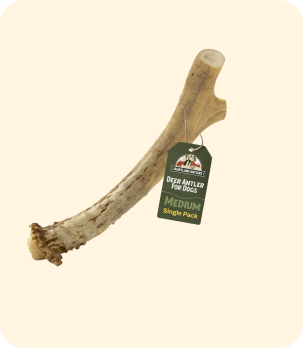
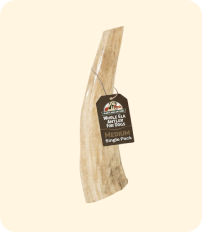
Medium whole elk, Grade A: The correct fit for most adult Jack Russells. The dense outer cortex of whole elk holds up to terrier-style grinding. The size is right for the mouth. The material is right for the jaw force. This is where most JRT owners start and stay.
Split elk, Grade A: For JRT puppies under 8 months. The puppy jaw is developing and the resistance level of whole elk is too high for safe early chewing. Split gives marrow access and keeps the dog engaged without putting hard, sustained pressure on forming teeth. Supervised only.
Split deer, Grade A: Not recommended for adult Jack Russells. It is the most common wrong order we see from JRT owners. The lower cortex density of deer and the marrow-exposed surface of split combine to make it the softest, least durable option in the lineup. For a terrier with serious chew drive, split deer is gone in a session.
Elk vs. Deer Antler for a Jack Russell Terrier: Why Whole Elk Wins
Elk for adult Jack Russells. The reasoning is structural.
Deer antler is lighter, smaller in diameter, and lower in cortex density than elk. Even Grade A deer is sized for dogs with moderate chew pressure at this weight range. A JRT does not chew at moderate pressure. The terrier jaw applies force that deer antler cannot absorb over a full session without degrading.
Elk antler at the same size grade runs 30-40% denser than deer at equivalent diameter. That cortex density resists the focused, repetitive pressure a JRT applies to one spot. Grade A medium whole elk typically lasts an adult Jack Russell three to five weeks; split deer is gone in a session. The chew lasts because the material can take it.
The split versus whole question matters as much as the species. Split elk exposes the softer inner marrow and makes it faster to consume. A JRT will eat through split faster than whole regardless of species. Whole elk gives the dog the surface it needs to work without consuming the antler in the first sitting.
How to Read the First Session
Put the antler down and watch for the first 15 minutes.
Correct fit: The dog picks it up, pins it down, and begins working one section methodically. Surface wear is visible after the session. Light scoring, some whitening at the contact point. The dog stays engaged. The antler holds its shape.
Signs the fit is wrong: The antler shows deep gouges or sharp edges after one short session, or the dog is working so frantically that pieces are breaking free. This is a grade or size problem. Verify Grade A. If the dog is at the larger, more powerful end of the JRT range, contact us before reordering.
Try split elk instead: The dog sniffs it, works it briefly, then walks away. Some JRTs are marrow-driven rather than resistance-driven. If whole elk does not hold attention, split elk gives the marrow reward while still providing enough density to last.
Supervision Notes
Watch the first full session. This matters particularly for terriers because they will push a session far past the point where other breeds would stop.
Retire the antler when it reaches molar width or shorter. A piece small enough to get behind the back teeth is a swallowing risk. JRTs will continue working a small piece with the same focused drive they applied to the full antler. Take it away. The dog will not stop on its own.
Keep sessions to 20 to 30 minutes for puppies on split elk. Sustained chewing on forming teeth carries more risk than most owners account for.
The Terrier Weight Trap
This is the central error we see with JRT orders.
An owner searches for "antler for small dog," reads that small antlers are for dogs 10 to 25 lb, and orders small split deer. The dog weighs 14 lb. The chart matched. The chew is gone in one session.
The weight trap is the assumption that small body weight equals moderate chew pressure. That assumption holds for many breeds. It does not hold for terriers. Jack Russells, Cairn Terriers, Border Terriers, and related working terrier types were bred for a job that required serious bite strength in a compact frame. That is not incidental. It is the point of the breed.
Terrier intensity at small scale defeats soft cuts. The right antler for a JRT is sized by chew intensity first, body weight second.
Medium whole elk. Grade A. That is the call.
Find the Right Fit
Most JRT owners need one order to get it right once they understand the terrier sizing logic.
Start with medium whole elk, Grade A, for any adult Jack Russell. If your dog is a puppy under 8 months, reach out before ordering so we can confirm the right split configuration for where they are in development.
Also worth reading: - Find the Right Fit by Breed and Jaw Style - Elk vs. Deer Antler: Which Is Right for Your Dog's Size - Antlers for Puppies: Age and Size Guide - Same Terrier Intensity: Antler for Miniature Schnauzer - What Grade A Means and Why It Matters - why structural integrity matters for a methodical jaw - Antler for a Dachshund - another small breed where terrier-style tenacity exceeds body weight expectations
Frequently Asked Questions
What is the best antler for a Jack Russell Terrier?
Medium whole elk, Grade A, is the correct fit for most adult Jack Russells. Body weight alone puts a JRT in the small category, but terrier jaw intensity places this breed above what split or deer antler can handle in a real chewing session. Grade A whole elk (medium size, dense outer cortex) matches the focused, sustained chew drive this breed brings to every session. Split deer is the most common wrong order for this breed and is gone in a single sitting.
Are antlers safe for Jack Russell Terriers?
Yes, with correct sizing and Grade A material. The risk with antlers comes from pieces that are too small to grip safely and from soft or low-grade material that breaks down into fragments. For a JRT, that means medium whole elk, Grade A, supervised. Retire the piece when it reaches molar width. The dog will not self-regulate.
What size antler for a Jack Russell Terrier?
Medium whole elk, Grade A. Weight-based sizing puts JRTs in the small category, but the cut and species matter as much as the size designation. Whole elk at medium size provides the cortex density and structural integrity that a terrier's chew intensity requires. Small split deer is not a safe substitute despite matching the weight chart.
Elk or deer antler for a Jack Russell Terrier?
Elk for adult Jack Russells. Deer antler, even Grade A, does not carry the cortex density to hold up under the focused, repetitive pressure of a terrier jaw. The smaller diameter and lower density of deer means it degrades faster under the same applied force. Whole elk is the right call.
How long does an antler last for a Jack Russell Terrier?
With correct sizing (medium whole elk, Grade A), most adult JRTs will work a piece down over three to five weeks. A dog at the higher end of the terrier intensity range chewing daily may move through it faster. If the antler is gone in one session, the cut or species was wrong. Switch to whole elk, Grade A, and verify the size is medium.
Frequently Asked Questions
What is the best antler for a Jack Russell Terrier?
Small whole elk, Grade A, is the correct fit for most adult Jack Russells. Body weight alone puts a JRT in the small category, but terrier jaw intensity places this breed above what split or deer antler can handle in a real chewing session. Grade A whole elk (small size, dense outer cortex) matches the focused, sustained chew drive this breed brings to every session. Split deer is the most common wrong order for this breed and is gone in a single sitting.
Are antlers safe for Jack Russell Terriers?
Yes, with correct sizing and Grade A material. The risk with antlers comes from pieces that are too small to grip safely and from soft or low-grade material that breaks down into fragments. For a JRT, that means small whole elk, Grade A, supervised. Retire the piece when it reaches molar width. The dog will not self-regulate.
What size antler for a Jack Russell Terrier?
Small whole elk, Grade A. Weight-based sizing puts JRTs in the small category and that size is right, but the cut and species matter as much as the size designation. Whole elk at the small size provides the cortex density and structural integrity that a terrier's chew intensity requires. Small split deer is not a safe substitute despite matching the weight chart.
Elk or deer antler for a Jack Russell Terrier?
Elk for adult Jack Russells. Deer antler, even Grade A, does not carry the cortex density to hold up under the focused, repetitive pressure of a terrier jaw. The smaller diameter and lower density of deer means it degrades faster under the same applied force. Whole elk is the right call.
How long does an antler last for a Jack Russell Terrier?
With correct sizing (small whole elk, Grade A), most adult JRTs will work a piece down over several weeks. A dog at the higher end of the terrier intensity range chewing daily may move through it faster. If the antler is gone in one session, the cut or species was wrong. Switch to whole elk, Grade A, and verify the size is small.