Getting the antler for alaskan malamute right means one thing above all: do not size this breed like a Husky.

Quick Answer: Alaskan Malamutes (75-100 lb, heavy-boned jaw, freight-dog bite force) need XL whole elk, Grade A. Despite sharing Arctic lineage with the Husky, the Malamute carries substantially more jaw mass and applies bite force comparable to a Rottweiler. A Grade A XL whole elk antler typically lasts an adult Malamute 2-4 weeks at daily sessions. Sizing a Malamute like a Husky is the most common fit error with this breed. Deer antler lacks the density to hold up; sessions end in days, not weeks. XL whole elk is the species and size that matches Malamute jaw mechanics.
We see it consistently with antler for alaskan malamute orders: most owners start in the wrong size. They see a big Arctic dog, think Husky, and order large. The antler is gone faster than it should be, or it splinters, or it just gets mauled in a way that ends the session early. The dog is not broken. The size is.
A Malamute is not a Husky with more fur. The jaw mechanics are different, the body weight is different, and the right antler size is different. Getting that right is where this article starts.
For most adult Alaskan Malamutes (75-100 lb, wide heavy-boned jaw, sustained grinding drive), the correct antler is XL whole elk, Grade A. Anything smaller gives the jaw too little surface to work and too little density to last.
Customers with Alaskan Malamutes consistently describe the same cycle: the dog works through a chew within a week and comes back looking for more. After working with Malamute owners, we've found the issue is almost always under-sizing. Medium elk that held up for lighter breeds disappears for a Malamute in a single hard session. XL whole elk Grade A changes that pattern.
The Alaskan Malamute Chew Profile: Freight-Dog Jaw, Sustained Drive, High Force
The Malamute is an Arctic freighting dog. It was bred to haul weight across miles of snow, not sprint like a Husky. That distinction shows up in the body and in the jaw.
An adult Alaskan Malamute (75-100 lb, wide heavy-boned skull, significant jaw mass) carries bite force comparable to a Rottweiler, not a Siberian Husky. Despite sharing Arctic lineage, the Malamute has substantially more jaw mass than a Husky at any comparable weight range. This is the number one fit mistake we see with this breed.
Chew style is bursty-to-sustained. A Malamute with high arousal, a new chew, or prey-drive activation will bear down hard and stay there. Once settled, the style shifts to methodical, sustained grinding. Both modes put more force on the chew than any Husky session does.
Prey drive is high. A Malamute engages a chew the same way it would engage quarry. Focused, committed, working. That drive does not switch off mid-session.
Antler for Alaskan Malamute: XL Whole Elk Grade A Configuration
These configurations are built around the Malamute's jaw mass, not just the number on the scale.
Standard adult Malamute (75-95 lb): XL whole elk, Grade A. This is the baseline. Anything smaller gives the jaw too little surface to work and too little density to last. Whole-cut is required for adults, not optional. A split elk in this weight class gets through too fast.
Heavy adult Malamute (over 95 lb): XL whole elk, Grade A, with a hard look at the chew by session three. Dogs at the top of this weight range with strong drive may run through an XL faster than average. If the surface is taking heavy damage in the first week, some dogs in this class need to go up in size or switch to a thicker-cut whole piece.
Malamute puppy: Medium whole elk or large whole elk, Grade A, depending on age and current weight. Do not start a Malamute puppy on XL. The teeth are not ready for a chew that requires the adult jaw to grip correctly. Match to current weight. Puppies grow fast, so expect to resize within a few months.
Senior Malamute or dog with dental wear: XL split elk, Grade A. The split face gives access to the marrow without demanding the full hard-surface chew work. A senior Malamute still has drive and still needs a job. Split elk gives the reward without the stress on worn teeth.
Elk vs. Deer for an Alaskan Malamute: Elk Only
Elk only, once your dog is an adult. Full stop.
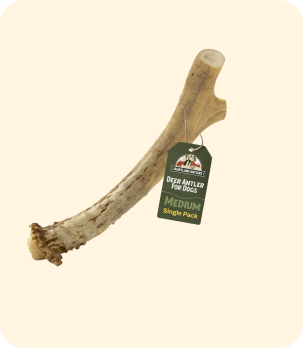
Elk antler is 30-40% denser than deer antler at equivalent size. For a dog in the Malamute weight and jaw class, deer antler does not provide enough resistance. Sessions end too fast. The density fails before the dog's drive does. You are back to shopping in days, not weeks.
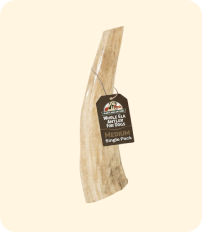
Elk is denser, heavier, and holds up to sustained pressure. For a Malamute, that density is not a preference, it is a functional requirement. A Grade A XL whole elk antler is what matches this dog's mechanics.
The size call is also non-negotiable. Malamutes are frequently sized like Huskies because both breeds look Arctic and carry similar reputations. But a 50 lb Husky and a 90 lb Malamute are not close fits. Large elk is the right call for an adult Husky. XL elk is the right call for an adult Malamute. Ordering large for a Malamute is the same category of error as ordering medium for a Rottweiler.
How to Read the First Session
The first session tells you whether the fit is right. Give your dog 20 minutes and watch closely.
What good looks like: Your dog engages hard at first, works through a burst of focused chewing, then settles into a slower grinding rhythm. There is visible surface wear by the end, but the antler holds its shape. No deep gouges, no cracking, no loss of structure.
What means the size is wrong: Significant material loss in one session. Deep gouge marks or cracking. The chew changed shape noticeably in 20 minutes. This means too small. For a Malamute, "too small" is the common failure, not the other direction. Go up.
What means the cut is wrong: The dog finishes the session but the marrow channel of a split cut is exposed and empty. For an adult Malamute, this is what happens when split replaces whole. The internal reward is gone before the session ends. Move to whole-cut.
Supervision Rules That Apply Specifically to Sled-Dog Drive
Supervise antler sessions, particularly with a new chew. Malamutes are working dogs with strong resource guarding tendencies. They take chews seriously. Multi-dog households need separation during sessions. This is not a chew to leave loose with other dogs in the room.
Retire the chew when it reaches molar width. For a Malamute, this comes faster than with lighter breeds. Check the antler after every few sessions in the first two weeks. Once the piece is small enough to fit entirely in the back molars, it is retired. In our experience supplying antler for alaskan malamute owners, the retirement trigger typically arrives between week 2 and week 4 on Grade A XL whole elk, compared to under 10 days on Grade B material under the same sustained load.
Sled-dog drive means high session intensity. A Malamute working a fresh chew is not casually occupied. It is focused. Do not interrupt a session abruptly. Let your dog finish or pause naturally, then retrieve the chew. Reaching in mid-session is how resource conflicts happen.
Malamute vs. Husky: Why the Fit Is Different
Same Arctic heritage. Very different dog.
The Siberian Husky was bred for speed and endurance over long distances at moderate load. Lean body type, lighter frame, medium-strength scissor bite. A Husky jaw is capable but not built for heavy crushing force.
The Alaskan Malamute was bred to haul heavy freight over shorter, harder terrain. Bigger body, heavier bone, wider jaw with more mass behind it. The Malamute is the freight train. The Husky is the distance runner.
That difference shows up in bone density and jaw mechanics. An adult Malamute in the 85-90 lb range applies roughly the same chew pressure as a Rottweiler at the same weight. A Husky at 50-55 lb applies a fraction of that force. The weight overlap between a large Husky and a small Malamute around 55-65 lb is where the misfit most often happens. Dogs that look similar in size are operating completely different jaw systems.
Sizing a Malamute like a Husky is the most common fit error we see with this breed. It leads to chews that fail too fast, sessions that end in splintered material, or dogs that lose interest because the chew offered no real resistance. XL whole elk for a Malamute is not oversizing. It is correct fit for the jaw, not the number on the scale.
Alaskan Malamute Antler Size and Grade Reference
| Dog | Weight | Recommended Antler | Duration |
|---|---|---|---|
| Standard adult Malamute | 75-95 lb | XL whole elk, Grade A | 2-4 weeks |
| Heavy adult Malamute | Over 95 lb | XL whole elk, Grade A | 2-3 weeks |
| Malamute puppy | Under 12 months | Large whole elk, Grade A | Varies |
| Senior Malamute | Any | XL split elk, Grade A | 3-6 weeks |
Find the Right Fit
For most adult Malamutes (75-95 lb): XL whole elk, Grade A.
For heavy adults over 95 lb: XL whole elk, Grade A, monitored closely in the first week.
For puppies: size to current weight; expect to resize within months.
For seniors: XL split elk, Grade A.
Heartland Antlers Grade A elk antler is naturally shed, hand-sorted for cortex integrity and density, and carries no additives or flavor sprays. One ingredient. For a freight-dog jaw like the Malamute, that density consistency is what the grade specification actually delivers.
Related reading: - Find the Right Fit by Breed and Jaw Style for the full sizing guide - Elk vs. Deer Antler: Which Is Right for a Soft-Jawed Retriever for the species comparison - Antlers for Senior Dogs: When to Switch to Split if your Malamute is older or has reduced jaw strength - The Right Antler for a Siberian Husky to understand why the sizing is different between these two Arctic breeds - What Grade A Means and Why It Matters -- the density and structural consistency requirements that matter for a freight-dog jaw - Antler for Akita -- another large-breed, patient-grinding profile where grade is the controlling variable
Find the Right Fit for your Alaskan Malamute
Frequently Asked Questions
What is the best antler for an Alaskan Malamute?
XL whole elk, Grade A, for most adult Malamutes (75-100 lb). The Malamute's jaw mass and chew force require the density of elk and the surface area of an XL cut. A large elk antler, which works for a Husky, does not hold up to the Malamute's bite mechanics. Whole-cut is required for adults. Grade A ensures the density and structural integrity to survive sessions without splintering.
Are antlers safe for Alaskan Malamutes?
Yes, with the right size and grade. The safety risks with antlers, fracturing and splintering, come from undersized chews and low-grade material. A correctly sized Grade A XL whole elk antler provides enough surface area and density to handle a Malamute's bite force. Retire the chew when it reaches molar width. Never start smaller than the size recommended for your dog's current weight and jaw class.
What size antler for an Alaskan Malamute?
XL for most adult Malamutes (75-100 lb). Dogs over 95 lb with strong drive should be monitored closely in the first few sessions and may need to move to a thicker-cut piece. Puppies should be sized to current weight and resized as they grow. Do not size a Malamute like a Husky. The jaw mechanics are not comparable.
Elk or deer antler for an Alaskan Malamute?
Elk for all adults. Deer antler lacks the density to hold up to Malamute chew force. Sessions end too fast, the surface degrades too quickly, and you are back to shopping in days. Elk is the species that matches this dog's mechanics. Whole-cut elk is the right call for any adult Malamute with antler experience.
How long does an antler last for an Alaskan Malamute?
A Grade A XL whole elk antler typically lasts an adult Malamute two to four weeks. Dogs with very high drive or over 95 lb may go through it faster. If the antler is gone in under a week, verify Grade A and move to a larger or thicker piece. Active, committed sessions with steady wear over several weeks is the target.
Schema (do not paste into Shopify body_html)
Frequently Asked Questions
What is the best antler for an Alaskan Malamute?
XL whole elk, Grade A, for most adult Malamutes (75-100 lb). The Malamute's jaw mass and chew force require the density of elk and the surface area of an XL cut. A large elk antler, which works for a Husky, does not hold up to the Malamute's bite mechanics. Whole-cut is required for adults. Grade A ensures the density and structural integrity to survive sessions without splintering.
Are antlers safe for Alaskan Malamutes?
Yes, with the right size and grade. The safety risks with antlers, fracturing and splintering, come from undersized chews and low-grade material. A correctly sized Grade A XL whole elk antler provides enough surface area and density to handle a Malamute's bite force. Retire the chew when it reaches molar width. Never start smaller than the size recommended for your dog's current weight and jaw class.
What size antler for an Alaskan Malamute?
XL for most adult Malamutes (75-100 lb). Dogs over 95 lb with strong drive should be monitored closely in the first few sessions and may need to move to a thicker-cut piece. Puppies should be sized to current weight and resized as they grow. Do not size a Malamute like a Husky. The jaw mechanics are not comparable.
Elk or deer antler for an Alaskan Malamute?
Elk for all adults. Deer antler lacks the density to hold up to Malamute chew force. Sessions end too fast, the surface degrades too quickly, and you are back to shopping in days. Elk is the species that matches this dog's mechanics. Whole-cut elk is the right call for any adult Malamute with antler experience.
How long does an antler last for an Alaskan Malamute?
A Grade A XL whole elk antler typically lasts an adult Malamute two to four weeks. Dogs with very high drive or over 95 lb may go through it faster. If the antler is gone in under a week, verify Grade A and move to a larger or thicker piece. Active, committed sessions with steady wear over several weeks is the target.