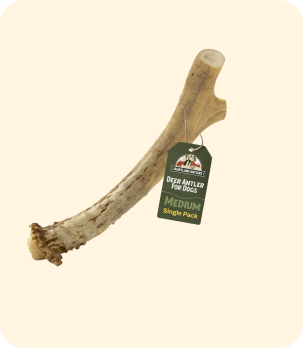
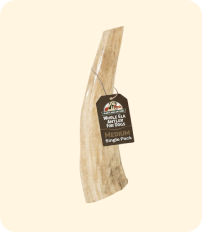

Choosing the right antler for akita owners starts with one fact: this is a patient, sustained-pressure breed that demands Grade A elk.

Quick Answer: Akitas (70-130 lb, wide patient-grinding jaw) need XL whole elk, Grade A. The Akita's broad jaw applies slow, constant pressure rather than explosive bursts, which exhausts lower-grade material faster than most owners expect. A Grade A XL whole elk antler typically lasts an adult Akita 4-10 weeks at daily sessions, compared to roughly half that on a Grade B piece under the same sustained load. Lower-grade antler carries internal inconsistencies a patient jaw finds and works to failure before the session ends.
For an Akita, the right antler is XL whole elk, Grade A. That is the answer for most adults, male or female, regardless of where in the 70-130 lb range your dog lands. The Akita's wide jaw and patient sustained grinding require the density and structural consistency only Grade A provides. After two years of fitting antler for akita owners, the pattern is consistent: Grade B pieces fail at the contact zones within the first three weeks on this breed, while Grade A XL whole elk holds structure for the full duration.
You bought a chew that looked solid. Your Akita picked it up, found a corner, and got to work. No drama. No loud cracking. Just focused, steady pressure.
Two weeks later it was half gone and starting to look wrong at the contact point. Not splintered, not explosive. Just quietly failing under something you never fully saw.
That is the Akita pattern, and it catches owners off guard because nothing about the dog looks frantic.
Customers with Akitas consistently report that lower-grade antler lasts a week or two, then fractures without warning during a normal session. After working with Akita owners, we've found the cause is almost always micro-fractures in the cortex that were invisible at purchase. Grade A elk, hand-sorted for cortex integrity, holds across the patient grinding pattern without sudden failure. That structural reliability is what separates Grade A from commodity antler for this breed.
Why the Akita's Patient Grinding Destroys Lower-Grade Antler
The Akita is a large Japanese breed, built wide through the chest and head. Bear-like, dense, and deliberate in everything it does. The jaw matches the build.
Weight: 70-130 lb. Males typically 100-130 lb. Females typically 70-100 lb.
Jaw type: Wide and powerful. The Akita head is broad, and the jaw spreads force across a wide contact surface. This is not a narrow, point-loading bite. It is a broad, distributed, sustained grip. An adult male Akita generates bite force estimated at 350-400 psi, applied steadily rather than in explosive bursts.
Chew style: Patient and methodical. The Akita is not a frantic destroyer. It is a focused grinder. It settles in, establishes its grip, and applies steady pressure. Session after session, it returns to the same zones and keeps working.
The bite force behind that patience is serious. But what punishes chews is not the peak force alone. It is the combination of serious force applied slowly and without interruption. A fast-burst chewer applies force, releases, applies force, releases. The chew gets brief rest between cycles. The Akita does not work that way. It holds and grinds. The pressure is constant.
A Grade A XL whole elk antler typically lasts an adult Akita 4-10 weeks at regular daily sessions. A lower-grade piece under the same conditions fails in half that time because the breed's sustained load finds every structural inconsistency.
Antler for Akita: XL Whole Elk Grade A Configuration by Life Stage
These are the configurations that match the breed's jaw and chew style.
Standard adult Akita (80-130 lb): XL whole elk, Grade A. This is the baseline for most adult Akitas, male or female. The wide jaw and sustained chew style require the full cross-section and density of an XL elk antler.
Large male Akita (over 100 lb): XL whole elk, Grade A. No adjustment needed on format. The size is right. Confirm the grade is correct before buying anywhere.
Female Akita (lighter build, 70-90 lb): XL whole elk, Grade A. Jaw geometry on this breed does not shrink proportionally with body weight. A 75 lb female Akita still carries the wide, strong jaw the breed is known for. Size to the jaw, not the weight chart.
Akita puppy: Split elk, supervised. The adult jaw is still forming. Whole elk hardness is too much for a developing bite. Split format gives access to the marrow with less hardness load on teeth and joints that are not finished yet.
Senior Akita: XL split elk. Marrow access, gentler surface contact, still enough mass for the jaw to engage properly. Supervision as with any senior.
Why Elk Beats Deer for Every Adult Akita
Elk for adults. That is the only call.
Elk antler is 30-40% denser than deer antler at equivalent size and grade. Under the Akita's sustained grinding pressure, deer antler loses structural integrity at the contact zones faster than the force numbers alone would predict. The reason is duration. Deer can handle a hard hit. It handles sustained, low-level, constant pressure less well.
An adult Akita grinding at a deer antler piece will work it to failure faster than an owner expects, often before the dog is done with the session. That means more frequent replacement and a piece that starts losing material in ways that require closer monitoring.
Grade A elk handles sustained load. Deer does not. For adult Akitas, elk is a material call, not a brand preference. A Grade A XL whole elk antler runs 15-25% heavier per linear inch than a Grade B piece at the same dimensions, which translates directly to more sessions before the piece fails under patient grinding.
Split deer remains appropriate for puppies where the goal is marrow engagement rather than chew duration. For any adult Akita, elk.
How to Read the First Session
The first 20 minutes tell you whether the fit is right. Watch the dog, not the chew.
What good looks like: Your dog settles immediately and works the piece with interest. At the end of the session, the antler is the same general shape. Surface wear is visible. Structure is intact. The dog comes back to it the next day.
What means a grade problem: Rapid, visible material loss in a single session. The surface eroding noticeably. Any developing grooves that are deepening faster than the outer surface would explain. With an Akita, rapid deep gouging is a grade signal. The breed's patience means it will keep applying pressure to a weak zone until something gives. A Grade A piece weathers surface work. A lower-grade piece starts surrendering structure.
What means try split: The dog mouths it and sets it down. Some Akitas are more marrow-driven early on. Split elk provides immediate marrow reward and keeps the dog engaged long enough to form the habit. Most will transfer to whole elk once they understand the piece.
Why Akitas Need Supervised Solo Chew Sessions
Standard retire criteria apply: retire any piece once it reaches molar width, shows cracking, or develops sharp edges. In our experience sourcing antler for akita customers, a correctly graded XL whole elk piece from the main shaft provides a cross-section that stays above the safe retirement threshold for the breed's full 4-10 week working life.
One Akita-specific note worth knowing. Akitas are a territorial breed in general, and many carry that into their chews. They will guard a piece, and some will not engage with it normally if another dog is nearby.
Single-dog sessions are recommended. This is not just a behavior management point. An Akita that feels its chew is under threat may alter its chew style, becoming less patient and more possessive, which changes how the piece is used and how quickly it gets worked down. Let your Akita have the chew on its own terms.
Why Grade A Is Non-Negotiable for Patient Grinders
This is the piece most owners do not think about until after a chew fails.
Grade B antler has internal inconsistencies. Density variation between layers. Micro-voids. Zones where the material is less uniform. A dog that chews in fast bursts may never find those weak points. The force is applied briefly and then released. The chew never has to hold under sustained stress.
The Akita finds every one of them.
Patient, sustained pressure is a different mechanical load than explosive force. Slow, constant grinding works into surface imperfections. It probes density variation. It applies load to a contact zone continuously, without the brief rest that episodic chewing provides. Over time, that kind of pressure finds fracture points that a harder, faster bite might miss entirely.
This is the specific reason Grade A matters more for the Akita than it does for many other large-breed dogs. A Rottweiler or a Pit Bull that chews hard and fast may not fully exploit a lower-grade piece's weaknesses, because the chew style does not stay on one spot long enough under continuous load. The Akita does.
Grade A elk is denser and more consistent. The inner and outer layers have less variation. There are fewer structural inconsistencies for sustained pressure to find and exploit. It handles what the Akita applies, session after session.
Grade B is not a savings for this breed. It is a failure waiting to be found by a patient jaw.
Grade A is the floor.
Heartland Antlers Grade A elk antler is harvested from naturally shed racks, sourced from the Rocky Mountain region, and hand-sorted to confirm cortex integrity, density, and marrow quality before shipping. No additives, no flavor sprays, one ingredient.
Akita Antler Size and Grade Reference
| Dog | Weight | Recommended Antler | Duration |
|---|---|---|---|
| Standard adult Akita | 80-130 lb | XL whole elk, Grade A | 4-10 weeks |
| Female Akita (lighter build) | 70-90 lb | XL whole elk, Grade A | 4-8 weeks |
| Akita puppy | Under 12 months | Split elk, supervised | Varies |
| Senior Akita | Any | XL split elk, Grade A | 3-7 weeks |
Related Reading for Akita Owners
Before you order, these articles are worth reading:
- What Grade A Means and Why It Matters -- density, sourcing, and the structural factors that matter for patient grinders
- Elk vs. Deer Antler: The Density Difference -- why elk density is the only call for sustained load chewers
- Find the Right Fit by Breed and Jaw Style -- full size guide by weight and jaw geometry
- Are Antlers Safe? The Grade A Answer -- what grade means for structural safety
- Antler for Alaskan Malamute -- similar large-breed, patient-grinder profile; useful comparison
- Antlers for Aggressive Chewers: What Grade A Handles -- why sustained load chewers fall into the aggressive-chewer category for grade purposes
Ready to order: Find the Right Fit for your Akita
Frequently Asked Questions
What is the best antler for an Akita?
XL whole elk, Grade A. The Akita's wide jaw and patient, sustained chew style require the density and structural consistency of Grade A elk. Lower grades have internal inconsistencies that the Akita's slow, constant pressure will find and exploit over time. Grade A elk handles the sustained load.
Are antlers safe for Akitas?
Yes, with correct fit and grade. The specific risk for an Akita is a lower-grade or undersized piece that fails under sustained grinding pressure. A piece that degrades unevenly can develop sharp edges or structural failure before the session ends. Grade A whole elk in XL fits the jaw and handles the load. Retire any piece that reaches molar width or shows cracking.
What size antler for an Akita?
XL whole elk for most adults. Males 100-130 lb and females 70-100 lb both size to XL because the Akita jaw is wide regardless of body weight. The wide contact surface and patient chew style require the full cross-section of an XL elk antler. Sizing down underestimates the jaw.
Elk or deer antler for an Akita?
Elk for adults. Deer antler is lower density and loses structural integrity under the Akita's sustained grinding faster than its hardness rating would suggest. The problem is duration, not peak force. A patient jaw applying constant pressure to deer antler will exhaust it at the contact zones faster than elk. Grade A elk handles sustained application. Deer does not.
How long does an antler last for an Akita?
A Grade A XL whole elk antler typically lasts an adult Akita 4-10 weeks depending on daily session length and chew intensity. The key variable is grade. A lower-grade piece under the Akita's patient sustained pressure will fail significantly faster, because the breed finds structural weaknesses that harder, faster chewers may never expose. Grade A is the difference between a piece that lasts and one that quietly fails before you notice.
Schema (do not paste into Shopify body_html)
Frequently Asked Questions
What is the best antler for an Akita?
XL whole elk, Grade A. The Akita's wide jaw and patient, sustained chew style require the density and structural consistency of Grade A elk. Lower grades have internal inconsistencies that the Akita's slow, constant pressure will find and exploit over time. Grade A elk handles the sustained load.
Are antlers safe for Akitas?
Yes, with correct fit and grade. The specific risk for an Akita is a lower-grade or undersized piece that fails under sustained grinding pressure. A piece that degrades unevenly can develop sharp edges or structural failure before the session ends. Grade A whole elk in XL fits the jaw and handles the load. Retire any piece that reaches molar width or shows cracking.
What size antler for an Akita?
XL whole elk for most adults. Males 100-130 lb and females 70-100 lb both size to XL because the Akita jaw is wide regardless of body weight. The wide contact surface and patient chew style require the full cross-section of an XL elk antler. Sizing down underestimates the jaw.
Elk or deer antler for an Akita?
Elk for adults. Deer antler is lower density and loses structural integrity under the Akita's sustained grinding faster than its hardness rating would suggest. The problem is duration, not peak force. A patient jaw applying constant pressure to deer antler will exhaust it at the contact zones faster than elk. Grade A elk handles sustained application. Deer does not.
How long does an antler last for an Akita?
A Grade A XL whole elk antler typically lasts an adult Akita 4-10 weeks depending on daily session length and chew intensity. The key variable is grade. A lower-grade piece under the Akita's patient sustained pressure will fail significantly faster, because the breed finds structural weaknesses that harder, faster chewers may never expose. Grade A is the difference between a piece that lasts and one that quietly fails before you notice.