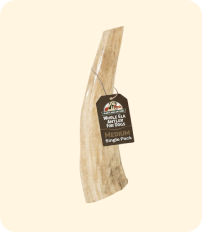
Quick Answer: Grade A elk antler outlasts Nylabone Power Chew by 3 to 6x for serious chewers and costs less per session over a month. A correctly sized Grade A large elk whole at $18-$24 lasts 3-8 weeks of daily hard use. A Nylabone Power Chew at $12 lasts a pit bull or Malinois 5-10 days. For power chewers, antler wins on duration, safety profile, and nutritional return. Nylabone is a reasonable choice for moderate or light chewers where synthetic material is not a concern.

| Feature | Grade A Elk Antler | Nylabone Power Chew |
|---|---|---|
| Ingredient | Shed elk antler, one ingredient | Nylon (synthetic), flavored surface |
| Lasts (power chewer) | 3-8 weeks of daily hard use | 5-10 days before chunk risk or flavor loss |
| Grade available | Grade A (cortex-inspected, density-sorted) | No grading system; single product line |
| Cost per session | Under $1/day ($18-$24 per chew) | $1.50-$2/day ($40-$60/month replacing weekly) |
| Nutritional return | Calcium, phosphorus, zinc, marrow protein | None. Nylon is not digestible |
| Safety (power chewer) | Fine organic powder as it wears | Large nylon chunks = GI obstruction risk |
| Best for | Power chewers, working breeds, daily hard use | Moderate/light chewers, convenience shoppers |
For working breeds and power chewers, Grade A elk antler is the correct choice. One ingredient, no synthetics, and the density holds up to real jaw pressure. A correctly sized Grade A large whole elk antler at $18 to $24 lasts an adult working breed 3 to 8 weeks of daily sessions. A Nylabone Power Chew at $12 lasts a serious pit bull or Malinois 5 to 10 days before the flavoring is gone and the chunk risk is real. The cost-per-session math and the safety profile both favor antler for the high end of chew intensity.
Nylabone is a real product that works for a real segment of dogs. If you own a moderate chewer, this comparison is closer. But if your dog has destroyed chews for a living, read on.
Customers who switched from Nylabone to Grade A elk antler consistently describe a dog that was tolerating the Nylabone but actively wants the antler. After working with power chewer owners through this transition, we've found engagement level is the clearest first-session difference. A dog that chewed a Nylabone out of necessity will self-select Grade A elk in a two-option test within the first minute. The marrow scent and natural cortex texture produce motivation that synthetic material cannot replicate.
What We See When Power Chewers Switch from Nylabone to Antler
After working with elk antler specifically and paying attention to what the other options do and do not deliver: dogs cycling through a Nylabone Power Chew in 5-10 days consistently hold a same-sized Grade A elk antler for 3-8 weeks. That is not a manufacturer claim. That is the performance gap customers report when they make the switch.
What Nylabone Is and What It Does Well
Nylabone is a flavored nylon chew toy. The core idea is behavioral: give the dog something to chew so it does not chew the couch. The product is made from nylon, textured on the surface, and infused with flavor, usually bacon, chicken, or beef.
A standard Nylabone Power Chew for large breeds retails at $10 to $14 and is rated for dogs above 50 pounds. For a moderate chewer, a 30 to 50-pound dog that chews for 10 to 15 minutes and stops, that product lasts several weeks. The product is widely available, consistent, and easy to find.
Nylabone's strength: consistency and convenience. You can find it at any pet store. For moderate chewers, the rating holds up. For a dog that chews casually and stops, Nylabone earns its place on the shelf.
Where Nylabone Falls Short for Power Chewers
The failure modes are specific and they matter.
The Power Chew line is not actually rated for the most powerful chewers. Pit Bulls, Belgian Malinois, Cane Corsos, Rottweilers. These dogs apply bite pressure that is not in the design envelope for most Nylabones. The result is not fine shavings. It is chunks. A dog that breaks off a large nylon chunk has created a potential GI obstruction. Nylon is not digestible and it does not break down.
The flavor burns off before the chew does. The surface flavoring is what drives interest. For a power chewer working the bone hard every session, the flavoring is gone in days. Dogs that were engaged stop caring. The nylon underneath has no intrinsic reward.
No nutritional component. The dog is consuming nothing. Nylon shavings, fine or otherwise, are not absorbed. There is no mineral content, no protein, no marrow. Chewing behavior is satisfied but nothing is returned to the dog.
Replacement cost adds up fast. A $12 Nylabone Power Chew lasts a serious pit bull a week, sometimes less. That is $50 or more per month on a product the dog defeats and then ignores.
The Ingredient Question Nylabone's Label Does Not Answer
Nylabone states their chews are BPA-free. That is accurate and they print it clearly. What the label does not address: PFAS (per- and polyfluoroalkyl substances), phthalates beyond the specific variants tested, or the long-term effect of nylon micro-shavings accumulating in a dog's digestive system over months of daily use.
"BPA-free" has become standard assurance in plastics marketing. It tells you one specific compound is absent. It does not describe what compounds are present. The nylon polymer itself, any surface treatments, any flavoring binders, and any breakdown products from sustained mechanical grinding are not disclosed. Nylabone is a food-contact product given to dogs daily. The ingredient transparency available to the buyer is limited to what the manufacturer has chosen to disclose.
Grade A elk antler is calcium phosphate, collagen, and bone marrow. That is what bone mineral is made of. The fine powder that abrades off during chewing is the same material as the antler itself. No polymer byproducts. No undisclosed surface treatments. No accumulation of non-digestible synthetic material in the gut.
This is not a claim that Nylabone's specific chemistry is harmful. It is a statement about comparative ingredient visibility. With antler, the ingredient list is complete. With nylon, the list covers what was tested and disclosed, which is not the same as what is present.
On the Nylabone "Antler Alternative" Product
Nylabone makes a product called the Antler Alternative Power Chew. It is shaped like an antler tine. It is still nylon.
The shape does not change the ingredient. It does not add nutritional return. It does not change that a power chewer will eventually produce nylon chunks that cannot be digested. It does not change the cost-per-session math. It does not change the ingredient transparency gap described above.
The product exists because the antler market is real and Nylabone operates in the same category. If you are looking for the durability and natural engagement that antler provides, a nylon object shaped like an antler tine is not the answer. Grade A elk antler is the antler.
What Grade A Elk Antler Offers Instead
Grade A elk antler is one ingredient. That is the starting point.
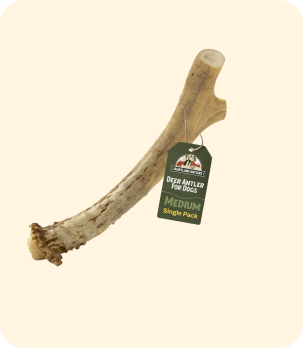
There is no flavoring applied to the surface. The interest the dog has in antler is structural. The outer cortex is dense bone. Inside is marrow, a fat-rich core with real nutritional value: calcium, phosphorus, zinc, and protein. The dog is not chasing a flavor coating. It is working toward a reward that is actually there.
A Grade A large whole elk antler at $18 to $24 lasts an adult working breed 3 to 8 weeks of daily hard-chewing sessions. That works out to under $1 per session for a dog chewing daily. The Nylabone equivalent for the same dog costs $10 to $14 per week, or $40 to $60 per month.
The material behaves differently under pressure. Grade A elk antler, sized correctly for the dog, does not chunk the way a defeated Nylabone does. The outer layer abrades as fine organic powder, the same material the antler is made of. The dog is not ingesting a synthetic material.
We have written a full breakdown of how the Grade A classification works: What Grade A Means: The Sourcing Standard.
For dogs at the high end of bite intensity, we also cover the specific fit and density requirements here: Why Power Chewers Need Grade A Elk.
The Honest Trade-offs
Antler is not simpler to manage than Nylabone. That is worth saying plainly.
Fit matters more. With antler, getting the right size for the dog's jaw width and chewing intensity matters. Too small and the dog can get it sideways in its mouth. Too large and a smaller dog cannot get any purchase. The sizing guide removes the guesswork: Find the Right Fit for Your Dog.
Supervision is more involved. Any chew with a new dog requires supervision, but antler is a natural material and it will wear down over time. When the antler gets small enough to be a choking hazard for a large dog, it should be swapped out. This requires periodic checks rather than leaving a dog unattended with it indefinitely.
The learning curve is real. A dog that has never had a natural chew may not know what to do with antler at first. Nylabone's consistent synthetic texture is familiar to most dogs from the start. A dog transitioning to antler sometimes needs a few sessions to find the working angle.
Availability is different. You are not picking this up at a gas station. You order it and it arrives. For some owners that is irrelevant. For others it is a consideration.
Side-by-Side Comparison
The comparison table at the top of this article summarizes the key differences. For a detailed cost-per-session breakdown, see Antler vs. Bully Stick: The Cost-Per-Session Math. The math framework applies equally to the nylabone-versus-antler calculation.
Who Should Switch and Who Should Stay
Switch to antler if:
Your dog is a power chewer. Pit Bull, Malinois, Cane Corso, Rottweiler, American Bully, large working breed. If the word "destroyer" shows up in how you describe your dog's relationship with chews, you are in the target group.
You have been replacing Nylabones on a cycle of days to two weeks. The math does not work long term and the chunk risk is real for dogs at the high end.
Your dog loses interest once the surface flavor is gone. Antler does not have this problem because the reward is structural, not cosmetic.
Stay with Nylabone if:
Your dog is a moderate or light chewer. If a Nylabone Power Chew lasts your dog a month without issue, it is doing its job.
Your dog is a puppy in the teething phase and you need something soft and familiar. For puppies, split deer antler can work, but fit needs to be right and requires more involvement than most owners want during the teething window.
You need to grab something from a local store on short notice. Nylabone is available everywhere. Antler requires ordering in advance.
Are Antlers Safe for Power Chewers?
The safety case for antler is covered fully here: Are Antlers Safe? Grade, Fit, and Supervision.
The short version: Grade A antler, correctly sized, abrades as fine organic powder rather than producing large breakaway chunks. The failure mode on Nylabone for a power chewer is chunk production. The failure mode on incorrectly sized antler is a piece too small to stay controlled. Size it right and supervise, and the safety profile for antler is clean.
Breed-Specific Fit
Not all power chewers are the same. A German Shepherd works a chew methodically, end-to-end. A Belgian Malinois works with sustained intensity that will find any weak point in a lower-grade material. A Pit Bull applies compression load that a Nylabone cannot absorb past day 5.
For each of these dogs, the Nylabone failure mode is the same: chunk risk or flavor loss. The antler solution is also the same: Grade A whole elk, sized to the jaw.
Find the Right Fit
If your dog belongs in the antler column, start with size. A correct fit makes the difference between a chew that lasts and one that creates a supervision headache.
Find the Right Fit for Your Dog covers weight ranges, jaw size, and chew intensity.
Ready to order? Shop Grade A elk antler.
Frequently Asked Questions
Is antler safer than Nylabone for dogs?
For power chewers, Grade A elk antler is the safer option. A dog powerful enough to break off large nylon chunks from a Nylabone faces a real GI obstruction risk, because nylon does not digest. Grade A elk antler, properly sized, abrades as fine organic powder rather than producing breakaway pieces. For moderate and light chewers, both products are reasonable when used as intended.
Does antler last longer than Nylabone?
For power chewers, yes, by a significant margin. A dog that cycles through a Nylabone Power Chew in 5 to 10 days will typically work the same-sized Grade A elk antler for 3 to 8 weeks of daily sessions. The cortex density of elk antler handles the pressure pattern of a working breed's bite better than nylon at the high end of force. For moderate chewers, the comparison is closer.
Can my dog eat antler pieces?
Small organic particles that abrade off during chewing are fine. They are natural bone mineral and keratin, the same material as the antler itself. What to avoid is allowing the antler to wear down to a piece small enough to be swallowed whole by a large dog. Monitor the antler as it wears and replace it before it reaches that size.
What is the best alternative to Nylabone for power chewers?
Grade A elk antler is the most direct alternative for dogs in the power chewer category. It matches the durability requirement, removes the synthetic material concern, and adds nutritional value that nylon cannot provide. For dogs where Nylabone is failing through fast destruction, chunk production, or loss of interest after the flavor wears off, Grade A elk antler addresses all three problems.
Is Nylabone bad for dogs?
Not categorically. For light to moderate chewers, Nylabone is a reasonable product. The concern is specific: power chewers that break off large nylon chunks face a GI obstruction risk, and nylon is not digestible regardless of piece size. Fine shavings generally pass without issue. If your dog is destroying Nylabones rather than wearing them down gradually, that is the signal to switch.
Frequently Asked Questions
Is antler safer than Nylabone for dogs?
For power chewers, Grade A elk antler is the safer option. A dog powerful enough to break off large nylon chunks from a Nylabone faces a real GI obstruction risk, because nylon does not digest. Grade A elk antler, properly sized, abrades as fine organic powder rather than producing breakaway pieces. For moderate and light chewers, both products are reasonable when used as intended.
Does antler last longer than Nylabone?
For power chewers, yes. A dog that cycles through a Nylabone Power Chew in 5 to 10 days will typically work the same-sized Grade A elk antler for 3 to 8 weeks of daily sessions. The cortex density of elk antler handles the pressure pattern of a working breed's bite better than nylon at the high end of force.
Can my dog eat antler pieces?
Small organic particles that abrade off during chewing are fine. They are natural bone mineral and keratin, the same material as the antler itself. What to avoid is allowing the antler to wear down to a size that could be swallowed whole by a large dog. Monitor the antler as it wears and replace it before it reaches that point.
What is the best alternative to Nylabone for power chewers?
Grade A elk antler is the most direct alternative for power chewer dogs. It addresses the three main failure modes of Nylabone for this use case: fast destruction, chunk production risk, and loss of interest after surface flavoring wears off. Antler provides nutritional return and sustained engagement that nylon cannot match.
Is Nylabone bad for dogs?
Not categorically. For light to moderate chewers, Nylabone is a reasonable product. The concern is specific to power chewers who can break off large nylon chunks, which are not digestible and carry a GI obstruction risk. Fine shavings generally pass without issue. If your dog is destroying Nylabones rather than wearing them down gradually, that is the signal to consider a different chew option.