
Quick answer: A natural label does not prove that a dog chew is safe, unprocessed or made from one ingredient. Read the material and ingredient information, check the maker's sourcing and care instructions, and consider the dog's teeth and chewing behavior. Antler is a hard animal material; its natural origin does not remove its dental risk.
Owners use the word natural for several different priorities. Some want a short ingredient list. Others want animal material, traceable sourcing or no added flavor. State your priority first. Then compare the exact products against it, rather than treating one word on a package as a complete answer.
Read the label beyond natural
AAFCO's consumer explanation of natural pet-food ingredients allows several types of processing. It does not define natural as single-ingredient, and it does not establish that natural ingredients are safer. This is pet-food label guidance, not a certification for every chew toy.
Check these separate facts:
- Material or ingredients: What is the product made from? Check coatings and added flavors as well as the main material.
- Processing: What has the maker done to clean, dry, cut, form or otherwise prepare it?
- Sourcing: What origin claim does the maker make, and what information supports it?
- Use: Is this an edible treat, a non-edible toy or another chew item? What are the care and removal rules?
A short ingredient list can make ingredient identification easier. It does not prove digestibility, tolerance, nutritional value or protection from injury. Our guide to single-ingredient dog chews provides further questions to ask about sourcing.

Compare the main natural chew categories
| Category | What to verify | What not to infer |
|---|---|---|
| Deer and elk antler | Species, whole or split cut, source, dimensions and condition | Natural shedding does not establish dental safety or a fixed useful life |
| Bully sticks | Exact ingredient statement, calories, processing, batch and storage instructions | One ingredient does not remove hygiene or swallowed-piece concerns |
| Tendons and ears | Animal source, added ingredients, texture, portion and care instructions | Do not assume all are soft or suitable for puppies or seniors |
| Cheese chews | Exact milk ingredients and recipe, hardness and manufacturer directions | A natural label does not mean single-ingredient or soft |
| Rawhide products | The specific product, processing and use instructions | Do not apply one manufacturing claim to every rawhide item |
Odor, grease, wear and dog interest vary by product and use. We do not have a common controlled test that ranks all these categories by life, smell or cost. You can compare the actual price and observed use of a suitable item. Our guide to long-lasting dog chews separates session time from product life.
Rawhide also illustrates why category-wide claims need care. The VOHC accepted-products list includes specific products in several categories, including rawhide. The list concerns the exact accepted dental claim. It is not a general endorsement of every rawhide item or every chewing pattern.

Understand what antler sourcing tells you
Naturally shed describes how an antler leaves the animal. It is separate from the steps used to prepare a retail chew. A collected antler can still be cleaned, cut, sized and inspected. It should not be described as untouched when preparation has taken place.
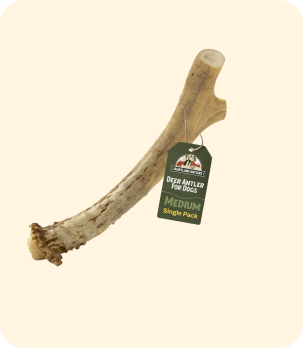
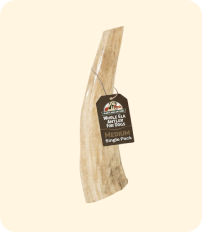
Heartland offers whole deer, whole elk and split elk antlers. Check the current item details in the product collection, and ask Heartland support about its source and preparation. The current catalog, rather than a general article, is the place to confirm the product you will receive.
A split elk antler exposes an inner surface while retaining hard outer material. A grading label is a product description, not proof of dental suitability. Neither sourcing nor the absence of synthetic material establishes that a piece is safe to swallow. Read the elk and deer comparison and the antler safety guide before making a choice.

Choose for teeth, behavior and diet
AAHA warns that hard chews, including antlers and hard cheese, can damage teeth. Broken and undersized pieces also need attention. Natural origin is not a way around these physical limits.
Tell your veterinarian if the dog crushes objects, gulps treats, has tooth damage or follows a restricted diet. A different cut or a different animal ingredient may not address the problem. For dental care, discuss home brushing and product-specific evidence. Do not infer an antler dental benefit from the fact that chewing creates friction; see our dental-health guide.
- Define the purpose: a food reward, enrichment activity or dental-care product.
- Check the exact item and its instructions against your dog's needs.
- Inspect before use and supervise closely.
- Remove the item for damage, loose pieces, poor fit or discomfort.
- Use the item's cleaning and storage directions. Stop and seek advice if symptoms appear.
You can compare deer antlers, elk antlers and split elk antlers without treating any category as a universal choice.

Frequently asked questions
What are the best natural dog chews?
There is no single best category for all dogs. Compare ingredients, hardness, fit, diet needs and instructions with your veterinarian. A natural label alone cannot make the choice.
Does natural mean unprocessed?
No. AAFCO's pet-food definition allows several processing methods. For a chew item, ask what the maker actually does rather than assuming that natural means untouched.
Are single-ingredient chews always better?
A short list can help identify an ingredient. It does not establish safety, tolerance or a complete diet. The exact material and dog still matter.
Are antlers a dental product?
Do not assume a plaque or tartar benefit. Check an exact product's evidence and discuss dental care with your veterinarian. Antler remains hard enough to pose a tooth-damage risk.
Is a split antler suitable for an older dog?
Age alone cannot establish suitability. The hard outer material remains, and older dogs can have dental problems. Ask your veterinarian before offering hard material.