
Quick answer: There is no reliable duration ranking that applies to every dog. Long-lasting dog chews differ in material, size, purpose and replacement rules. Judge a chew by its suitability, its condition and how your dog uses it. A hard piece that lasts a long time can still damage teeth.
If each new chew seems to disappear before you sit down, it is reasonable to compare the cost and use you get. First, separate two different questions: how long does the dog stay interested, and how long does the item remain suitable for use? Those are different measures. A toy can last in a basket for months because a dog ignores it. An edible treat can serve its purpose in one supervised session.
Separate session time from product life
Session time is the time your dog spends using an item during one supervised activity. Product life ends when the item is consumed, damaged, too small, unsuitable or due for replacement under its instructions. Do not keep a damaged chew to improve the cost calculation.
A useful record has five fields: exact product and size, purchase price, date first used, observed use, and reason for removal. Record your own dog's behavior rather than a promised number of weeks. Take a photograph before first use so changes in shape are easier to see.
Comparisons also need the same conditions. A whole antler, a split antler, an edible dental treat and a rubber food toy do not have the same purpose. Our guide to how long antler chews last covers the factors that affect antler wear. No calendar estimate should override a condition check.

Compare materials and their limits
| Category | What to compare | Main limit to check |
|---|---|---|
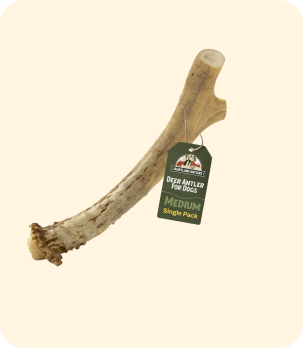
| Whole deer or elk antler | Natural variation, dimensions, surface and wear | Hard material can fracture teeth; remove damaged or swallowable pieces |
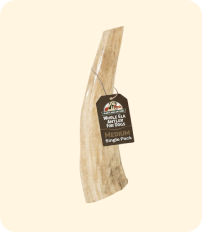
| Split elk antler | The exposed inner surface and remaining hard outer material | A split cut does not remove the dental risk |
| Edible chews, such as bully sticks or tendons | Ingredients, calories, serving instructions, storage and batch information | Swallowed pieces, hygiene and the dog's diet still matter |
| Hard cheese chews | Exact recipe, hardness and preparation instructions | Hard cheese can damage teeth; follow that product's directions |
| Nylon chew toys | Exact model, size, condition and maker's replacement guide | Non-edible hard material can damage teeth or cause ingestion problems |
| Flexible food toys or puzzles | Material flexibility, fit, cleaning and the dog's ability to damage it | Remove damaged toys and account for food placed inside |
| Dental products | The exact product, accepted dental claim and use instructions | Dental purpose does not establish a long chewing session |
For dental claims, use the Veterinary Oral Health Council's accepted-products list. Check the exact item and whether its accepted claim concerns plaque, tartar or both. A claim for one item does not apply to every product in that category.

Put dental suitability before durability
AAHA's chew guidance identifies tooth damage from very hard chews and hazards from broken or undersized pieces. A dog that crushes hard objects needs a different plan from a dog that carries a soft toy. Supervision can help you respond to a problem; it does not make hard material safe for teeth.
Describe your dog's chewing behavior and dental history to your veterinarian. For a dog with a damaged tooth, pain or known dental disease, stop the chew and obtain advice. Cornell explains why a damaged tooth needs veterinary assessment. Do not use a larger antler or a split cut as a treatment. Breed, body weight, adult age and a grading label do not establish dental suitability.
Heartland's range includes whole deer, whole elk and split elk antlers. All retain hard material. Compare their features in elk versus deer antlers and discuss the behavior described in our aggressive-chewer guide. These categories do not support a promise that one lasts longer or protects teeth better.

Measure value and inspect each use
Use actual cost and actual suitable use. Divide the amount paid for one item by its observed uses. Include replacement and cleaning needs. Keep edible treats separate from toys when the purpose differs. A lower price per day cannot compensate for an item that is unsuitable for your dog.
- Read the product's current size, care and replacement instructions.
- Check for cracks, loose pieces, sharp edges and changes in size or shape before each use.
- Stay close enough to observe chewing and remove the item if the dog tries to crush it or swallow pieces.
- Stop use when damage, poor fit or discomfort appears. Follow the maker's earlier replacement instruction where it applies.
- Keep a short use record so your next purchase reflects this dog's needs.
There is no universal session length that makes hard chewing safe. Stop earlier when behavior or condition calls for it. Our size guide and current size collection can help with product dimensions. Ask Heartland support about the item, and ask your veterinarian about the dog's teeth.

Frequently asked questions
What is the longest-lasting dog chew?
There is no verified universal winner. Material, dimensions, the individual dog and the replacement rule all change the result. Do not compare a manufacturer's estimate with an owner's anecdote as if they were a controlled test.
Do antlers last longer than bully sticks?
They are different materials used in different ways. An antler may remain available across sessions, while a bully stick is an edible treat. We do not have a controlled comparison that supports a fixed multiplier or a guaranteed number of weeks for your dog.
Are longer-lasting chews safer for aggressive chewers?
No such conclusion follows from duration. Hardness can create a dental risk, and damaged pieces can create an ingestion risk. Choose with your veterinarian based on behavior and dental condition.
Can split antlers solve a hard-chew problem?
No. The cut exposes the inner material, but the hard outer material remains. It is not a safety conversion for a puppy, senior or dog with dental disease.
What should I compare if I want better value?
Compare the exact item's price, usable sessions, replacement rules and suitability. A record from your dog is more useful than a fixed ranking based on unsupported duration claims.