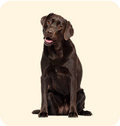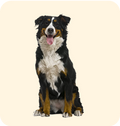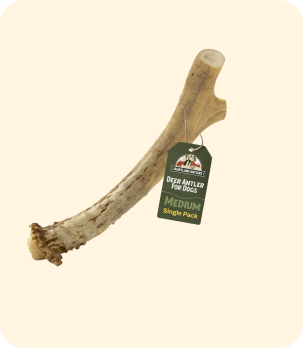
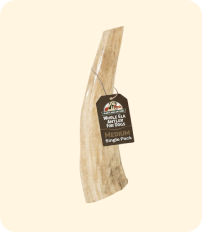

Your English Springer Spaniel's actual behavior matters more than a “soft mouth” label. Carrying a toy gently does not show how the dog will bite a hard antler. Whole and split antlers can damage teeth, so start with dental history and a veterinary discussion.
A Springer that walks away from an antler is giving you useful information about that moment. The behavior does not prove that the dog needs a different cut, a stronger flavor or more encouragement. This guide separates interest, product facts and suitability.
Observe use without a breed assumption
Notice how your dog approaches an activity, what it does with the item and when it leaves. Carrying, chewing and trying to swallow pieces are different actions. A dog's behavior with one toy does not establish what it will do with a new material.
A “soft mouth” description associated with retrieving does not measure tooth strength or guarantee gentle chewing. Avoid choosing an antler because a breed guide says that Springers apply a fixed level of jaw force. There is no breed-wide pressure measurement behind this guide.
If the dog loses interest, allow it to leave. Do not hold a hard piece against its mouth, smear food on it to overcome reluctance or repeatedly prompt forceful chewing. A new eating change, dropped food or avoidance of previously enjoyed activities is a reason to discuss health with your veterinarian.
Cornell explains that tooth fractures can cause pain and may be found without a clear injury history. Keep an observation record for the clinic rather than treating refusal as a product engagement problem.

Compare surfaces without a safety shortcut
Whole elk and split elk differ in how much of the interior is exposed. Heartland also sells whole deer antlers. A split surface may be easy to see, but exposed material is not proof that the complete item is soft enough for teeth.
AAHA warns that hard antlers can damage or fracture teeth. Size, grade and cut do not remove that risk. We do not claim that split elk is the correct chew for every adult Springer, or that split deer is a Heartland puppy option.
Compare exact dimensions and directions rather than a breed average. A medium or large label is a product range, not an individual dental assessment. There is also no reliable three- to eight-week lifespan promise for every Springer. The piece, the dog's use and its condition vary.
Read the whole and split guide for the cut comparison and the size guide for interpreting labels.

Give an active dog different ways to engage
An activity can be useful without involving hard chewing. Consider a simple food search, short training or a suitable feeding puzzle. Choose the activity for your Springer today, with attention to health, experience and interest.
A practical feeding-puzzle setup starts with a manageable task. Put aside part of the measured meal, follow the device's directions and introduce it while you are present. Make the task easier if the dog becomes frustrated. A more difficult puzzle is not automatically better enrichment.
Inspect flexible toys too. Remove pieces that are torn, loose or small enough to swallow, and stop if the dog tries to eat the device. Ask your veterinarian which materials fit your dog. A different material can address one concern while still requiring care and supervision.
Allow rest after activity. There is no need to make a dog chew for a fixed number of minutes after a walk or training session. If the dog appears distressed or cannot settle, discuss the pattern with a qualified professional rather than treating a hard chew as a calming treatment.

Check condition, fit and behavior each time
Where a chew is used, inspect it before and during the session. Look for damage, loose parts and a size that could be swallowed. Keep the item away from the dog while checking it. Do not test a worn piece by positioning it at the back teeth.
Watch the dog's response as well. Stop forceful biting or attempts to gulp a piece, and seek advice about a more suitable activity. Fast wear does not prove that you should buy a denser antler or simply increase the size.
Keep items clean, dry and out of reach between sessions. Storage does not make a damaged piece usable again. Discard a questionable item where the dog cannot retrieve it. See storage guidance and when to retire a worn piece.
Bring product details and observations to your veterinarian if you are unsure. For current Heartland dimensions and cuts, ask our team or view the catalog.

Frequently asked questions
What is the best antler for an English Springer Spaniel?
There is no single cut established as the best choice for the breed. Start with the individual dog's dental history and behavior, then discuss whether a hard chew is appropriate.
Does a soft mouth make antlers safer?
Gentle carrying does not prove gentle chewing or stronger teeth. Antler hardness remains a dental risk.
Should I change to split elk if my Springer walks away?
Walking away alone does not identify a cut problem. Let the dog stop, consider other activities and report persistent changes in eating or comfort.
How many minutes should a Springer chew?
A universal timer cannot establish safety. Follow individual advice and product directions, remain present and stop when behavior, comfort or condition changes.