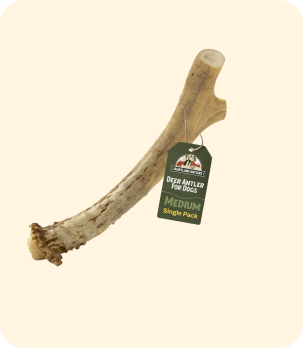
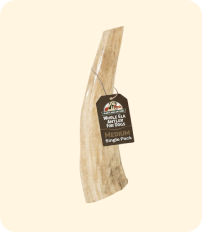
Adult Irish Setters (60-70 lb, soft-mouth scissors bite) need Heartland Antlers Grade A large whole elk antler, sized to survive both the active burst phase and the week-long gap phase that follows.

Your Irish Setter worked a chew hard for two days straight. Then stopped completely. The antler sat on the floor untouched for a week, and you started wondering if the phase was over.
Quick Answer: The right antler for an Irish Setter must survive both the burst phase and the gap phase. Irish Setters (60-70 lb, soft-mouth scissors bite) require Heartland Antlers Grade A large whole elk. The breed chews in a burst-and-gap pattern: intense focus for several days, then a week or more of ignoring the piece entirely. Whole elk holds its integrity across the gap because elk runs 30-40% denser than deer; split cuts and deer antler degrade faster during active phases and hold less interest after a long idle. A Grade A large whole elk antler typically lasts an adult Irish Setter 4-7 weeks across multiple burst-and-gap cycles. A split or lower-density piece used up in one burst leaves nothing for the next phase.
It was not over. That is how Irish Setters chew. The job is picking a chew that can handle the burst and survive the gap. From customers with Irish Setters, the single most common issue is a split or soft chew that disappears during the burst phase, leaving nothing for when the next phase begins.
For most adult Irish Setters (60-70 lb, soft-mouth scissors bite, moderate jaw force), the correct antler is large whole elk, Grade A. The whole cut holds its integrity across the ignore phase so the chew is ready when the next burst begins.
Customers with Irish Setters consistently report the same confusion: the dog works a chew hard for several days, stops completely, and picks it back up a week later as if nothing happened. After working with Irish Setter owners, we've found this burst-and-gap pattern is reliable and breed-typical, not a signal that the chew is wrong. The problem arises when the chew gets used up during the burst phase and leaves nothing for the next one. Large whole elk Grade A handles both phases.
Why the Irish Setter's Burst-and-Gap Pattern Demands Whole Elk Grade A
An adult Irish Setter (60-70 lb, lean athletic build, long narrow skull) is a soft-mouth breed developed to retrieve birds undamaged. The Irish Setter applies consistent, controlled pressure rather than crushing force. It does not demolish a chew the way a Malinois or a Pit Bull does. It works with it.
Chew drive is high in bursts and inconsistent across time. An Irish Setter in a chew phase will come back to the same piece every few hours. Then, with no signal, the phase ends. The chew sits for days or a week. Then the phase starts again.
The long-muzzle factor also matters. A long, narrow muzzle means the back-molar use zone is different from a broad-skulled breed. The Irish Setter works the sides of a piece more than the back. Geometry matters for cut selection.
The problem is not chew intensity during a phase. The problem is what happens to the chew during the gaps. Soft cuts get stale. Small pieces get buried and forgotten. A whole antler with a solid outer surface holds exactly where it left off between sessions.
Antler for Irish Setters: Configuration by Life Stage
These are the configurations that match how Irish Setters actually chew.
| Dog | Size | Cut | Species | Grade | Typical Duration |
|---|---|---|---|---|---|
| Standard adult (60-70 lb) | Large | Whole | Elk | A | 4-7 weeks |
| High-drive or active adult | Large | Whole | Elk | A | 4-7 weeks |
| Puppy under 10 months | Medium | Split | Deer | A | Supervised, under 20 min sessions |
| Senior Irish Setter | Large | Split | Elk | A | 6-12 weeks |
Standard adult Irish Setter (60-70 lb): Large whole elk, Grade A. The whole cut gives this breed a surface that holds its integrity across the ignore phase. When your dog comes back to it after a week, the chew is exactly as it was. Nothing has degraded, softened, or oxidized. The session starts where the last one left off.
High-drive or very active Irish Setter: Large whole elk, Grade A. Drive level does not change the cut logic for this breed. The burst-and-gap chew pattern persists regardless of how much exercise the dog gets. A field dog coming off a full morning of work will chew harder in that first session back, but the whole cut still holds.
Irish Setter puppy (under 10 months): Medium split deer, supervised. Adult teeth are not fully set. Whole elk is too hard at this stage. Split deer is appropriate at lower jaw pressure with marrow exposure that keeps a developing chewer engaged. Keep sessions under 20 minutes.
Senior Irish Setter: Large split elk, Grade A. Drive often moderates with age. The split opens the marrow channel and reduces the jaw effort required, which matters for older dentition. The gap phase may extend further in a senior dog, and split elk handles idle time without degrading.
Elk vs. Deer Antler for an Irish Setter: Whole Elk Wins the Gap Phase
Whole elk for most adult Irish Setters. This is the call the burst-and-gap pattern demands.
Deer antler is lower density. For a breed with a moderate bite and a pattern of long gaps between sessions, lower density creates a durability problem. During an active phase, a 70 lb Irish Setter will work through deer antler faster than expected. During the ignore phase, a smaller, lighter piece is more likely to get lost under furniture or buried in the yard.
Whole elk gives you density that survives the burst. It also gives you mass. A large whole elk piece is harder to misplace and harder to destroy in a single three-day run.
The argument for split elk is marrow access. For breeds where reward rate is the primary engagement variable, the exposed marrow face changes the equation. For Irish Setters, that calculus is different. The breed engages readily at the start of a phase regardless of cut. The sustained interest is driven by novelty and scent, not by immediate marrow delivery. Whole elk holds its scent signature and surface texture across weeks. Split elk, once the marrow face is worked down, has less to offer on a return visit.
For puppies under 10 months: split deer is correct. Whole elk hardness is not appropriate at this stage.
For seniors: split elk. The marrow access reduces jaw effort without sacrificing longevity.
How to Read the First Session
Watch the first session closely. It tells you whether the fit is working.
Right fit: Your dog settles with the piece within five minutes. You see surface work along the sides and the brow tine. The dog returns to the piece at least twice during the same session. Some enamel wear or scuff marks are visible at the end.
Go up in size: The dog is engaged and focused but is consuming the piece faster than expected. If you see real material loss in a 30-minute session, the piece is undersized for the chew intensity during this phase. Size up to extra-large whole elk.
Losing interest in under five minutes: This is rare for Irish Setters early in a phase. If it happens, check whether the dog is simply not in a phase. Put the chew away and offer it again in two or three days. If the dog engages on the second or third offer, the fit is likely right and the first session was between phases.
Note on burst sessions: An Irish Setter in an active phase can look like a power chewer. The volume of time spent on the piece in 48 hours is real. That is normal. Do not size down after a heavy phase. The phase will end and the whole elk will still be there when it starts again.
Supervision Notes
Supervise all chew sessions until you know how your dog works the piece.
Retire criteria: Pull the piece when it is reduced to a size small enough to reach the back of the mouth. For a 60-70 lb Irish Setter, retire when the piece reaches roughly molar-width. This is the primary safety threshold regardless of breed.
Gap supervision: During the ignore phase, store the chew somewhere clean and dry. Do not leave it on the floor where it collects debris or moisture. An antler that sits clean stays fresh. One left in a damp corner develops surface mold, which is a reason to discard rather than continue.
Session length: Irish Setters in an active phase will self-regulate better than breeds with compulsive chew drives. Most will not work a hard surface to exhaustion. Still, limit initial sessions to 30 minutes until you have a read on your specific dog's chew style.
The Ignore-Phase Problem: Why Whole Elk Outlasts Every Other Chew
Most chews cannot survive the ignore phase.
Bully sticks oxidize and lose their appeal after a few days exposed to air. Soft cuts get worked down to a nub in one burst and are finished before the next phase starts. Rawhide goes limp. Toys get thrown across the room twice and forgotten.
An Irish Setter's owner ends up shopping constantly, not because the dog is a hard chewer, but because nothing survives the gap.
Whole elk holds. The outer cortex of a whole elk antler does not degrade on a shelf timeline. It does not dry out, oxidize badly, or lose its structural integrity sitting unused for a week. The marrow inside stays sealed. When your dog comes back to it after eight days away, the piece is still a piece. The surface is exactly as hard as it was.
One piece of Grade A whole elk will cover multiple phases. A large whole elk Grade A antler typically lasts an adult Irish Setter 4-7 weeks precisely because of the gap phases, when the piece sits unused but does not degrade. Elk antler runs 30-40% denser than deer at equivalent diameter, which is the density margin that keeps the piece intact through an active burst rather than disappearing before the next phase begins.
Find the Right Fit
For most adult Irish Setters (60-70 lb): large whole elk, Grade A.
For high-drive or field dogs: large whole elk, Grade A.
For puppies under 10 months: medium split deer, supervised.
For seniors: large split elk.
Related reading: - Find the Right Fit by Breed and Jaw Style covers the variables that body weight alone does not capture - Elk vs. Deer Antler: Which Is Right for a Soft-Jawed Retriever for the full species comparison - What Grade A Means and Why It Matters for a Working Dog - covers the density and structural standards that hold up across the burst phase - Antlers for Senior Dogs: When to Switch to Split if your Irish Setter is older or has reduced jaw strength - The Right Antler for an English Springer Spaniel for another sporting gun dog fit guide - Antler for a German Shorthaired Pointer - another gun dog breed, similar drive-state chew demands
Frequently Asked Questions
What is the best antler for an Irish Setter?
Large whole elk, Grade A, for most adult Irish Setters (60-70 lb). The whole cut holds its integrity across the breed's characteristic gap phases, when the dog ignores the chew for several days to a week between active sessions. When your dog comes back to it, the chew is exactly as it was. Nothing has degraded, softened, or lost surface appeal while it sat.
Are antlers safe for Irish Setters?
Yes, with the right fit. Use Grade A whole elk for adults. Supervise sessions until you understand how your dog works the piece. Retire the antler when it is reduced to a piece small enough to reach the back of the mouth. For puppies under 10 months, use split deer rather than whole elk. Store the piece in a dry location during the ignore phase so it does not collect moisture or debris.
What size antler for an Irish Setter?
Large for most adult Irish Setters (60-70 lb). Mass also matters for this breed because of the burst-and-gap chew pattern. A larger piece has more total surface and more total material, which means it lasts across more phases. If a large whole elk is disappearing faster than expected, size up to extra-large.
Elk or deer antler for an Irish Setter?
Elk for adult Irish Setters, specifically whole elk. Whole elk gives you the density that survives both an active burst phase and a week of sitting untouched on the floor. Deer antler is lower density and may get worked through faster during a high-drive phase, leaving the dog with nothing when the next phase starts. Split deer is appropriate for puppies under 10 months where whole-antler hardness is not the right fit.
How long does an antler last for an Irish Setter?
A large whole elk, Grade A, typically lasts an adult Irish Setter between four and seven weeks. The burst-and-gap pattern means total contact time is lower than a breed that chews daily at a consistent rate. During the gap phases, the antler does not degrade. The life of the piece extends across cycles. If the antler is disappearing faster than expected during burst phases, confirm that you have Grade A elk and verify the piece is sized large, not medium.
Frequently Asked Questions
What is the best antler for an Irish Setter?
Large whole elk, Grade A, for most adult Irish Setters (60-70 lb). The whole cut holds its integrity across the breed's characteristic gap phases, when the dog ignores the chew for several days to a week between active sessions. When your dog comes back to it, the chew is exactly as it was. Nothing has degraded, softened, or lost surface appeal while it sat.
Are antlers safe for Irish Setters?
Yes, with the right fit. Use Grade A whole elk for adults. Supervise sessions until you understand how your dog works the piece. Retire the antler when it is reduced to a piece small enough to reach the back of the mouth. For puppies under 10 months, use split deer rather than whole elk. Store the piece in a dry location during the ignore phase so it does not collect moisture or debris.
What size antler for an Irish Setter?
Large for most adult Irish Setters (60-70 lb). Mass also matters for this breed because of the burst-and-gap chew pattern. A larger piece has more total surface and more total material, which means it lasts across more phases. If a large whole elk is disappearing faster than expected, size up to extra-large.
Elk or deer antler for an Irish Setter?
Elk for adult Irish Setters, specifically whole elk. Whole elk gives you the density that survives both an active burst phase and a week of sitting untouched on the floor. Deer antler is lower density and may get worked through faster during a high-drive phase, leaving the dog with nothing when the next phase starts. Split deer is appropriate for puppies under 10 months where whole-antler hardness is not the right fit.
How long does an antler last for an Irish Setter?
A large whole elk, Grade A, typically lasts an adult Irish Setter between four and twelve weeks. The burst-and-gap pattern means total contact time is lower than a breed that chews daily at a consistent rate. During the gap phases, the antler does not degrade. The life of the piece extends across cycles. If the antler is disappearing faster than expected during burst phases, confirm that you have Grade A elk and verify the piece is sized large, not medium.