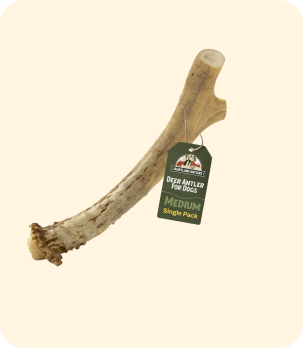
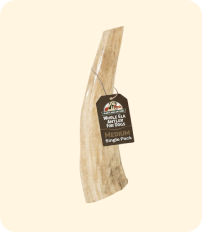

Keep an antler found in the woods out of your dog's chew routine. Its appearance cannot establish its history, condition, or suitability for your dog's teeth. A clean-looking shed is still hard bone. Bringing it home does not turn it into a checked dog product.
This guide covers the moment you find one on a walk. For the wider question of whether any antler suits your dog, read our antler suitability guide.
1. A woodland find has an unknown history
You can see the shape, surface, and location of an antler. You usually cannot confirm when it fell, how long it lay outside, or what happened to it before you arrived. A photo also cannot show every crack or weak area.
The National Park Service explains that antlers grow from bone and are shed seasonally. Finding one on the ground is part of that natural cycle. That fact explains the find; it does not establish a safe use for a pet. Source: National Park Service.
Keep two questions separate: What is this object? and Should my dog chew it? A correct species identification answers only the first. A seller's label, a social media comment, or a pale surface cannot replace the second assessment.

2. Guide your dog past it, then record the find
Keep your dog at a comfortable distance. If the dog already holds the antler, use a familiar, reward-based release cue if it is safe to do so. Avoid turning the object into a tug game. A dog that guards objects needs a separate management plan with a qualified professional.
If you want to identify the antler, photograph it where it lies. Include the broad base, points, and overall shape. Record the location for your own notes. You can enjoy the discovery without giving it to your dog.
| What you observe | What to do with that information |
|---|---|
| A branched, bone-like object | Use wildlife references to identify it. |
| Cracks, sharp edges, or a chalky surface | Keep it away from the dog. |
| A piece already missing | Tell the vet if the dog might have swallowed it. |
| An object on managed or private land | Check the land manager's current collection rules before taking it. |
These are observation steps. They do not form a home test that certifies an antler for chewing.

3. Cleaning cannot resolve the tooth-fracture question
Washing changes surface cleanliness. It does not demonstrate that the object will yield before a tooth does. Hardness remains a separate concern. Texas A&M's veterinary guidance identifies antlers among chews linked with fractured teeth and warns about swallowed pieces. Source: Texas A&M Veterinary Medicine, 2019.
Avoid trying to solve this uncertainty with a home boiling, baking, bleaching, or cutting recipe. This guide does not provide a validated method to make a found antler suitable for a dog. If a chew needs major alteration before you feel comfortable offering it, choose a different activity.
If local rules allow you to keep the antler as a nature specimen, store it in a secure place that your dog cannot reach. A closed display or cupboard is a better choice than a low open shelf. Keep decorative antlers separate from items that the household gives the dog.

4. If your dog chewed it, describe what happened
Remove access to the remaining object when safe. Note when chewing happened, the approximate size of any missing piece, and changes in your dog's behavior. A photograph can help your veterinarian understand the object. It cannot diagnose an injury.
Contact a veterinarian promptly if a piece might have been swallowed. Breathing difficulty or collapse requires emergency care. Do not induce vomiting or give a home remedy unless the veterinarian directs you to do so. Veterinary assessment depends on the object and the dog, rather than a universal waiting period. Source: VCA, ingestion of foreign bodies.
Use our swallowed antler piece guide to organize the details for that call. For a dog that simply needs something to do after the walk, try activities without hard chews.

Frequently asked questions
Is a freshly shed antler safe for my dog?
Freshness does not remove the hardness concern. It also does not establish a suitable size, shape, or match for your dog's teeth. Keep a woodland find out of the chew routine.
Can I boil a found antler to make it safe?
This guide provides no validated home process for that purpose. Surface cleaning cannot establish that a hard object is safe for teeth or safe to swallow.
Is a purchased antler risk-free?
Purchased antlers also carry risks. A product label can provide traceable details, but it cannot guarantee that a particular dog will avoid tooth damage or swallowing problems.
What details should I tell the vet?
Give the time of the incident, your dog's approximate weight, any signs you have noticed, and the size of a potentially missing piece. Keep the remaining object or a photograph available.
Editorial note: This article provides general information, not a veterinary examination. The images are AI-generated illustrations, not photographs of tested products or clinical cases.