
Your Cane Corso just destroyed something that was supposed to last a week. Again.
Maybe it was a "tough" bully stick that disappeared in three minutes. Maybe it was an "indestructible" rubber toy that lasted one afternoon. You've tried the heavy-duty options at the pet store. You've read the labels that say "for aggressive chewers." None of them were built for this.
That's not a training problem or a supervision problem. It's a physics problem. The Cane Corso is an Italian mastiff - a working guardian breed with one of the most powerful bites in the domestic dog world. Jaw force estimates for the breed run around 700 PSI, though the exact figure is contested and hasn't been precisely measured under controlled conditions. What isn't contested is what you see every week in your living room: nothing lasts.
Most "aggressive chewer" products are designed with German Shepherds and Labrador Retrievers in mind. They're not built for mastiff anatomy, mastiff jaw structure, or the sustained crushing pressure a Corso applies over a full chew session. This guide is.

Why Do Cane Corsos Destroy Every Chew?
The answer starts with anatomy. Cane Corsos have wide, broad skulls - a defining mastiff trait. That width isn't cosmetic. It creates a wider jaw base, which means more surface area for the temporalis and masseter muscles to attach, which means more mechanical advantage per bite. The ~700 PSI estimate (contested, but directionally correct) reflects a crushing style of chewing, not a shearing style. Where a Terrier or Husky will gnaw and scrape, a Corso compresses.
That distinction matters enormously for chew selection. A soft chew center - the kind found in bully sticks, rawhide, and even many "tough" chews - collapses under compression pressure almost immediately. The chew doesn't get gnawed away gradually; it gets pulverized in chunks. That's why a bully stick is gone in two or three minutes. The Corso isn't eating it slowly. It's applying peak pressure until the structure fails, then moving on to the next weak point.
Females typically run 80 - 110 lbs, males 100 - 150 lbs. Add the wide jaw geometry and you have a dog generating force well above what most chew manufacturers tested against when they stamped "for large breeds" on the label.
There's also the boredom factor. Corsos are working dogs. They need a job. Without adequate mental engagement, a destructive chewing drive becomes a coping mechanism. A chew that dissolves in minutes doesn't satisfy - it frustrates. An owner watching this cycle repeat every week isn't dealing with a bad dog; they're dealing with a mismatch between tool and animal.
What Makes a Chew Actually Work for a Cane Corso?
Density. Not size. Density.
A bully stick can be XL and still fail in minutes because the material itself is soft. A rawhide can be thick and still fail because it absorbs moisture and loses structural integrity under jaw compression. The variable that determines whether a chew survives a Corso session is the hardness of the outer cortex and the density of the internal structure.
Naturally shed antler has the highest density profile of any commercially available dog chew. The outer cortex - the smooth, hard layer on the outside of a whole antler - is compact mineralized bone. It does not absorb moisture. It does not soften. It resists compression rather than collapsing under it. When a Corso chews on a Grade A whole antler, the surface wears down slowly rather than fracturing all at once.
Compare that to the mechanics of a bully stick: it's essentially a stretched, dried tendon. Under compression, it softens with moisture and then the whole piece can be bitten through. For a human eating a breadstick that comparison works fine. For a dog that generates several hundred pounds per square inch of force - the breadstick analogy holds, and not in the chew's favor.
This is why size recommendations on most chew packaging are inadequate for Corsos. A Large bully stick is still a bully stick. The material is the problem, not the diameter.

The Best Chews for Cane Corsos
1. Deer Antler - Top Pick for Adult Corsos
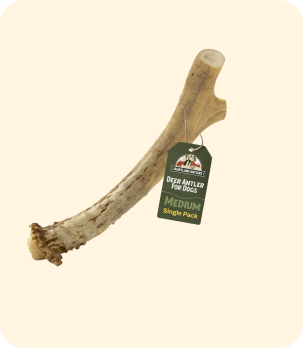
Heartland Grade A Deer Antler Chews
Grade A naturally shed deer antler is the correct primary chew for adult Cane Corsos. The outer cortex is the hardest surface of any antler type - denser than elk, bison, or moose antler - which means it holds up under the sustained compression of a mastiff jaw longer than any other natural chew. No splintering. No mess. No odor from across the room.
Deer antler wears down slowly over weeks to months rather than dissolving in minutes. For a breed whose owners describe watching chew after chew disappear in a single session, that lifespan difference is significant. The internal marrow provides motivation to keep working; the hard outer cortex provides the resistance that makes the session last.
For most adult Corsos - especially males over 100 lbs - XL or Giant is the starting point. See the size table below.
Best for: Adult Corsos (18+ months), hard chewers, owners tired of spending money on things that vanish.
2. Whole Elk Antler - For Slightly Less Intense Chewers
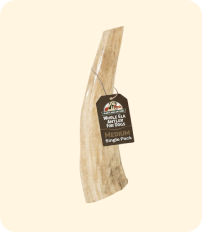
Whole elk antler is a step below deer antler in density but still dramatically more durable than any soft chew. It's a good option for Corsos that are on the moderate end of the power-chewer spectrum, dogs in their first year after the puppy phase, or dogs transitioning from soft chews who need a slightly less demanding starting point.
Elk antler is also somewhat larger in diameter than deer antler at equivalent weight grades, which can be useful for very wide-muzzled Corsos. Size XL or Giant only for adult dogs.
Best for: Moderate-intensity adult Corsos, dogs new to antlers, first-time antler buyers.
3. Split Elk Antler - Best for Puppies and Sensitive Chewers
Split elk antler (cut lengthwise to expose the marrow center) is softer than whole antler and much easier for dogs new to the experience. It's not the right long-term primary chew for a fully grown, hard-charging adult Corso - it won't last. But it's the correct starting point for Corso puppies, dogs recovering from dental work, or dogs that have never chewed antler before and need an introduction to the texture and scent.
The exposed marrow makes it highly attractive. Most dogs that ignore a whole antler will immediately engage with split elk. Use it to build the habit, then transition to whole elk or deer once your dog understands what antler chewing is.
Best for: Corsos under 12 months, antler-skeptic dogs, post-dental-procedure chewers.
4. Buffalo Horn - Honorable Mention
Buffalo horn is denser than bully sticks and lasts longer than most soft chews. It deserves a mention because it's the second-hardest natural chew option and can provide meaningful session length. The caveat: buffalo horn can splinter under extreme jaw force from a fully grown adult Corso. The edges, as the horn wears, can become sharp. If you use buffalo horn, monitor the chew state closely and discard before it gets to sharp-edge territory.
Best for: Owners who want antler-adjacent options; moderate Corsos under supervision.
What NOT to Give a Cane Corso
- Rawhide - Softens and swells with moisture, can be swallowed in large chunks, poses GI obstruction risk. Chemical processing residues are a secondary concern.
- Bully sticks - For most adult Corsos, gone in 2 - 3 minutes. Not a functional chew; more of an expensive appetizer.
- Squeaky or plush toys - Not chews. A Corso will remove the squeaker in minutes and potentially ingest fabric or stuffing.
- Nylon chews - Synthetic material. Small shavings accumulate in the GI tract over time. Not designed to be consumed.

What Size Antler Does a Cane Corso Need?
| Weight | Recommended Size |
|---|---|
| 80 - 100 lbs | Large or XL |
| 100 - 120 lbs | XL |
| 120 - 150 lbs | XL or Giant |
Important note for all Corsos: Always size up. Jaw force in mastiff-type breeds is disproportionate to body weight relative to other large breeds. A 90 lb Corso applies more sustained crushing pressure per session than a 90 lb Golden Retriever. When in doubt, go larger - a chew that's too big is safe; a chew that's too small becomes a swallowing hazard as it wears down.
For a full breakdown of sizing across all breeds and weight classes, see the Heartland size guide.
Cane Corso Puppies: When Can They Start Chewing Antlers?
Corsos are a giant breed - they don't fully mature until around 24 months. Puppy jaw development and adult tooth timing matter here.
- Under 5 months: No antler chews. Baby teeth are not equipped for hard chews.
- 5 - 12 months: Split elk antler only. Puppy teeth are coming in; the softer split elk marrow side is acceptable with supervision. Whole or deer antler is too hard at this stage.
- 12 - 18 months: Transition to whole elk antler once adult teeth are set. Deer antler can be introduced cautiously toward the later end of this window for dogs whose adult teeth appear fully developed and strong.
- 18 months and beyond: Full Grade A deer antler is appropriate. XL and Giant sizing for most Corsos at this stage.
Supervise every session in the first year regardless of antler type. Watch for cracking or unusual wear on teeth and consult your vet if you notice anything concerning. See our guide on antler chew safety for more detail on what to monitor.
Safety Tips for Extreme Power Chewer Owners
Antler is the most durable natural chew available - but "durable" and "unsupervised" aren't the same thing.
First sessions: Supervise the first 2 - 3 sessions with any new antler. Watch how your Corso interacts with it. Some dogs gnaw carefully; others apply full jaw force immediately. You'll learn your dog's style quickly, and that tells you how to pace rotation.
Replace at 2 - 3 inches: When an antler wears down to roughly 2 - 3 inches, it becomes small enough to be a swallowing hazard. Retire it. Do not let a Corso chew a worn-down antler unsupervised.
Grade A = no splintering: Naturally shed Grade A antler does not splinter under normal chewing. This is a meaningful distinction from cooked or cut bones, which can fracture into sharp shards. Heartland antlers are naturally shed - no processing that compromises the cortex integrity.
Dental check-ups: Schedule a veterinary dental exam at least once a year if your Corso chews regularly. Hard chews are generally dental-positive (mechanical plaque removal), but any extreme chewer should have tooth surfaces monitored for wear or micro-fractures. For more on this, see antler chews and dog dental health.
The jowl bonus: Cane Corsos have heavy jowls and produce significant drool. Wet chews - bully sticks, rawhide, collagen chews - amplify that mess substantially. Antler chews are odor-free and produce no wet residue, which is a practical daily quality-of-life win for Corso owners.
Frequently Asked Questions
How long does an antler last a Cane Corso? A Grade A XL or Giant deer antler typically lasts a Cane Corso 2 to 8 weeks depending on chewing intensity and session frequency. That's weeks to months compared to minutes for bully sticks. Whole elk antler lasts slightly less - usually 1 to 4 weeks - for a hard-charging adult Corso.
Is deer antler or elk antler better for a Cane Corso? Deer antler is the top recommendation for most adult Cane Corsos. It's denser than elk antler, with a harder outer cortex that resists sustained crushing pressure better. Whole elk antler is the right step-down for Corsos that are slightly less intense or for dogs new to antlers. Split elk antler is best reserved for puppies under 12 months or for dogs being introduced to antler for the first time.
Can antler chews break a Cane Corso's teeth? Grade A naturally shed antler does not splinter, which eliminates the main tooth-injury risk associated with cooked bones. However, any very hard chew carries some risk of slab fracture for dogs with extreme jaw force. The key precautions: always size up (XL or Giant for most adult Corsos), supervise the first several sessions, replace the antler when it wears down to 2 - 3 inches, and schedule regular dental check-ups.
What size antler for a 120 lb Cane Corso? A 120 lb Cane Corso should be using XL antler as a minimum - Giant is often the better call. Corsos generate jaw force that is disproportionate to their body weight compared to other large breeds, so the standard rule is to size up one step beyond what a simple weight chart would suggest.
What chews are bad for Cane Corsos? Rawhide is the biggest concern - it softens under jaw pressure, can be swallowed in large pieces, and carries chemical processing residues. Bully sticks dissolve within minutes under mastiff jaw force. Nylon chews are synthetic; fragments accumulate in the GI tract over time. Squeaky toys and plush toys are not chews - they're destruction targets that present choking risks.
Ready to Finally Find a Chew That Lasts?
For most adult Cane Corsos, the answer is Grade A deer antler in XL or Giant size. Naturally shed. No splintering. Odor-free and mess-free - which matters more than you'd think with a breed that drools as much as the Corso does.
Not sure which size is right for your dog? Use the Heartland size guide to match by weight and chewing intensity.
Free shipping on orders over $50. All antlers are Grade A, naturally shed, and sourced in North America.
Still comparing options? See how antler stacks up in our full aggressive chewer guide, or check out the comparable breed guides for Pit Bulls and Rottweilers.