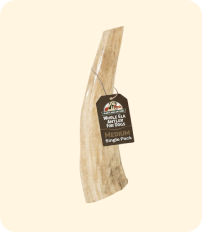
By age three, 80 - 89% of dogs show signs of periodontal disease. Most dog owners have no idea. Their dog's breath gets worse, a little yellow builds up on the back molars, and somewhere in the back of their mind they know a vet dental cleaning is probably overdue - along with a $500 - $1,500 bill to go with it.
Antler chews won't replace that cleaning. But used correctly, they're one of the most effective preventative tools you can put in your dog's routine - because they physically scrape plaque off tooth surfaces every single time your dog chews.
This is the full picture: how antler chews clean teeth (the actual mechanism), what the calcium and phosphorus in antlers do for dental health, how antlers compare to other dental chew options, which antler type gives the most dental benefit, and where antlers have real limits.
How Antler Chews Clean Your Dog's Teeth
The mechanism is called mechanical abrasion. It's the same principle as brushing - friction against the tooth surface physically removes soft deposits before they harden.
When your dog gnaws on an antler chew, the dense surface rubs repeatedly against the tooth enamel. That friction scrapes away biofilm - the soft, sticky layer of bacteria and food particles that forms constantly in your dog's mouth. Left alone for 24 - 48 hours, that biofilm mineralizes and becomes tartar. Tartar is hard. Once it's there, no chew removes it - that's a job for a dental scaler at the vet's office.
The window antler chewing operates in is the plaque stage. Soft, recent, removable.
Two things make antler chews particularly effective at this:
Sustained contact time. Unlike a dental treat that's consumed in minutes, a Grade-A antler chew gives your dog 15 - 30 minutes of active gnawing in a single session. That's a lot of abrasive contact across all tooth surfaces - including the rear molars where plaque tends to accumulate unnoticed.
Density and texture. Antlers are denser and more abrasive than most natural chews. The outer cortex has a rough, bone-like texture that works against tooth surfaces more aggressively than softer options. Research on dental chews published in peer-reviewed veterinary journals confirms that mechanical abrasion from harder chew surfaces produces more consistent plaque reduction than softer alternatives.
Chewing also stimulates saliva production, which matters. Saliva is mildly antibacterial, helps buffer the oral pH, and physically rinses loose plaque from the mouth. The longer your dog chews, the more saliva is produced.
The Mineral Nutrition Angle - Calcium and Phosphorus for Dental Health
Antler chews aren't just a mechanical tool. The marrow inside - particularly in split antlers - delivers calcium and phosphorus for healthy teeth and bones.
That ratio matters. Antlers carry calcium and phosphorus in roughly a 2:1 ratio, which closely mirrors the optimal balance for canine bone and dental mineralization. Calcium is the primary structural mineral in enamel. Phosphorus works alongside it to maintain mineral density throughout the tooth and jaw structure.
This doesn't mean chewing on an antler is equivalent to a supplement - your dog absorbs minerals through the marrow as they gnaw, not in large concentrated doses. But over time, consistent access to these minerals supports the underlying dental structures that make teeth resilient.
Split elk antlers are particularly worth noting here. The exposed marrow isn't just more palatable - it extends chewing sessions significantly, because dogs are motivated to keep working at the marrow. More chewing time means more mechanical cleaning, more saliva production, and more mineral contact. It's a compounding benefit.
Plaque vs. Tartar: Why the Distinction Matters
Before comparing antler chews to other options, it helps to be clear about what chewing can and can't do.
Plaque is soft. It forms continuously - within hours of a cleaning. It's a film of bacteria, food particles, and saliva proteins that adheres to tooth surfaces. At this stage, it can be removed by brushing, chewing, or any abrasive mechanical action.
Tartar (also called calculus) is mineralized plaque. Once plaque has been sitting for 24 - 72 hours, it begins to harden. Once fully mineralized, tartar bonds to the tooth surface and cannot be removed by chewing, brushing, or any home treatment. It requires a veterinary dental cleaning with a scaler - the same instrument a human dentist uses.
Antler chews fight plaque. They do not remove established tartar. That's not a flaw - it's just the honest picture. Think of antler chewing as daily maintenance that keeps the plaque load low enough that tartar forms more slowly, and that the spaces between professional cleanings get longer.
Antler Chews vs. Other Dental Chew Options
Not all dental chews work the same way. Here's how antlers stack up against the most common alternatives:
| Chew Type | Plaque Removal | Safe for Power Chewers | All-Natural | Lasts a Long Time | Notes |
|---|---|---|---|---|---|
| Antler (Grade A) | High - dense abrasion | Yes, with correct sizing | Yes - naturally shed | Weeks to months | Most durable natural option; requires size-matching |
| Split Elk Antler | High - marrow extends chew time | Yes - slightly more forgiving | Yes | Weeks to months | Best starter antler; marrow motivates longer sessions |
| Dental Sticks (Greenies, etc.) | Moderate - VOHC-approved options available | No - consumed quickly, not for aggressive chewers | No - typically contain additives | Minutes | VOHC seal available; good for light-to-moderate chewers |
| Rawhide | Low - soft texture, minimal abrasion | No - dangerous for aggressive chewers | No - chemically processed | Minutes to an hour | Digestive and choking risk; not recommended |
| Bully Sticks | Low-moderate | No - consumed too fast for sustained dental benefit | Yes - single ingredient | Minutes | Highly digestible, dog-friendly; poor dental value for power chewers |
| Nylabone (nylon) | Moderate - raised bristle effect | Marketed for tough chewers | No - synthetic nylon | Very long | Tooth fracture risk; nylon shavings concern; not digestible |
| Rubber Chew Toys | Low | Yes - very safe | No - synthetic | Long | Minimal abrasion; good for redirecting chewing behavior, not dental cleaning |
| Yak Chews | Moderate | Moderate - consumed eventually | Yes | Days to weeks | Good natural alternative; not as abrasive as antler |
The honest verdict: For power chewers who need real dental support from a natural chew, antlers lead the category. They're the most abrasive natural option, the longest-lasting, and they deliver mineral nutrition that synthetic alternatives don't. Dental sticks have VOHC backing and work well for dogs who aren't aggressive chewers - but they're gone in two minutes for a power chewer, which limits their dental value.
Which Antler Type Is Best for Dental Health?
The answer depends on your dog - but here's the hierarchy:
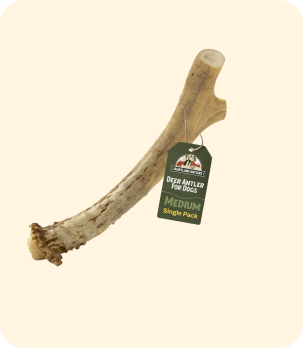
Deer antler is the hardest and most abrasive antler type. For a confirmed power chewer in the right size, deer antler offers the most aggressive mechanical cleaning. The density means it lasts longer and scrapes harder with each session. The trade-off: it demands correct sizing. Too small for your dog's jaw, and there's real risk of a tooth fracture. Size correctly, and deer antler is the top choice for dental benefit.
Whole elk antler sits in the middle. It's hard enough for sustained dental benefit, slightly more forgiving than deer, and lasts well for moderate-to-heavy chewers. Good all-around dental support option.
Split elk antler has the lowest hardness of the three, but it's worth highlighting for dental health specifically because of the marrow. Dogs chew split elk longer and more consistently than whole antler, because the exposed marrow gives them continued motivation. That sustained chewing - 20, 30, sometimes 45 minutes at a stretch - produces more total dental contact than a harder chew that the dog loses interest in. For dogs who are new to antlers or moderate chewers, split elk often delivers more real-world dental benefit than a deer antler the dog ignores after five minutes.
A simple guide:
- New to antlers / moderate chewer: Start with split elk
- Regular chewer / medium breed: Whole elk
- Power chewer / confirmed destroyer: Deer antler - sized correctly
See our split vs whole elk antler guide for the full breakdown.
How Often Should Your Dog Chew for Dental Benefits?
Frequency beats duration. A 15-minute chewing session five days a week does more for your dog's dental health than a 90-minute marathon once a week.
Here's why: plaque forms continuously. Within 24 hours of a cleaning, new biofilm begins building on tooth surfaces. The goal is to disrupt that cycle before it mineralizes. Regular, consistent chewing - ideally daily - keeps the plaque load low across the whole mouth.
Research on dental chews in veterinary literature found that 15 - 20 minutes of daily chewing produced measurable reductions in plaque and calculus over 29-day study periods. Intermittent chewing showed no significant benefit at the two-week mark.
Practically speaking:
- Daily chewing = the most dental benefit
- 4 - 5 times per week = still meaningful
- Once a week or less = minimal dental impact
You don't need to time sessions strictly. Most dogs with a good antler chew will settle in for 15 - 30 minutes naturally.
When Antler Chews Can Harm Teeth - The Honest Caveat
The tooth fracture risk with antlers is real. It's worth addressing directly instead of burying it in fine print.
Slab fractures - where a chunk of tooth breaks away - happen most often in two situations: the chew is too hard for the dog's chewing style, or the antler piece has worn down to a small nub that concentrates bite force in one spot.
Grade-A antler chews, properly sized, minimize this risk substantially. Here's what to watch for:
The thumbnail test. Press your thumbnail into the antler surface firmly. If it leaves no impression, the antler may be harder than your dog's enamel tolerates. This is more relevant with deer antler for dogs who are not power chewers.
Watch for worn-down pieces. As the antler shrinks to a size your dog could swallow or bite through fully, retire it. That's when fracture risk goes up.
Supervision. This applies to every chew, not just antlers. Watch the first few sessions with any new antler type to see how your dog engages with it. Aggressive chomping straight down is more risky than sustained side-grinding.
Dogs with existing dental disease. If your dog already has fractured teeth, significant tartar buildup, or gum disease, see a vet before introducing hard chews. Chewing on damaged teeth makes existing problems worse.
For dogs who are moderate chewers or new to antlers - split elk is the safest starting point. The marrow keeps them interested, the slightly lower hardness reduces fracture risk, and you can observe their chewing style before moving to whole or deer antler.
Antler Chews as Part of a Complete Dog Dental Care Routine
Antler chews work best as one piece of a broader routine, not the whole thing.
Here's what a practical dental care routine looks like for most dog owners:
Daily or near-daily antler chewing. This is your front-line plaque management. Grade-A, naturally shed, sized correctly. See our size guide if you're not sure where to start.
Brushing, if your dog tolerates it. Daily brushing is still the gold standard for plaque removal - it's the most thorough method available at home. Most dog owners don't do it consistently (veterinary compliance data puts the number below 2% of owners brushing daily), but even 3 - 4 times per week adds up. Use dog-specific toothpaste only - human toothpaste contains xylitol, which is toxic to dogs.
Water additives. Some are VOHC-approved and help maintain lower bacterial counts in the mouth between mechanical cleaning sessions. Not a replacement for chewing or brushing, but a reasonable addition.
Periodic dental chews with VOHC approval. For dogs who aren't power chewers, VOHC-approved dental sticks (Greenies Dental Chews, Virbac C.E.T. Chews) offer a proven plaque-reduction benefit in a softer format. These and antler chews aren't mutually exclusive - many owners use both.
Professional veterinary cleanings. Once a year is the standard recommendation for most dogs, though frequency varies by breed, age, and individual dental health. No home routine replaces professional cleaning entirely. It removes tartar, checks for disease under the gumline, and identifies problems before they become extractions. Think of everything above as extending the time between necessary cleanings - not eliminating them.
The goal of antler chewing in this context isn't to replace any of these. It's to give your dog a natural, mineral-rich, power-chewer-appropriate tool that fits into their existing routine, keeps plaque in check between brushings, and does something brushing alone can't: give a power chewer 20 - 30 minutes of deeply satisfying dental work every day.
Check out our detailed breakdown in 10 Ways Antler Chews Fight Tartar and Plaque in Dogs for more on the tartar-specific benefits.
Frequently Asked Questions
Do antler chews actually clean dog teeth?
Yes - antler chews clean teeth through mechanical abrasion. As your dog gnaws, the hard antler surface scrapes against the tooth enamel, physically removing soft plaque before it hardens into tartar. They work best as a preventative tool used consistently, not as a replacement for professional dental cleanings.
How often should my dog chew for dental benefits?
Daily or near-daily sessions of 15 - 20 minutes produce the most consistent dental benefit. Plaque begins forming again within 24 hours of cleaning, so sporadic chewing has limited impact. Consistency matters more than duration of any single session.
Can antler chews replace professional dental cleanings?
No. Antler chews are a preventative tool, not a treatment. They help remove soft plaque from tooth surfaces, but they cannot reach subgingival plaque (below the gumline) or remove established tartar. Dogs with existing dental disease need a professional veterinary cleaning first.
Which antler is best for dog dental health - deer or elk?
Deer antler is the hardest and most abrasive, making it the most effective for mechanical plaque removal - but it must be matched to the right dog (confirmed power chewers, correct size). Split elk antler is a strong second choice: the marrow encourages sustained chewing, which extends contact time against tooth surfaces, and it is slightly gentler, making it appropriate for a wider range of dogs.
What do vets say about antler chews and dog dental health?
The Veterinary Oral Health Council (VOHC) does not currently award its seal to antler chews, as they haven't undergone the council's formal clinical trials. Many vets flag the risk of tooth fractures from very hard chews - a real concern with wrong sizing or worn-down antler pieces. The honest answer: Grade-A antlers, sized correctly, used with supervision, are a legitimate dental support tool. The risk comes from going too hard, too small, or skipping supervision.
How do I know if an antler chew is too hard for my dog?
Use the thumbnail test: press your thumbnail firmly against the antler surface. If it leaves no mark, the antler may be too hard for your dog's chewing style. Also watch for: cracking sounds during chewing, reluctance to continue chewing, or any visible tooth damage. When in doubt, choose split elk over whole or deer antler.
Do antler chews help with bad dog breath?
Yes - bad breath in dogs is most often caused by the bacteria in plaque and tartar. As antler chews mechanically remove plaque, they also reduce the bacterial load responsible for odor. Consistent chewing typically leads to noticeably fresher breath within a few weeks.
Are antler chews safe for a dog's teeth?
Grade-A antler chews, sized correctly for your dog's weight, are safe for most healthy adult dogs. The risk of tooth fracture is real but manageable: choose split elk for moderate chewers, deer antler for confirmed power chewers with correct sizing, supervise every session, and retire the chew when it becomes small enough to swallow. Dogs with existing dental disease should see a vet before starting any hard chew. See our antler safety guide for the full picture.
Start the Routine
Eighty percent of dogs have dental disease by age three. Most of them aren't getting daily brushing, and professional cleanings are expensive. Antler chews aren't a magic fix - but for a power chewer, they're one of the best natural dental support tools available.
Grade-A, naturally shed, calcium and phosphorus for healthy teeth and bones, no splintering when sized right. Natural dental support with every chew.
Shop Antler Chews - Natural Dental Support with Every Chew
Not sure which antler is right for your dog? Use our size guide to find the right fit by weight and chewing style.
Internal links included: