The right antler for a Rottweiler is Grade A XL whole elk (80-120 lb, crusher jaw, sustained compression) lasting 3-6 weeks at regular sessions. Jaw mass and chew style, not weight alone, determine fit for this breed.

Quick Answer: Adult Rottweilers (80 lb and above) need XL whole elk, Grade A. The breed applies sustained, even compression through a wide jaw that concentrates force differently than a same-weight retriever or pointer. Weight-based sizing places a 100 lb Rottweiler in the large category; jaw mass and chew style place it firmly in XL. Grade A elk runs 30-40% denser than deer and 15-25% heavier per linear inch than Grade B, absorbing the compressive load rather than cracking under it. Dogs over 100 lb benefit from keeping two XL pieces in rotation. Heartland Antlers Grade A XL whole elk is the baseline for this breed, not an upgrade.
Fitting the right antler for a Rottweiler comes down to one decision: XL, not large. Most Rottweiler owners who contact us after a chew failed describe the same situation. We've seen this pattern so consistently, owner orders large based on the weight chart, piece fails in one or two sessions, owner moves to XL Grade A elk and the same dog gets four to ten weeks out of the piece, that we now recommend XL as the automatic starting point for this breed. They checked the sizing chart. Their dog was 95 or 100 pounds, so they ordered large. The antler arrived, the dog worked it for a session or two, and something cracked or splintered well before it should have. The chart said large was correct. The chart was wrong.
For an adult Rottweiler 80 lb and above, the correct antler is XL whole elk, Grade A. Weight-based sizing works reasonably well for a lot of breeds. Rottweilers expose its limits. This breed carries a wide, powerful jaw and applies force in a way that a 100-pound retriever, a 100-pound Weimaraner, or even a 100-pound Cane Corso does not. Body weight is one input. Jaw mass and the force that mass delivers are the inputs the chart ignores.
Customers with Rottweilers consistently describe ordering large, watching it hold for one or two sessions, and seeing it fail before it should. After working with Rottweiler owners, we've found the jaw mass is the variable the weight chart ignores. A Rottweiler's wide, heavy skull concentrates sustained compression in a way that defeats large elk and holds only on XL. XL whole elk Grade A is the correct baseline for this breed.
Rottweiler at a glance: 80-130 lb working guard breed. Wide, heavy jaw with sustained compression chew style: not explosive, but relentless. AKC working group. Bred for herding, guarding, and draft work. The jaw mass-to-body-weight ratio exceeds most breeds at equivalent size. Requires Grade A XL whole elk antler.
The Rottweiler Chew Profile: Mass Behind the Bite
A Grade A XL whole elk antler typically lasts a standard adult Rottweiler (80-100 lb) 4 to 10 weeks of regular chewing, compared to 1 to 3 weeks for a large Grade A piece on the same dog -- the jaw mass difference, not the dog's weight, determines wear rate.
A Rottweiler does not chew the way most dogs chew. There is no flicking, no rapid gnawing, no testing for a weak point to exploit. A Rottweiler sets the piece, locks the jaw, and applies sustained, even compression. The force builds slowly and holds. That is what makes the breed one of the most demanding testers of any chew material.
Bite force in Rottweilers ranks among the highest of any domestic breed. But raw bite force alone does not tell the full story. The jaw is wide, which distributes the load across a broad surface area. The chew style is patient. A Rottweiler will work one position on an antler for a long time, concentrating force on the same spot session after session.
The result is a grinding, compressive load that is harder on chew material than an explosive bite from a smaller-jawed, higher-energy breed. It is slow. It is thorough. It does not stop. A Grade A XL whole elk antler typically lasts a standard adult Rottweiler (80-100 lb) 4 to 10 weeks of regular chewing. The same dog works through a large Grade A piece in 1 to 3 weeks, because jaw mass, not body weight, is the relevant variable.
Why XL Whole Elk Is the Starting Point for Rottweilers, Not an Upgrade
A 100-pound Rottweiler is not a 100-pound dog in chew terms. That is the core of the sizing problem.
The breed's jaw structure adds mechanical advantage that body weight does not reflect. More jaw mass means more force transmitted per square inch of contact. A large antler rated for a 75-100 pound dog is sized for a dog that produces a certain range of bite pressure. A Rottweiler at the same weight produces more. The math changes.
We see this consistently. Owners size by weight, land on large, and the antler fails early. When they move to XL whole elk, the same dog works the piece down gradually over weeks or months the way it should. Nothing cracks. Nothing splinters. The chew does its job.
XL whole elk is the starting point for adult Rottweilers at 80 pounds and above. Not an upgrade for the biggest dogs. The baseline for the breed.
Grade A is also non-negotiable here. A Rottweiler's steady, concentrated force will find and exploit any weakness in the cortex. Grade B and C antler carries more internal variation, softer patches, and inconsistencies that hold up fine under lighter chewing pressure. Under a Rottweiler's sustained load, those inconsistencies fail. Grade A means the densest, most structurally consistent pieces in the shed. That consistency is what allows the antler to absorb the force over time rather than crack under it.
Elk antler runs 30-40% denser than deer at equivalent piece size and Grade A pieces run 15-25% heavier per linear inch than Grade B. Both of those numbers matter for this jaw type.
Antler for Rottweilers: Fit by Size and Life Stage
| Dog | Size | Cut | Species | Grade | Notes |
|---|---|---|---|---|---|
| Adult Rottweiler 80-100 lb | XL | Whole | Elk | A | Baseline for breed |
| Adult Rottweiler over 100 lb | XL | Whole | Elk | A | Two pieces, rotate |
| Rottweiler puppy under 12 months | Large | Split | Elk | A | Supervised; jaw developing |
| Senior Rottweiler | Large | Split | Elk | A | Reduces pressure on worn teeth |
Longevity comparison: XL whole elk Grade A lasts 4-10 weeks vs. large Grade A at 1-3 weeks on the same adult Rottweiler.
What Size Elk Antler Does a Rottweiler Need
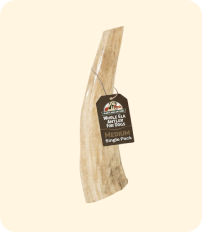
XL Whole Elk, Grade A: The standard fit for most adult Rottweilers. Dense cortex, substantial mass, the right resistance for a patient, powerful jaw. This is where most owners start and stay.
Two-Piece Rotation (XL Whole Elk, Grade A): For dogs over 100 pounds, or any Rottweiler with a particularly active chew habit, rotating two pieces across sessions keeps both pieces fresh and extends the life of each. Same sizing, two pieces in the house.
Split Elk (Grade A): For puppies under 12 months. Rottweilers are a giant breed, and their jaw development is slower than their body weight suggests. A split piece exposes the marrow, reduces the resistance level, and gives the puppy access to the antler without applying the kind of sustained force their jaw is not yet ready to generate safely. Senior dogs do better on split as well.
Whole Elk (Large, Grade A): Not recommended for adult Rottweilers. Listed here because we get asked. The jaw mass and patient chew style will work through a large piece faster than the sizing suggests and increases the risk of early failure.
Antler for Rottweiler: Elk vs. Deer Is Not a Close Call
Grade A elk antler runs 30-40% denser than deer at equivalent piece size, and that density gap is a structural safety requirement under a Rottweiler's sustained compression load, not a longevity preference. A Rottweiler applies patient, even jaw pressure that accumulates over sessions, deer antler does not hold this load over time regardless of grade.
Elk vs. Deer Antler for a Rottweiler
Elk only for adult Rottweilers. Full stop.
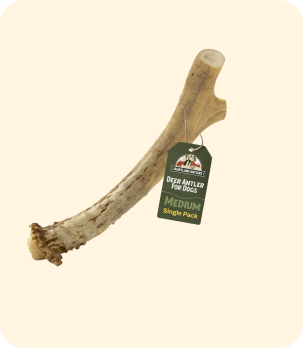
Deer antler is smaller in diameter, lighter in overall mass, and lower in cortex density than elk. Grade A deer antler is excellent for medium breeds and some large breeds with moderate chew pressure. Under the sustained load of a Rottweiler's jaw, even Grade A deer will not hold up over time the way elk does. The mass-behind-the-bite principle applies here too. The chew material needs to match the mechanical reality of the jaw working it.
Deer antler can work for Rottweiler puppies in certain cases, but we default to split elk because the sizing is more predictable as the dog grows.
How to Read the First Session
Put the antler down in a spot where you can watch. Let the dog engage for 10-15 minutes.
A good fit looks like this: the dog picks it up, sets it, and works one section with steady interest. The surface shows light scoring or scuffing after the session. The dog stays engaged without losing interest quickly, but is not frantic or frustrated.
Signs the fit is wrong: the dog ignores it entirely (undersized pieces sometimes get dismissed as not worth the effort), or the dog works it aggressively for a few minutes and then loses interest because the piece is too small to grip comfortably. You might also see the dog trying to swallow sections rather than working them. That is a size problem, not a behavior problem.
If you ordered XL and the dog is treating it like a pebble, the dog may be on the larger, more powerful end of the breed spectrum. Contact us. We have seen this with particularly large male Rottweilers and know how to fit them.
The Rotation Protocol for Large Rottweilers
Dogs over 100 pounds benefit from keeping two XL pieces in the house. The logic is simple. A Rottweiler applies steady force every session. That means the contact point on the antler accumulates wear consistently. Alternating between two pieces gives each one time to rest between sessions, which extends the life of both.
Rotate on a session-by-session basis. One piece out today, the other piece out tomorrow. Keep both in a dry spot between sessions. This approach also means you always have a piece available if one gets worked down to the safety size limit earlier than expected.
The rotation protocol is the same logic we use for Cane Corsos and American Bullies. High bite mass plus a patient chew style means one piece takes a beating faster than it would for other breeds at the same weight.
Find the Right Fit for a Rottweiler
Start with XL whole elk, Grade A, for any adult Rottweiler 80 pounds and up. If your dog is over 100 pounds, order two. If you have a puppy, contact us before ordering so we can confirm the right split configuration for where they are in development.
Read these next:
- What Grade A Means for a Power Chewer
- How We Grade Antlers for Aggressive Chewers
- Find the Right Fit by Breed and Jaw Style
- Elk vs. Deer Antler: Which Holds Up to a Crushing Jaw
- Antler for a German Shepherd
- Antler for a Pit Bull: Sizing a Crusher Jaw -- similar mass-behind-the-bite principle in a medium-weight frame
Shop XL Grade A elk antler for Rottweilers -- Shop Now
Frequently Asked Questions
What size antler for a Rottweiler?
XL whole elk, Grade A, for most adult Rottweilers at 80 pounds and above. The breed's jaw mass and chew force place it above what standard large sizing is designed for, regardless of body weight. Dogs over 100 pounds often benefit from keeping two pieces and rotating them across sessions.
Are antlers safe for Rottweilers?
Yes, with correct sizing and Grade A material. The safety case for antler over most other chews rests on the fact that elk antler does not splinter into sharp shards the way bone or rawhide does. The key for Rottweilers is proper sizing. A piece that is too small becomes a swallowing risk. Grade A antler has the cortex density to absorb sustained chewing pressure without cracking unexpectedly. B and C grade material carries a higher risk of failure under the steady load a Rottweiler applies.
Elk or deer antler for a Rottweiler?
Elk for adult Rottweilers. Deer antler, even Grade A, does not carry enough mass or cortex density to hold up under the sustained jaw pressure of an adult Rottweiler over time. The diameter is smaller and the overall structure is lighter. Elk provides the right resistance level and the physical mass to give the dog a proper, lasting chew.
How long does an antler last for a Rottweiler?
With correct sizing (XL whole elk, Grade A), most adult Rottweilers (80-100 lb) work a piece down over 4 to 10 weeks depending on how frequently the dog chews. Dogs over 100 pounds that chew daily are at the high end of consumption. A two-piece rotation extends the life of each piece and means you always have one available.
Do Rottweilers need Grade A antler specifically?
Yes. This matters more for Rottweilers than for most breeds. The sustained, compressive force a Rottweiler applies will find structural inconsistencies in lower-grade antler and exploit them over time. Grade A pieces are selected for cortex density and structural integrity. That is not a marketing distinction for this breed. It is a functional one.
Frequently Asked Questions
What size antler for a Rottweiler?
XL whole elk, Grade A, for most adult Rottweilers at 80 pounds and above. The breed's jaw mass and chew force place it above what standard large sizing is designed for. Dogs over 100 pounds benefit from keeping two pieces and rotating them across sessions.
Are antlers safe for Rottweilers?
Yes, with correct sizing and Grade A material. Elk antler does not splinter into sharp shards the way bone or rawhide does. Grade A antler has the cortex density to absorb sustained chewing pressure without cracking. The key for Rottweilers is proper sizing and Grade A grade selection.
Elk or deer antler for a Rottweiler?
Elk for adult Rottweilers. Deer antler does not carry enough mass or cortex density to hold up under the sustained jaw pressure of an adult Rottweiler. Elk provides the right resistance level and physical mass for a proper, lasting chew.
How long does an antler last for a Rottweiler?
With correct sizing (XL whole elk, Grade A), most adult Rottweilers (80-100 lb) work a piece down over 4 to 10 weeks depending on chew frequency and jaw strength. A two-piece rotation for dogs over 100 pounds extends the life of each piece.
Do Rottweilers need Grade A antler specifically?
Yes. The sustained, compressive force a Rottweiler applies will find structural inconsistencies in lower-grade antler over time. Grade A pieces are selected for cortex density and structural integrity, which is a functional requirement for this breed, not a marketing distinction.