
An Alaskan Malamute needs a chew decision based on its own teeth, behavior and the exact item. Its substantial build does not create an automatic XL whole-elk prescription. A product that lasts longer is not necessarily safer for teeth.
Do not copy a Husky's product choice, but do not replace that shortcut with a different breed-wide rule. Assess each dog, follow current directions and review the material itself before comparing sizes.
Use breed context without inventing bite mechanics
The AKC describes the Alaskan Malamute as a strong working dog of spitz type, with substantial bone and a thick coat. Those traits explain its familiar appearance. They do not provide a measured comparison of chewing force with a Husky, Rottweiler or any other dog.
Your Malamute's behavior is more useful than an assumed “freight-dog jaw” category. Observe whether it licks, bites forcefully, works one area, tries to break off pieces or attempts to swallow the end. Calm, noisy, short and long sessions all need attention; none is a safety certificate.
AAHA warns that antlers can fracture teeth. Strength does not protect a tooth against a hard surface. If the dog bears down hard or has a history of dental injury or swallowing objects, discuss alternatives with your veterinarian before buying another hard chew.
Do not treat high activity needs as a demand for high resistance. Walks, suitable play, training, sniffing and rest have different roles. One object does not have to provide all the work or enrichment in a Malamute's day.

Compare each dog and each actual piece
A Malamute and a Husky are different breeds, but neither name supplies an exact chew size. Two dogs in the same household can also differ in oral health, behavior and ability to handle a particular shape. Keep a separate assessment for each dog.
Read the current product size range and use directions. Ask about the natural piece's length, width and shape if the listing does not answer your questions. Do not override the directions with a breed-based rule to go one size up, or assume that the largest available option resolves all concerns.
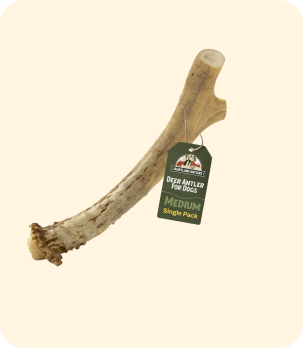
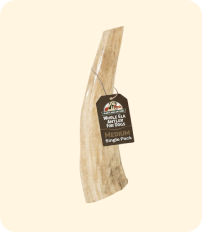
Heartland lists whole deer, whole elk and split elk. These labels describe species and cut. A split face exposes the interior and still leaves hard material. Neither whole elk nor a grade label guarantees a piece will remain intact or prevent a tooth fracture.
Be cautious with fixed density percentages and promises that deer lasts days while elk lasts weeks. No breed-specific trial data is offered here to support those comparisons. Ask the seller what its grading terms mean, then keep that commercial description separate from the dental decision.
For puppies, seek suitable materials for developing teeth. For older dogs, use current oral health and comfort. Do not switch a dog with dental wear to split elk as a substitute for an assessment. The senior guide explains the questions to raise.

Manage access without testing the dog's tolerance
If an item is offered after review, supervise every use. Keep the dog in a place where you can observe its actions and changes in the object. Do not rely only on the first twenty minutes, and do not assume that an established routine makes unattended access suitable.
Allow the dog to stop. Interest is not a fit measurement, and walking away is not a command to provide a denser piece. New reluctance to pick up food or toys can be a health signal. Arrange a veterinary assessment if the change persists or comes with other signs.
In multi-dog homes, provide enough secure separation to prevent competition over valued items. Do not infer guarding from the breed, or wait for conflict before planning collection. If a dog freezes, growls or resists approach, keep others away and get qualified behavior help rather than reaching into its mouth.
End the activity for forceful biting, attempts to swallow, loose fragments or discomfort. Inspect before and during use and after collection. Store the piece out of pets' reach between supervised sessions so another dog cannot find it.
A suitable flexible toy or measured-meal activity can be considered with the veterinary team. Follow each item's directions and check for damage. Alternatives also require selection and observation; the aim is to fit the activity to the dog.

Let damage trigger a new decision
A chew that cracks or develops deep damage should be removed. Do not interpret that result only as a size failure that needs an immediate upgrade. A dog that repeatedly damages hard items may need a different material or activity.
Retire a piece for sharp changes, loose material, cracks or a shape that could be swallowed. Do not wait until it reaches molar width, or until a promised two-to-four-week working life ends. Condition and behavior matter at each use.
Do not heat, boil, sand or reshape a damaged antler. Follow current cleaning and storage instructions for an intact item. A rest period or rotation does not restore its original condition, so every piece must pass its own inspection.
If you suspect a broken tooth, stop hard chews and contact your veterinarian. Cornell's dental guidance explains why tooth damage needs attention even when the dog continues to eat. Suspected ingestion needs prompt advice; choking or trouble breathing needs urgent care.
For value, consider suitable supervised use rather than a breed-wide duration promise. An item that must be removed early has reached the end of its use for that dog, regardless of its price or how much material remains.

Frequently asked questions
Does every Malamute need XL whole elk?
No. A breed label does not establish the exact piece or its medical suitability.
Can I use the same size as my Husky?
Assess each dog separately and follow the actual product's directions. Similar appearance is not enough information.
Is rapid wear a reason to buy harder antler?
It is a reason to stop and reassess first. A more resistant object can leave the tooth-fracture risk in place.
Does Grade A mean it cannot splinter?
No such guarantee is established. Ask about the seller's definition and inspect the individual piece.
Sources and product help
Read the Husky guide, Akita guide and size guide. For current dimensions and directions, view Heartland's catalog or contact Heartland.