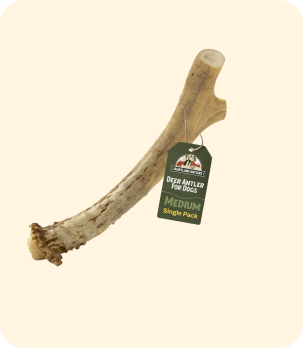
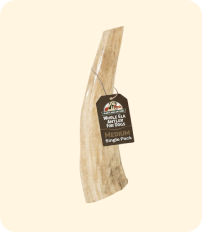

Antlers are hard bone. Rubber toys are manufactured products whose flexibility and purpose vary. Start by identifying the activity you want to offer, then compare the actual items. A food puzzle, a fetch toy, and a chew toy can have different instructions even when all three contain rubber.
Neither the word “natural” nor a claim of toughness is enough to make the decision. Your dog's teeth and behavior remain part of it.
1. Compare the actual purpose
An antler is a hard chewing object. A rubber item may be designed for chewing, holding food, fetching, or interactive play. Read the intended use before treating these items as substitutes.
| Question | Antler chew | Rubber product |
|---|---|---|
| What is the material? | Natural hard bone | A manufactured rubber formulation |
| Does it flex? | It remains rigid in normal handling | Depends on the specific design |
| Can it hold food? | Not its product purpose | Some designs can, if their instructions allow |
| What needs inspection? | Size loss, cracks, sharp edges, loose material | Tears, missing parts, exposed components |
| What determines suitability? | Dental condition, behavior, fit, condition | Intended use, design, fit, condition, behavior |
The comparison is not a ranking of which object lasts longest. It helps identify which product serves the activity you want. If the dog needs a quiet food activity, for example, evaluate a suitable food-dispensing design rather than simply searching for the hardest material.

2. Flexibility is a property to check
Rubber products differ. A soft, flexible toy and a dense, rigid toy can both be sold in the same aisle. Check the manufacturer's description and handle the actual item when possible. A color name or “power” label is not a measured hardness specification.
AAHA recommends choosing appropriate toys and cautions about excessively hard chewing objects. Its guidance also makes supervision and the dog's way of using the item part of the choice. Source: AAHA, 2024.
If your dog has a history of tooth damage or forceful back-tooth biting, discuss that history before choosing another hard object. Buying a larger antler does not resolve the hardness issue. For the current Heartland exclusions, read the antler suitability guide.

3. Inspect each material for its own failure signs
For an antler, check for loose fragments, a sharp edge, a crack, or a size that no longer suits the dog. For a rubber toy, look for tears, missing sections, or exposed internal parts. Follow the product's removal guidance and stop use when its condition is uncertain.
Texas A&M's veterinary guidance warns that rubber or nylon toys can become dangerous when a dog tears off and swallows pieces. It also describes fractured teeth associated with antlers. Those are different failure modes, which is why one general “durable” label cannot settle the comparison. Source: Texas A&M Veterinary Medicine, 2019.
Keep a damaged item out of reach. A photograph can help a seller review a product concern, but a suspected swallowed piece or injury belongs with a veterinarian. Do not put the item back in use simply because the dog still wants it.

4. Run a simple observation check
Introduce an appropriate item while you can watch. Follow its instructions. Notice what the dog actually does: noses it, licks it, carries it, chews gently, or tries to break off pieces. Record what you observe instead of assigning a fixed chewing-style label from the dog's breed.
For a food toy, use food that already fits the dog's dietary plan and account for it in the daily portion. Keep cleaning instructions with the product. A toy intended for interactive use should not become an unsupervised item merely because it is made from rubber.
If the dog does not engage, you can change the activity rather than escalating to a harder object. Try a simple scent search, an easy puzzle, or a short reward-based training session. Our five home enrichment activities provide starting points.
If you are comparing an antler with a rigid nylon item instead, use the separate nylon comparison. Keep rubber, nylon, and antler material descriptions distinct.

Frequently asked questions
Are all rubber dog toys flexible?
No. The material and design vary. Check the specific product and its intended use rather than relying on the category name.
Is an antler a substitute for a food puzzle?
They serve different purposes. Choose a product designed for the activity, and follow its instructions.
Can a rubber toy cause a swallowing problem?
Yes. A dog can tear off and swallow parts of a toy. Inspect the item, supervise its use, and remove damaged products.
Which one is best for every strong chewer?
There is no universal choice established here. Dental health, actual behavior, product design, and condition must guide the decision.
Image note: The images are AI-generated illustrations. They are not product tests, material measurements, or endorsements of a particular rubber-toy brand.