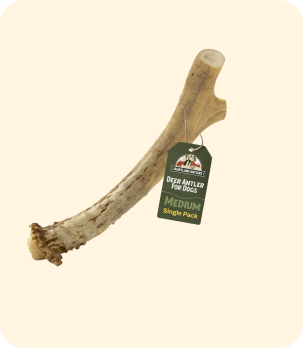
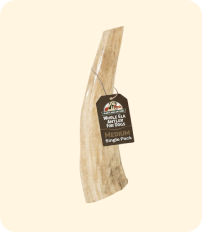
The right antler for a Siberian Husky is large whole elk, Grade A: the episodic chew style this breed uses across 4-8 weeks of intermittent sessions requires elk density to hold surface texture between uses, and Grade A ensures nothing degrades between the sessions that bring the dog back.

Most Husky owners have the same two stories. The first: the chew that didn't last the afternoon. Destroyed, scattered, retired by Tuesday. The second, harder to explain: the chew the dog was into for exactly one day, then ignored completely.
Neither of those is a breed problem. They are a fit problem. And for a Husky, the fit question is different from most dogs.
Quick Answer: For a standard adult Siberian Husky (45-60 lb, medium-strength scissor bite, episodic chew style), the correct antler for a Siberian Husky is large whole elk, Grade A. The goal is not a chew your dog cannot destroy. It is a chew your dog keeps coming back to. Elk density holds its surface texture between sessions, which is the key variable for a dog that chews in bursts across days and weeks. A Grade A large whole elk antler typically lasts an adult Husky 4-8 weeks. Sizing down to split or deer produces rapid scent loss between sessions, which is the most common reason Huskies abandon antlers after day one.
Antler for Siberian Husky: Why Episodic Style Changes the Fit
Customers with Huskies tell us the same story: one good day, then ignored. We've found that the problem is almost never the dog and almost always the grade or cut failing between sessions. A Grade A whole elk antler holds surface texture across a week of intermittent use. Lower grades and split cuts do not.
The Husky Chew Profile: Episodic Style, Medium Bite, Return-Dependent Engagement
A Siberian Husky (35-60 lb, medium-strength scissor bite) is not a power chewer. That is the first thing most sizing guides get wrong.
The jaw is capable but not relentless in the way a Malinois or Pit Bull is. The Husky was built for sled work, not for crushing. What matters for fit is not peak bite force, but the episodic chew pattern that defines how this breed actually uses a chew over time.
A Husky works the chew in bursts. Chews for a stretch, then stops. Carries it across the room. Mouths it. Sets it down. Comes back an hour later, or the next morning. A typical Husky chew session runs 10-20 minutes of active contact, followed by 6-24 hours of no contact before the dog returns. Over a week, total active chew time rarely exceeds 90-120 minutes, which is why a Grade A whole elk antler lasts this breed 4-8 weeks rather than the 3-6 weeks typical for a sustained-chew working breed at the same weight. This is normal Husky behavior, not disinterest. A chew that loses its texture between sessions, or softens, or stops offering anything when the dog returns, stops being worth returning to. Huskies abandon chews that do not reward coming back.
The right chew for a Husky holds its shape between sessions. Surface intact. Marrow structure preserved. Something still there to work on when the dog circles back.
What We Ship for Huskies
These configurations match the Husky's episodic chew style, not the weight chart alone.
| Dog | Weight | Configuration | Notes |
|---|---|---|---|
| Standard adult Husky | 45-60 lb | Large whole elk, Grade A | Holds surface between episodic sessions |
| Lighter adult Husky | 35-45 lb | Medium or large whole elk, Grade A | Start large; drop to medium if engagement is low |
| Husky new to antler | Any adult | Large split deer, Grade A | Entry point; transitions to whole elk after 1-2 orders |
| Senior Husky or worn teeth | Any | Split elk, Grade A | Softer access without full cortex demand |
Standard adult Husky (45-60 lb): Large elk, whole-cut, Grade A. The episodic nature means the chew needs to survive many partial sessions across days and weeks, not one continuous one. Elk density holds up to that pattern. Whole-cut maintains surface texture between sessions in a way split does not for an adult dog with antler experience.
Lighter adult Husky (35-45 lb): Medium or large elk, whole-cut, Grade A. Drive and jaw engagement vary in this range. Start with large. Watch the first three sessions. If the dog is barely touching it, medium may be a better engagement match.
Husky new to antler: Large split deer. A dog that has never worked an antler surface may not engage a whole-cut elk right away. The marrow is visible, accessible, and rewarding from session one. Split deer is the entry point.
Senior Husky or dog with worn teeth: Split elk. The softer access keeps the marrow reward available without demanding hard-surface chew work from a dog whose teeth don't support it. See Antlers for Senior Dogs for the full senior configuration guide.
The Between-Session Problem: Why Elk Holds When Other Chews Don't
Most chew guides measure "how long it lasts" as a single-session metric. For a Husky, that measurement is wrong.
A bully stick that has been mouthed and set down twice has lost most of what made it interesting. The surface is soft. The smell has changed. The dog picks it up, confirms there's nothing left to discover, and walks away. You're back to shopping.
A Grade A elk antler that has been worked for 20 minutes still has hours of surface left. The density does not change between sessions. A whole-cut elk antler left on the floor for three days looks almost exactly as it did when the dog first got it, minus the small amount of surface the dog has worked down.
This is what makes elk the right species for most adult Huskies, and whole over split for dogs that have had antler before. The density holds. The surface rewards returning. When your dog comes back to it on day 4, there is still something there.
Softer chews, lower-grade antler, and split cuts on dogs that have already learned to work the surface all fail this test faster. They lose texture and interest between sessions at the exact rate a Husky's episodic style exposes.
Elk vs. Deer for a Husky: Entry vs. Sustained Use
Adults with antler experience: elk, whole, Grade A.
First-time antler dogs: split deer. It gives the marrow reward immediately, which is what engages a dog that has not yet learned to work the surface. Most Huskies move to elk after one or two purchases.
The between-session argument closes this call. Deer antler is less dense than elk. For a dog that picks it up and puts it down repeatedly across a week, deer loses texture and surface faster. An adult Husky that has had deer and elk will typically show more sustained return behavior with elk. That is the data point that matters.
Split deer for entry. Elk for everything after.
How to Read the First Session
The first session is diagnostic. Give the dog 20 minutes and watch.
What good looks like: The dog engages, works it in bursts, sets it down, comes back. Maybe carries it around. There is visible surface wear by the end of the session. The antler is structurally the same shape it started.
What means the fit is wrong: The dog worked through significant material in one session, the antler has deep gouge marks or changed shape noticeably, or the dog shows no interest at all. Material loss in one session usually means the grade or cut was wrong. No interest from a first-timer usually means try split.
What to do on session 2 and 3: Does the dog return to it? This is the Husky-specific check. A dog that engaged session one but ignores it on day 2 is telling you the surface has stopped rewarding return. Grade A whole elk should not reach this point in two sessions.
The Chew Graveyard Reality
Husky owners know the graveyard. Bully sticks, dental chews, rope toys, rubber toys, rawhide alternatives. Some lasted a session. Some the dog ignored after day one. The pile adds up.
Three bully sticks a week is not unusual for a heavy chewer. That's over 150 sticks a year. A Grade A large elk antler that gets returned to for six weeks changes that math completely. One chew that holds up is not the same budget as twelve chews that don't.
The Husky-specific wrinkle: a chew the dog ignores after day one is not cheaper than a chew the dog destroyed. Both end up in the graveyard. The goal is a chew that earns returns.
Find the Right Fit
For a standard adult Husky (45-60 lb): large whole elk, Grade A.
For a lighter adult (35-45 lb): start with large, drop to medium if engagement is low.
For a Husky new to antler: large split deer, then transition to whole elk.
For seniors or dogs with worn teeth: split elk.
Related reading: - Find the Right Fit by Breed and Jaw Style for the full sizing guide - Elk vs. Deer Antler: Which Is Right for a Soft-Jawed Retriever for the species comparison - Antlers for Senior Dogs: When to Switch to Split if your Husky is older or has reduced jaw strength - The Right Antler for an Alaskan Malamute if you have a Malamute in the house - The Right Antler for a Samoyed for another Arctic spitz breed fit guide - The Right Antler for a Shiba Inu for the compact spitz breed with a different jaw geometry
Shop Grade A elk antler for Huskies
Frequently Asked Questions
What size antler for a Siberian Husky?
Large whole elk, Grade A, for a standard adult Husky (45-60 lb). For a lighter adult (35-45 lb): medium or large elk depending on drive. For a Husky new to antler: large split deer. The episodic chew style means the antler needs to hold up across many short sessions over days and weeks, not survive one long one.
Are antlers safe for Huskies?
Yes, with the right fit and grade. The safety concerns with antlers (fracture points and splintering) come from undersized chews and low-grade material. For a Husky, Grade A elk whole-cut in the right size addresses both. The medium-strength Husky jaw does not generate the kind of force that stresses correct-grade antler. Retire the chew when it's down to molar width.
Elk or deer antler for a Husky?
Elk for adults that have had antler before. Split deer for first-timers. Elk holds its surface texture between sessions better than deer, which matters for a dog that chews episodically across days. Deer split is a good starting point but most adult Huskies move to elk after one or two orders.
Why does my Husky ignore the antler after the first day?
The chew stopped rewarding return. Either the grade was low enough that the surface changed noticeably after the first session, or the cut gave up its reward too quickly. Try Grade A whole elk. The density holds surface texture between sessions in a way lower-grade or split antler does not.
How long does an antler last for a Husky?
A Grade A large whole elk antler typically lasts a Husky four to eight weeks, sometimes longer. The episodic chew style extends duration compared to a sustained chewer of the same weight, because total chew time per day is lower. If the antler is gone in a week, verify Grade A and consider sizing up. If the dog ignores it, start with split deer.
Frequently Asked Questions
What size antler for a Siberian Husky?
Large whole elk, Grade A, for a standard adult Husky (45-60 lb). For a lighter adult (35-45 lb): medium or large elk depending on drive. For a Husky new to antler: large split deer. The episodic chew style means the antler needs to hold up across many short sessions over days and weeks, not survive one long one.
Are antlers safe for Huskies?
Yes, with the right fit and grade. The safety concerns with antlers -- fracture points and splintering -- come from undersized chews and low-grade material. For a Husky, Grade A elk whole-cut in the right size addresses both. The medium-strength Husky jaw does not generate the kind of force that stresses correct-grade antler. Retire the chew when it's down to molar width.
Elk or deer antler for a Husky?
Elk for adults that have had antler before. Split deer for first-timers. Elk holds its surface texture between sessions better than deer, which matters for a dog that chews episodically across days. Deer split is a good starting point but most adult Huskies move to elk after one or two orders.
Why does my Husky ignore the antler after the first day?
The chew stopped rewarding return. Either the grade was low enough that the surface changed noticeably after the first session, or the cut gave up its reward too quickly. Try Grade A whole elk. The density holds surface texture between sessions in a way lower-grade or split antler does not.
How long does an antler last for a Husky?
A Grade A large whole elk antler typically lasts a Husky four to eight weeks, sometimes longer. The episodic chew style extends duration compared to a sustained chewer of the same weight. If the antler is gone in a week, verify Grade A and consider sizing up. If the dog ignores it, start with split deer.