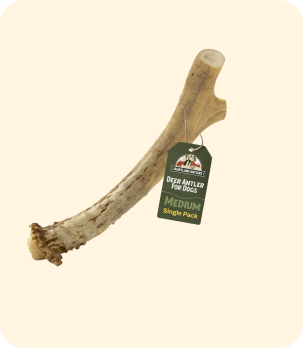
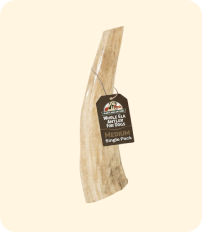

Quick answer: Choose any chew for a Dachshund by the individual dog's mouth, current size, behavior and care plan. A long muzzle does not prove that a dog needs a split antler, and a split cut does not make hard material tooth-safe. Heartland sells whole deer, whole elk and split elk. It does not offer the split-deer or mini split-deer options sometimes described in generic breed advice.
Standard and miniature labels help describe a Dachshund, but they do not decide whether antler is appropriate. This guide separates product fit, dental risk and activity planning so each question gets its own check.
Look beyond the standard or miniature label
Use your dog's measured weight instead of an assumed breed average. Check the actual length and thickness of a product and its current directions. A size label such as small is a seller's category, not a universal measurement across brands.
Observe how your dog handles suitable toys. Gentle exploration, repeated crushing and attempts to swallow an object are different behaviors. A narrow muzzle does not make every cylindrical object impossible to grip. We have no measured evidence that all Dachshunds require a flat antler face or apply a predictable amount of bite force.
If an item is awkward, that does not mean you should automatically choose a smaller piece. Reducing size can introduce a swallowing concern. Pause and review the product rather than forcing a fit. Refusal or loss of interest can be a preference; a new change accompanied by discomfort needs a health check.

Separate cut choice from dental suitability
Splitting an antler lengthwise reveals the inner structure. Hard material remains. A whole antler retains more outer surface, but that distinction does not establish which cut is safe for a particular tooth. “Grade A” describes product selection, not a clinical guarantee against fractures.
AAHA warns that hard chews can damage teeth. Supervision helps an owner notice a problem; it does not prevent every injury. Puppies, seniors and dogs with dental treatment need individual guidance, not a default recommendation for split antler.
| Question | Useful information |
|---|---|
| What is the material? | Confirm species and cut. Whole deer, whole elk and split elk are the Heartland range. |
| What are the dimensions? | Check the actual product and weight guidance. Do not transfer size names between sellers. |
| What is the dental history? | Account for pain, fractures, loose teeth and recent treatment with the veterinarian. |
| How does the dog use it? | Review forceful biting, loose pieces, attempts to swallow and signs of discomfort. |
We cannot support a fixed percentage difference in deer and elk density or a claim that one species is universally gentle enough for Dachshunds. A harder object is not automatically the solution when a dog destroys another chew.

Keep recovery activities within the care plan
A Dachshund on restricted activity needs the plan set by its treating clinician. VCA's discussion of cervical disc disease explains that recovery can require strict rest and clinician-directed changes in activity. That is not a recommendation for antlers as a recovery tool.
Ask which food activities, toys, handling and positions are allowed for your dog. An activity that looks quiet can still involve pulling, twisting or forceful effort. Do not assume that a lying-down chew session is suitable because the dog is staying in one place.
Describe the proposed activity clearly: the object, the surface, whether the dog must reach for it, and how you will remove it. If the care team approves an alternative, use it as directed. Avoid inventing a twenty-minute target or extending an activity because it appears to keep the dog occupied.
New pain, weakness or a change in movement needs prompt veterinary advice. A chew should not be used to distract a dog from a symptom that needs assessment. This section concerns questions to ask, not a treatment or rehabilitation protocol.

Check condition and offer other activities
If an antler is used, supervise all sessions and inspect it before, during and after access. Stop for cracks, sharp edges, loose pieces, an unsafe remaining size or changes to forceful biting. Do not blame every fracture on a low grade; any damaged piece should be removed.
Retirement is based on condition, not an expected three-to-five-week lifespan. Do not pass a small remainder to another dog to get more value from it. Keep used items clean and dry according to their care directions, and store them out of reach.
For a healthy dog without activity restrictions, options may include gentle scent searches, training tasks and suitable food puzzles. Count food used in games within the daily allowance. Let the dog leave an activity. A Dachshund that prefers a different task does not need to be persuaded to chew antler.
If you suspect a swallowed piece, contact your veterinarian with the product details. Choking or breathing difficulty requires urgent care. Suspected tooth damage also needs assessment even if the dog continues to eat.

Frequently asked questions
Does a Dachshund need split deer?
There is no universal breed rule. Heartland does not sell split deer. A split elk option still contains hard material and needs the same individual suitability questions.
Can a miniature use the smallest available piece?
Do not assume that. Check the product's current guidance and actual dimensions, and consider swallowing risk and dental suitability.
Can an antler help during back recovery?
Ask the treating clinician before adding it. Quiet appearance or a long claimed lifespan does not establish that an activity fits the recovery plan.
When should a Dachshund stop using a piece?
Stop for damage, loose parts, sharp edges, unsafe size, forceful biting or discomfort. Do not wait for a planned number of days.
See the product size guide and antler safety guide. Contact Heartland for current product details or browse the available range.