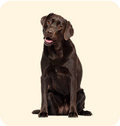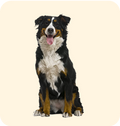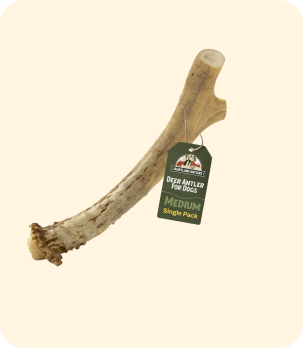
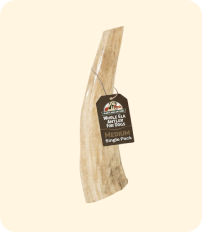

For a Boxer, start with comfortable eating, dental history and the way the dog uses an object. An underbite does not establish that a split antler is the correct chew. Whole and split antlers are hard materials that can damage teeth.
The useful question is what your own dog needs from an activity. A Boxer that carries a toy, plays with a person or leaves a chew may need different choices at different times. There is no need to make every activity end with antler chewing.
Check comfort before interpreting grip
A Boxer may hold an object between its paws, carry it or turn it in its mouth. Those observations do not measure tooth strength. They also do not prove that a particular jaw shape requires a flat antler surface.
Keep a simple record of changes: meals eaten normally, food dropped, interest in usual toys and any reluctance to touch the mouth. Report a new or persistent change to your veterinarian. Do not put an antler against the teeth to test whether the grip is comfortable.
Cornell explains that a fractured tooth may be found without a known injury event. Previous chewing without an obvious problem does not confirm that the teeth are healthy now.
If your Boxer walks away, allow that choice. Repeatedly adding flavor or holding the item for the dog can obscure the information you need. Interest in a flavored surface is not evidence that the hard material underneath is suitable.

Separate cut, dimensions and dental risk
Heartland's antler range includes whole elk, split elk and whole deer. A lengthwise split exposes more of the interior. It still retains hard material, including the outer surface. Exposed does not mean soft enough for the dog's teeth.
AAHA identifies hard antlers as a tooth-fracture concern. A large size, Grade A description or natural source does not remove that concern. Discuss suitability before using a size label to select a product.
Read the exact product dimensions and directions. Keep your dog's current measured weight available, but do not treat a typical Boxer weight as a substitute. A label describes a range of products; it does not assess your dog's mouth or behavior.
There is no fixed three- to six-week lifespan established for every Boxer. Nor does fast wear prove that a denser antler is the answer. Stop and reassess an item that becomes damaged, small enough to swallow or the focus of forceful biting.
Use the whole and split comparison for cut details and the size guide for label questions.

Give play a clear beginning and end
The AKC describes the Boxer as bright and alert. That broad description can suggest ways to engage with the dog. It cannot establish a chewing force, material choice or daily chewing time.
Try a short, familiar training task in a quiet area. Set aside any food rewards from the dog's daily allowance. Finish while the dog can still respond comfortably, then allow a rest. A predictable finish helps you observe whether the activity itself suits the dog.
For a food puzzle, start with a simple task and follow the device directions. Stay present. Stop if the dog tries to eat the device or becomes frustrated. Inspect flexible toys for loose or torn parts as well; an alternative material still needs appropriate selection and care.
Keep vigorous play and quiet rest as separate choices. Do not use a hard chew as a required step to make a dog settle after exercise. Persistent difficulty settling calls for attention to the wider routine and, where needed, professional advice.

Prepare the end of a session
Choose a space where you can remain present and other animals will not crowd the dog. Plan how an item will be collected before offering it. Avoid creating a chase game around a worn piece.
Do not force a guarded item from the mouth or punish a warning. Keep people and other animals away, and seek a safe management plan from a qualified professional. A different antler cut does not resolve guarding.
Inspect an item with the dog kept away. Check its full surface, dimensions and any loose parts. Discard damage or an uncertain small piece out of reach. Resting it on a shelf does not repair it.
For product facts, ask Heartland or view the current range. For mouth discomfort, breathing changes or a suspected swallowed object, contact your veterinarian promptly.

Frequently asked questions
Does a Boxer's underbite require a split antler?
No universal cut follows from an underbite. Comfort, teeth and actual behavior need individual assessment, and split antlers remain hard.
Should I encourage a Boxer that loses interest?
Let the dog stop. Consider other activities and report changes in eating or comfort rather than forcing engagement.
Is a larger antler better after rapid wear?
Rapid wear is a reason to remove the piece and reassess. Increasing size does not establish dental safety.
Can a puppy or senior Boxer use split deer?
Heartland's listed deer antlers are whole. Age alone does not establish that any hard antler is suitable; discuss an appropriate activity with your veterinarian.