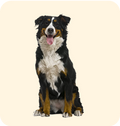

A Bernese Mountain Dog's large body does not tell you how it will use a chew. A quiet dog can still bite a hard object forcefully, and a gentle manner does not establish dental safety. Review the actual dog and the actual material before choosing an antler.
The AKC describes the Berner as a large working breed with an affectionate nature. Use that background to plan suitable interaction and activity, not to assign an untested “soft-mouth” antler formula.
Separate body size from chewing behavior
Weigh the dog and check the current product label. Then observe how the dog handles suitable existing toys: gentle mouthing, forceful biting, tearing or attempts to swallow parts. These are observations to share with the veterinarian, not tests to perform with a hard antler.
Do not size down because a large dog seems quiet or unmotivated. A smaller object can be easier to take fully into the mouth. Equally, a bigger object does not solve the dental risk of a hard material.
This guide does not have evidence that all Berners are low-force chewers or that an antler has a fixed lifespan for this breed. Use individual history instead of assuming that the breed name predicts pressure or wear.
Ask the clinic about missing or damaged teeth, previous swallowed objects, dietary restrictions and any change in comfort. Current health can matter more than the type of chew the dog used in the past.

Make the activity easy to access
Choose a stable area with room for the dog to stand, turn and settle. A comfortable mat can be useful for quiet activities. Avoid making the dog squeeze into a small corner to use a food puzzle or retrieve a toy.
If getting down, rising or moving around the activity looks difficult, stop and discuss the change with the veterinarian. Do not assume that longer chewing on a softer-looking surface will solve discomfort.
Choose opportunities for company, suitable movement and learning as well as quiet time. A brief search or measured-food activity can be adapted to the dog's comfort. It does not need to last for a prescribed number of minutes to be worthwhile.
With a large dog, also plan the space for people. Keep children out of the activity area and use secure separation from other pets around valued items. A calm household reputation is not proof that a dog will welcome interruption.

Compare cut and material without a guarantee
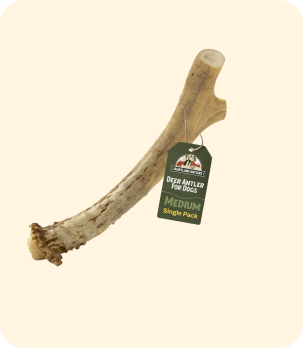
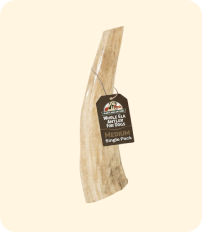
Heartland offers whole deer, whole elk and split elk. Split elk exposes the interior, but hard material remains. AAHA warns that antlers can fracture teeth.
A split piece is not an established dental-safe choice for Berners, puppies or seniors. Grade A and natural origin do not guarantee that a piece will resist damage or protect a tooth. Ask whether hard chewing is appropriate before choosing among antler forms.
There is no supported rule here that whole cuts fail to interest Berners or that split elk lasts four to eight weeks. Interest and wear vary. A dog that declines an object may simply prefer a different activity.
Do not refrigerate, soak or coat an antler to overcome refusal. Those changes do not answer whether the material is appropriate. Read our softening guide before relying on home preparation.

Observe, end and reassess the session
Stay present during any chewing activity. A dog that mouths an item quietly still needs observation. Check the actual piece before and after use for damage, loose parts or a size that could be swallowed.
Do not use your fist or a fixed muzzle-width rule as a universal cutoff. Do not put the piece in the mouth to test it. If condition or size is questionable, remove access and retire it out of reach.
Collect only when it is safe. A stiff posture, growling or guarding is a reason to keep people away and seek help, not reach in and insist. Our multi-dog guide covers planning around valued items.
Report new eating or chewing changes to the veterinarian. Contact the clinic promptly for a suspected swallowed piece or damaged tooth. Breathing trouble, collapse or severe distress needs emergency care.

Frequently asked questions
Should every Berner use large split elk?
No. A single cut and size cannot be assigned from breed alone. Check individual health, behavior, current weight and product details.
Does a gentle temperament reduce the need to supervise?
No. Quiet behavior does not remove hard-material or swallowing risks.
Why does my Berner ignore an antler?
Preference, context and health can all matter. Do not diagnose the cut as wrong from refusal alone. Report a new eating or chewing change.
Can I make a split antler last a certain number of weeks?
No verified breed-specific duration is available here. Condition and behavior determine when to stop.
See the current catalog for product facts and prepare with our veterinary checklist. Contact Heartland for details about a specific item.